
Bahrain In-vitro Diagnostic Market Size and Forecast by Product Type, Technology, Application, Disease Type, End User, and Distribution Channel: 2019-2033
Oct 2025
| Format:

 |
Pages: 110+
|
Type: Sub-Industry Report
|
Authors:
Mahesh Y
(Assistant Research Manager)
|
Pages: 110+
|
Type: Sub-Industry Report
|
Authors:
Mahesh Y
(Assistant Research Manager)
MARKET OUTLOOK
Bahrain In-Vitro Diagnostic Market Outlook: Insurance-Driven Momentum in a Compact Healthcare Arena
Open with Bahrain’s insurance-led expansion of orthopedic device adoption: Bahrain is actively shifting toward a more structured health insurance framework, which is strengthening the foundation for broader diagnostic utilization. The implementation of mandatory coverage for expatriates and expanded citizen benefits under the national insurance fund (SHIFA) are increasing access to diagnostics and screening. As coverage rises, demand for lab tests, imaging adjuncts, and advanced diagnostic instruments is expected to grow in tandem with service utilization.
We project the Bahrain In-Vitro Diagnostic (IVD) market to be approximately USD 29.0 million in 2025, reaching about USD 37.5 million by 2033. This growth is underpinned not solely by population growth but by deeper penetration of diagnostics into insured care pathways, rising chronic disease incidence, and modernization of health facilities. While the country is small in scale, its per-capita health expenditure and policy reforms provide a supportive backdrop for steady, sustainable diagnostic growth.
Drivers & Restraints: Compact System Strengths Remain Balanced by Scale Limits
Compact Health System, High Per-Capita Spend & Regional Patient Flows Fuel Uptake
Bahrain’s healthcare system, with nearly universal access for citizens and subsidized care for residents, is inherently compact and well-managed. The shift to mandatory insurance coverage, beginning with expatriates and moving to citizens, enhances utilization of diagnostic and screening services. The government’s investment in upgrading hospital infrastructure and medical equipment further drives procurement of analyzers, reagents, and software. Also, Bahrain’s positioning as a medical destination for niche services (such as precision diagnostics or second opinions) encourages inbound diagnostic referrals, modestly expanding market breadth.
Limited Scale, Central Procurement & Niche Private Sector Restrict Pace
However, Bahrain’s small population imposes a ceiling on diagnostic volume growth, making scale harder to achieve compared to larger GCC markets. Public procurement processes are heavily centralized, which can prolong tender cycles and limit the flexibility of diagnostic suppliers. The private sector, though growing, remains niche, many facilities still rely on referrals to centralized public labs. In addition, expectations on service quality and pricing pressure in lower-margin segments may inhibit uptake of very high-end systems beyond major hospitals.
Trends & Opportunities: Telehealth, Referral Bundles & Niche Clinics
Niche Private Clinics, Telemedicine & Cross-Border Referrals Reshaping Demand
An evolving trend within Bahrain IVD sector is the rise of boutique specialty clinics offering advanced diagnostic packages, often targeting expatriates and health-conscious locals. These clinics frequently link with telehealth platforms for post-test consults, reinforcing demand for rapid turnaround and digital reporting. Cross-border referrals, patients coming from nearby islands or smaller Gulf markets for specialized diagnostics, are also augmenting test volumes. The alignment of lab reporting systems with telehealth platforms is enabling continuity and value-added service.
Opportunities in Telehealth Follow-up, Specialty Bundles & Regional Collaboration
Because capital investments in full-scale lab systems may be less feasible in small markets, Bahrain presents opportunity for hybrid models: telehealth + remote lab partnerships, diagnostic bundles tied to specialty clinics, and outsourcing core diagnostics while focusing value-addive consultative services locally. For suppliers, collaborating with regional hubs (e.g., Dubai, GCC lab centers) to offer rapid logistics and service support can reduce cost barriers. Bundling diagnostics with orthopedic or cardiology services in referral trusts could create packaged revenue streams, leveraging insurance coverage to absorb incremental tests.
Competitive Landscape: Service Bundles, Tele-Collaborations & Training Focus
The Bahrain IVD market is dominated by global diagnostic firms, such as Roche Diagnostics, Abbott, Siemens Healthineers, operating via local distributors who also provide servicing, reagent supply, and training. Competitive advantage is increasingly derived not from raw instrumentation but from integrated service models: tele-reporting, reagent logistics, and local technical support. Given the small market size, firms offering managed diagnostics (leasing, reagent-based subscription models) or tele-lab partnerships will likely gain traction. Emphasis on training local technologists under NHRA accreditation builds sustainability and credibility in vendor partnerships.
*Research Methodology: This report is based on DataCube’s proprietary 3-stage forecasting model, combining primary research, secondary data triangulation, and expert validation.
[Learn more]
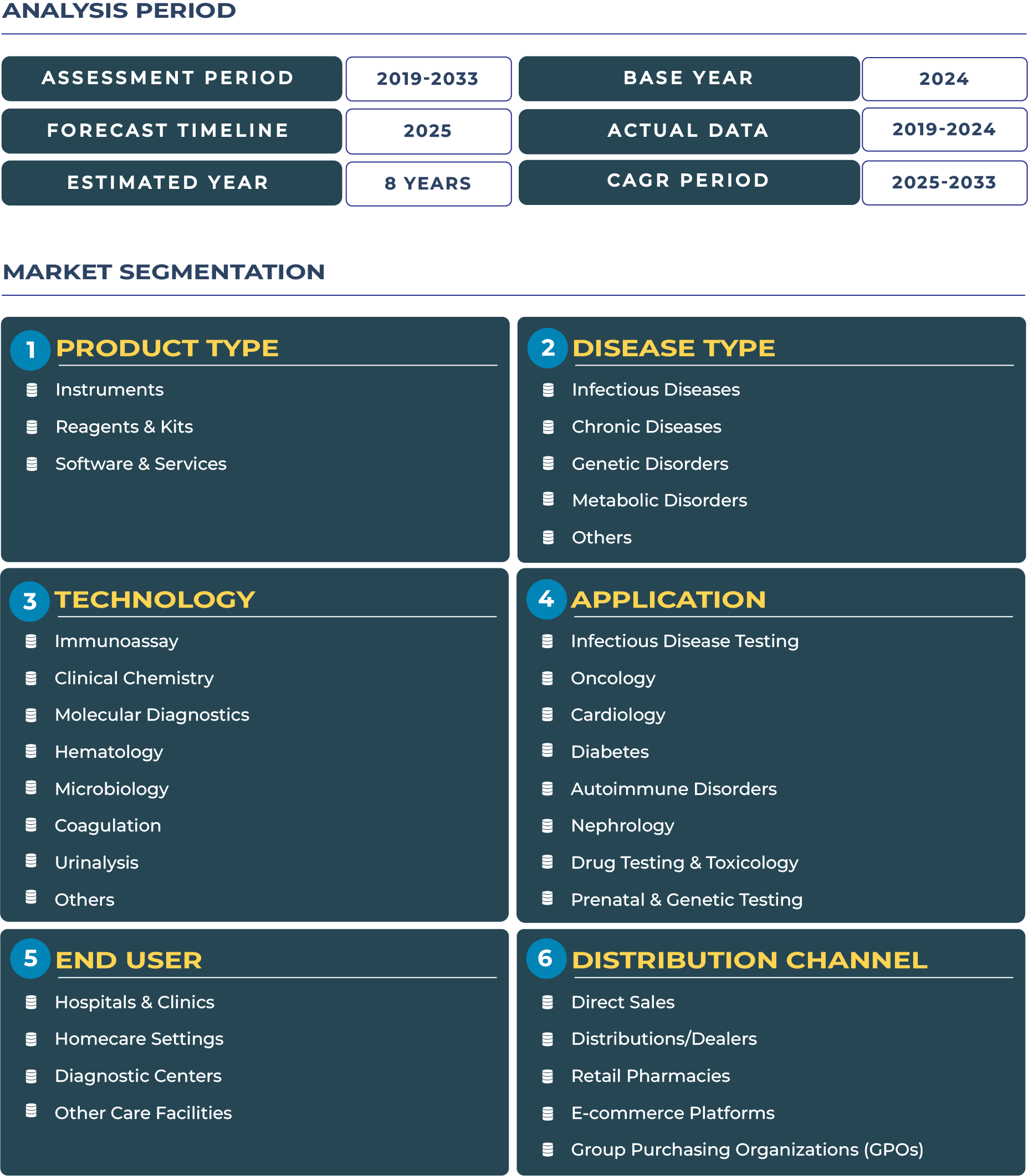
Bahrain In-vitro Diagnostic Market Segmentation
Frequently Asked Questions
Greater insurance coverage reduces out-of-pocket barriers, increasing patient access to routine and advanced diagnostic tests. This expands the role of diagnostics in preventive and chronic care pathways.
The small market scale limits economies of scale, making high-cost diagnostic and implant technologies harder to rationalize beyond major hospital centers.
Private and specialty clinics, especially those serving expatriates and niche services, are creating premium demand for diagnostics. They often adopt partnerships with global IVD firms for service and telehealth integration.
Related Reports

Saudi Arabia SaaS Market Size | 2019-2034
- Report ID: IT1862 | Coverage: Country |
- Category: Information Technology | Sub-Category: Cloud Computing Technology |
- Published Date: Dec 2025 | US$495 |
China Private Banking Market Size | 2019-2033
- Report ID: BAF924 | Coverage: Country |
- Category: Banking and Finance | Sub-Category: Banking Services |
- Published Date: Oct 2025 | US$495 |
Nigeria Private Banking Market Size | 2019-2033
- Report ID: BAF985 | Coverage: Country |
- Category: Banking and Finance | Sub-Category: Banking Services |
- Published Date: Nov 2025 | US$495 |
BRICS AI Service Robotics Market Size | 2019-2033
- Report ID: IT1944 | Coverage: Regional |
- Category: Information Technology | Sub-Category: Artificial Intelligence |
- Published Date: Dec 2025 | US$1,345 |
Saudi Arabia SaaS Market Size | 2019-2034
- Report ID: IT1862 | Coverage:Country |
- Category:Information Technology | Sub-Category: Cloud Computing Technology |
- Published Date: Dec 2025 |US$495 |
China Private Banking Market Size | 2019-2033
- Report ID: BAF924 | Coverage:Country |
- Category:Banking and Finance | Sub-Category: Banking Services |
- Published Date: Oct 2025 |US$495 |
Nigeria Private Banking Market Size | 2019-2033
- Report ID: BAF985 | Coverage:Country |
- Category:Banking and Finance | Sub-Category: Banking Services |
- Published Date: Nov 2025 |US$495 |
BRICS AI Service Robotics Market Size | 2019-2033
- Report ID: IT1944 | Coverage:Regional |
- Category:Information Technology | Sub-Category: Artificial Intelligence |
- Publishing Soon |US$1,345 |
Why Choose Us

24/5 Research Support
Get your queries resolved prior to and post purchasing research study

Customize As Per Specific Requirements
Get in-depth analysis based on your tailored research needs

Expertise in Tracking Niche Markets
Comprehensive view of latest technologies and opportunities across markets

360-Degree Analysis
Fact-based insights derived through supply & demand side analysis

Assured Quality
Deliver most accurate industry insights to maintain research quality

Information Security
Your confidential and personal data is secure and safe