
Bahrain Orthopedic Devices Market Size and Forecast by Product Type, End User, Distribution Channel, and Patient Demographics: 2019-2033
Oct 2025
| Format:

 |
Pages: 110+
|
Type: Sub-Industry Report
|
Authors:
Mahesh Y
(Assistant Research Manager)
|
Pages: 110+
|
Type: Sub-Industry Report
|
Authors:
Mahesh Y
(Assistant Research Manager)
MARKET OUTLOOK
Bahrain Orthopedic Devices Market: Insurance-Led Pathway to Accessible Orthopedic Care
The Bahrain orthopedic devices market is entering a growth phase shaped by the increasing role of insurance-driven healthcare financing. With a compact yet high-performing health system, Bahrain has aligned medical coverage policies to improve patient access to specialized care, including orthopedic treatments. The government’s reforms under the National Health Regulatory Authority have broadened coverage, ensuring that orthopedic procedures once considered financially burdensome are now increasingly affordable. This insurance-backed momentum is reshaping demand for trauma fixation devices, spinal implants, and arthroscopy tools, particularly within hospital networks and specialized clinics.
As Bahrain intensifies its healthcare reforms, insurance penetration emerges as the cornerstone of market expansion. The orthopedic devices industry in Bahrain is forecasted to grow from USD 12.5 million in 2025 to USD 18.4 million by 2033, at a CAGR of 5.0%. This trajectory is fueled by the government’s push to integrate universal health insurance and its efforts to attract foreign expertise for specialized medical care. Patients increasingly view orthopedic procedures as accessible, thanks to insurance subsidies covering joint reconstruction devices and prosthetics. Additionally, Bahrain’s strategic healthcare positioning in the Gulf Cooperation Council (GCC) draws regional patients, adding demand beyond its population base. This shift ensures consistent utilization of orthopedic products across both public and private hospitals, anchoring market stability and signaling sustained growth across the forecast period.
Drivers & Restraints: Understanding the Balancing Forces in Bahrain Orthopedic Devices Ecosystem
Compact Health System and Regional Patient Flows Driving Growth
The orthopedic devices landscape in Bahrain benefits from its compact yet highly concentrated healthcare infrastructure. Hospitals and specialty centers in Manama act as regional hubs for advanced procedures, attracting patients from neighboring countries seeking efficient and affordable orthopedic care. High per-capita health spending further supports access to premium devices, particularly in trauma fixation and spinal surgery. Moreover, regional patient flows create demand stability, with Bahrain’s orthopedic sector serving as a niche but high-value market within the GCC.
Scale Limitations and Centralized Procurement Slowing Momentum
Despite strong drivers, the orthopedic devices sector in Bahrain faces limitations that hinder scalability. The country’s small population base reduces total device volumes compared to larger regional markets. Additionally, procurement processes remain centralized through public channels, limiting the agility of private healthcare providers in adopting cutting-edge prosthetics or orthobiologics. With the private sector accounting for a relatively small share of overall care delivery, growth opportunities are sometimes constrained, particularly outside Manama where device adoption lags due to fewer specialized facilities. These restraints highlight the need for flexible financing and leasing models to expand device adoption in a controlled market environment.
Trends & Opportunities: Emerging Shifts Creating New Market Channels
Niche Private Clinics and Telemedicine Transforming Orthopedic Care
One of the most significant trends in Bahrain orthopedic devices industry is the emergence of niche specialty clinics focusing on sports injuries and joint care. These clinics prioritize minimally invasive treatments supported by arthroscopy devices and modern prosthetic solutions. Complementing this, telemedicine adoption is growing rapidly, with orthopedic consultations and post-surgery monitoring increasingly integrated into virtual platforms. Cross-border referrals, particularly from Saudi Arabia, are also strengthening Bahrain’s role as a treatment hub for orthopedic services, reinforcing device demand in selective hospital and clinic networks.
Telehealth Follow-Up Services and Specialty Clinics Offering Untapped Potential
The Bahrain orthopedic devices market holds opportunities in telehealth and niche specialty expansions. Pilot projects that integrate telehealth for post-operative care reduce follow-up costs and improve long-term device outcomes. Meanwhile, specialty clinics focusing on knee reconstruction and spinal alignment are exploring bundled packages for cross-border patients, combining surgical treatment with follow-up rehabilitation. These strategies not only boost the uptake of prosthetics and spinal devices but also ensure that Bahrain leverages its insurance-backed system to maximize patient inflows and device utilization.
Competitive Landscape: Strategic Moves Redefining Bahrain Orthopedic Devices Market
The orthopedic devices ecosystem in Bahrain features both multinational companies and local distributors aligning to meet insurance-driven demand. Global leaders such as Smith+Nephew maintain a presence in the region, supplying advanced arthroscopy and joint reconstruction systems. Local distributors play a crucial role in bridging procurement processes with the public sector, often through partnerships that bundle telehealth follow-ups and financing solutions. Emerging strategies include offering flexible leasing options for high-value spinal devices and establishing niche clinics in Manama to focus on specialized procedures. These developments signal an adaptive approach where market participants align with Bahrain’s unique insurance-led healthcare structure to sustain competitive advantage.
*Research Methodology: This report is based on DataCube’s proprietary 3-stage forecasting model, combining primary research, secondary data triangulation, and expert validation.
[Learn more]
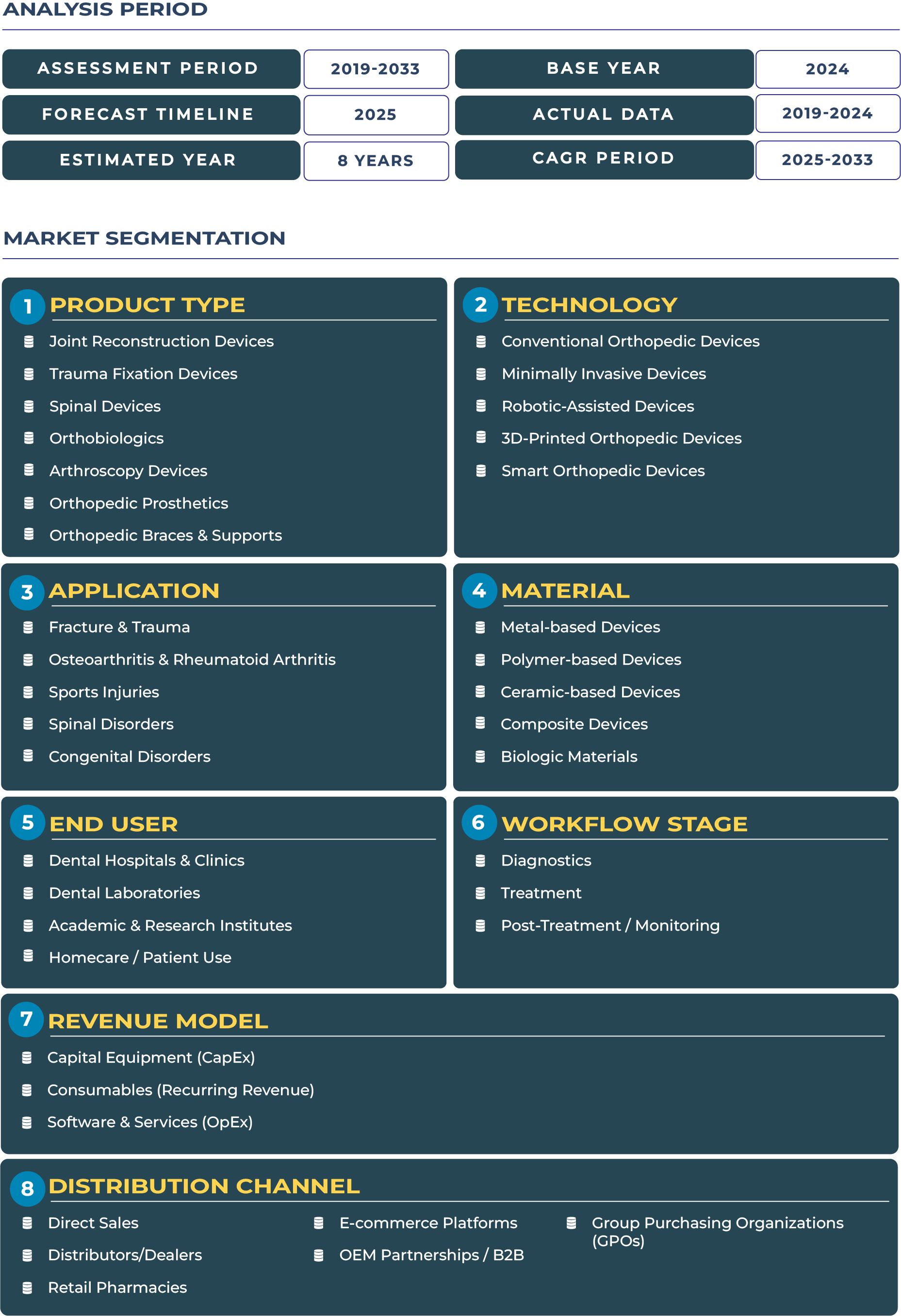
Bahrain Orthopedic Devices Market Segmentation
Frequently Asked Questions
Insurance reforms ensure affordability, making orthopedic surgeries more accessible and boosting device adoption across public and private facilities.
Limited population scale, centralized procurement, and a relatively small private sector restrict supply volumes and slow the adoption of advanced devices.
Private hospitals, though smaller in number, are pioneering niche orthopedic care, leveraging telehealth and specialty clinics to expand access and drive demand for advanced devices.
Related Reports

Saudi Arabia SaaS Market Size | 2019-2034
- Report ID: IT1862 | Coverage: Country |
- Category: Information Technology | Sub-Category: Cloud Computing Technology |
- Published Date: Dec 2025 | US$495 |
China Private Banking Market Size | 2019-2033
- Report ID: BAF924 | Coverage: Country |
- Category: Banking and Finance | Sub-Category: Banking Services |
- Published Date: Oct 2025 | US$495 |
Nigeria Private Banking Market Size | 2019-2033
- Report ID: BAF985 | Coverage: Country |
- Category: Banking and Finance | Sub-Category: Banking Services |
- Published Date: Nov 2025 | US$495 |
BRICS AI Service Robotics Market Size | 2019-2033
- Report ID: IT1944 | Coverage: Regional |
- Category: Information Technology | Sub-Category: Artificial Intelligence |
- Published Date: Dec 2025 | US$1,345 |
Saudi Arabia SaaS Market Size | 2019-2034
- Report ID: IT1862 | Coverage:Country |
- Category:Information Technology | Sub-Category: Cloud Computing Technology |
- Published Date: Dec 2025 |US$495 |
China Private Banking Market Size | 2019-2033
- Report ID: BAF924 | Coverage:Country |
- Category:Banking and Finance | Sub-Category: Banking Services |
- Published Date: Oct 2025 |US$495 |
Nigeria Private Banking Market Size | 2019-2033
- Report ID: BAF985 | Coverage:Country |
- Category:Banking and Finance | Sub-Category: Banking Services |
- Published Date: Nov 2025 |US$495 |
BRICS AI Service Robotics Market Size | 2019-2033
- Report ID: IT1944 | Coverage:Regional |
- Category:Information Technology | Sub-Category: Artificial Intelligence |
- Publishing Soon |US$1,345 |
Why Choose Us

24/5 Research Support
Get your queries resolved prior to and post purchasing research study

Customize As Per Specific Requirements
Get in-depth analysis based on your tailored research needs

Expertise in Tracking Niche Markets
Comprehensive view of latest technologies and opportunities across markets

360-Degree Analysis
Fact-based insights derived through supply & demand side analysis

Assured Quality
Deliver most accurate industry insights to maintain research quality

Information Security
Your confidential and personal data is secure and safe