
Benelux Orthopedic Devices Market Size and Forecast by Product Type, End User, Distribution Channel, and Patient Demographics: 2019-2033
Oct 2025
| Format:

 |
Pages: 110+
|
Type: Sub-Industry Report
|
Authors:
Mahesh Y
(Assistant Research Manager)
|
Pages: 110+
|
Type: Sub-Industry Report
|
Authors:
Mahesh Y
(Assistant Research Manager)
MARKET OUTLOOK
Benelux as a Gateway for Medtech Innovation: An Emerging Orthopedic Devices Market
Benelux—comprising Belgium, the Netherlands, and Luxembourg—has historically positioned itself as a strategic entry point for healthcare and medtech innovation into Europe. The region combines strong clinical infrastructure, advanced hospital systems, and favorable regulatory environments, making it a preferred destination for early-stage clinical testing and technology adoption. For orthopedic devices, Benelux has emerged as a critical testing ground for advanced joint reconstruction, spinal interventions, and minimally invasive trauma fixation devices. In 2025, the Benelux orthopedic devices market is estimated at USD 958.9 million and is projected to reach USD 1,371.1 million by 2033, reflecting a CAGR of 4.6% from 2025 to 2033. This sustained growth underscores the region’s role as both a commercial and innovation hub, driven by its healthcare modernization, cross-border collaboration, and emphasis on high-value medical technologies.
Why Benelux Orthopedic Devices Market Signals Stronger Innovation Gateway to Europe
The orthopedic devices market in Benelux demonstrates consistent upward momentum fueled by multiple healthcare and economic drivers. Belgium is home to a cluster of academic hospitals with global recognition for orthopedic surgeries, while the Netherlands leads in digital health adoption and value-based care, and Luxembourg supports a robust medical technology ecosystem through favorable investment frameworks. Together, they create a synergistic regional ecosystem that strengthens orthopedic device adoption. Despite geopolitical uncertainties and post-pandemic budget pressures, the region’s high per-capita healthcare spending continues to drive adoption of advanced devices, particularly in arthroscopy devices and orthopedic prosthetics. Furthermore, national health authorities in Belgium and the Netherlands have invested in outcome registries, which serve as powerful enablers of evidence-based purchasing decisions. The market’s expansion reflects the region’s unique positioning as a low-risk, high-value entry point for global medtech companies targeting wider European adoption.
Drivers & Restraints: Key Forces Shaping the Benelux Orthopedic Devices Landscape
High per-capita healthcare spend and advanced registry systems fueling adoption
The Benelux region maintains one of the highest healthcare expenditures per capita in Europe, according to Eurostat. This economic strength enables hospitals to procure advanced spinal devices, orthobiologics, and cutting-edge robotic-assisted surgical systems. Belgium’s orthopedic surgery registries, such as hip and knee replacement databases, allow for quality assurance and data-driven clinical decision-making. This system supports manufacturers in demonstrating cost-effectiveness and clinical superiority of advanced implants, driving faster uptake. The appetite for early adoption has been particularly visible in Dutch university hospitals, where robotic-assisted arthroscopy pilots are shaping best practices for minimally invasive surgeries.
Cross-border procurement challenges and price sensitivity limiting market scalability
Despite growth drivers, several structural constraints slow down scaling in the Benelux orthopedic devices industry. As three relatively small yet fragmented healthcare markets, Benelux countries often experience inefficiencies in cross-border procurement. Hospitals in Luxembourg, for example, rely on imports from Belgium and Germany, leading to procurement complexity and delays. Moreover, national reimbursement systems exhibit price sensitivity, pushing buyers to prioritize cost-effective trauma fixation devices over premium-priced implants. With health systems recovering from the fiscal strain of the COVID-19 pandemic, budgetary pressure remains a significant restraint, forcing manufacturers to adapt with more transparent value-based pricing strategies.
Trends & Opportunities: How Early Adopter Clinics and Regional Collaborations Define Future Growth
Emergence of early adopter clinics and cross-border patient flows strengthening demand
Benelux hospitals often function as European pioneers in testing new orthopedic technologies, creating a culture of early adoption. Dutch clinics have been among the first to trial advanced orthopedic prosthetics with sensor integration, while Belgian hospitals attract cross-border patients from France and Germany seeking complex joint reconstruction procedures. Patient mobility across borders, supported by EU healthcare agreements, accelerates the diffusion of innovation and expands the market footprint of orthopedic device providers.
Expanding opportunities through robotics pilots and pan-Benelux procurement alliances
Robotics-assisted orthopedic surgeries are at the frontier of opportunity in Benelux. Hospitals in Brussels and Amsterdam are piloting robotics programs for knee and spinal procedures, supported by academic partnerships and private funding. In addition, discussions around pan-Benelux purchasing consortia are gaining traction, with the potential to harmonize procurement and create scale for orthopedic devices suppliers. Key opinion leaders (KOLs) across Belgian and Dutch medical societies are increasingly publishing outcome-based studies, influencing adoption across broader European orthopedic markets and amplifying the role of Benelux as a trend-setting hub.
Competitive Landscape: Strategic Moves Redefining Orthopedic Devices Market Positioning
The Benelux orthopedic devices ecosystem is highly competitive, featuring global players such as Stryker, Zimmer Biomet, and Johnson & Johnson’s DePuy Synthes, alongside local innovators. Recent strategies include flagship hospital installations that serve as proof points for national rollouts. For instance, Dutch hospitals initiated pilot installations of robotic joint reconstruction systems in 2024, accelerating adoption among regional centers. Similarly, Belgium’s partnerships with orthopedic research institutes have facilitated outcome publications that directly influence reimbursement authorities. International companies are also leveraging cross-border centers to maximize economies of scale, while local players benefit from niche innovations in trauma fixation and customized orthobiologics. This competitive dynamic is reshaping procurement decisions, ensuring that the Benelux orthopedic devices industry continues to attract investment and technological advancements.
*Research Methodology: This report is based on DataCube’s proprietary 3-stage forecasting model, combining primary research, secondary data triangulation, and expert validation.
[Learn more]
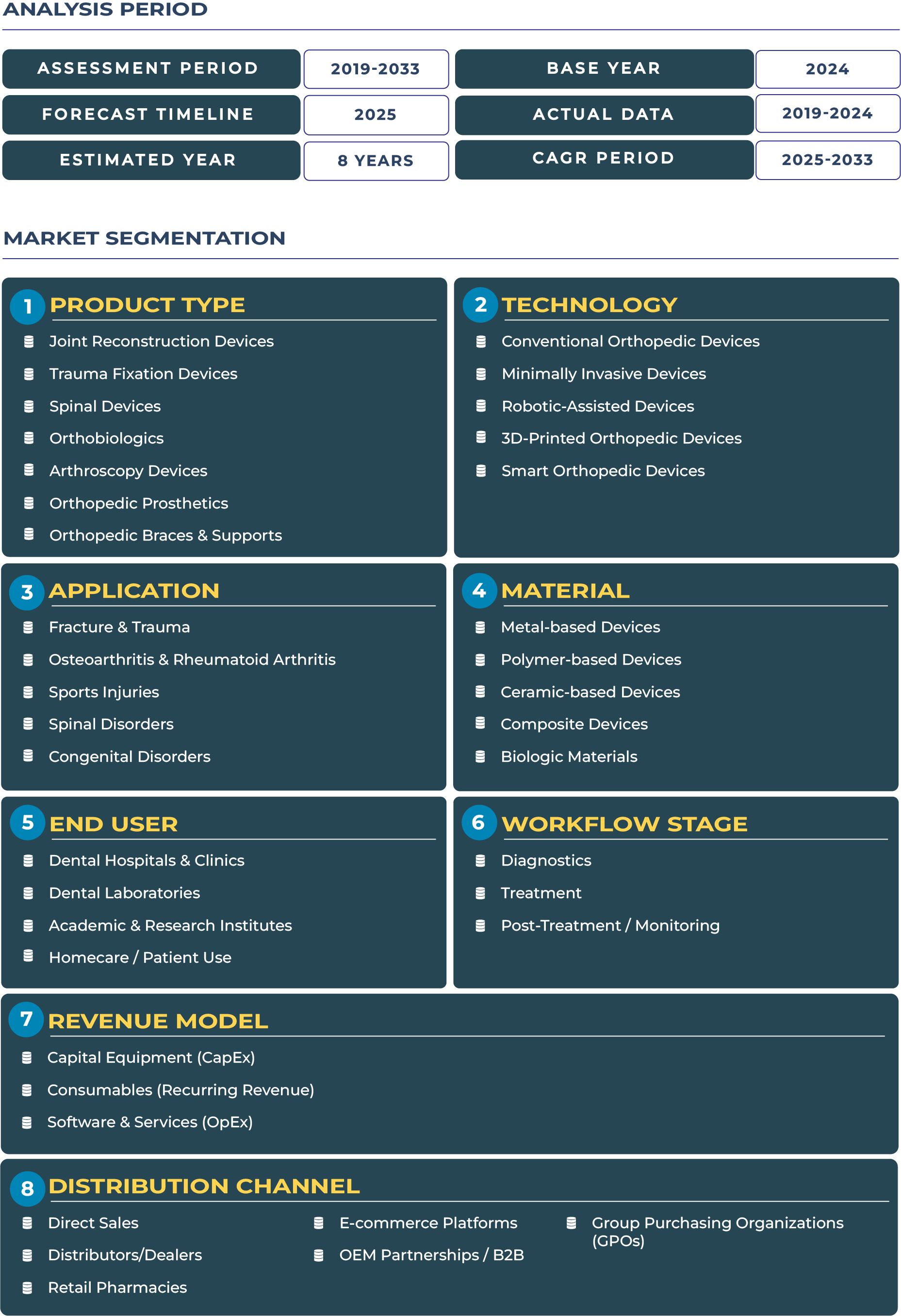
Benelux Orthopedic Devices Market Segmentation
Frequently Asked Questions
Benelux serves as an innovation hub due to its advanced healthcare systems, clinical trial ecosystem, and cross-border patient mobility, making it a low-risk, high-value entry point into the European orthopedic devices market.
Startups face procurement complexity, fragmented reimbursement systems, and price sensitivity, requiring them to demonstrate strong clinical outcomes and cost-effectiveness to achieve scale in Benelux.
Academic hospitals in Belgium and the Netherlands run advanced trials, producing evidence that supports faster adoption and helps companies expand into broader European markets.
Related Reports

Zimbabwe SaaS Market Size | 2019-2034
- Report ID: IT1872 | Coverage: Country |
- Category: Information Technology | Sub-Category: Cloud Computing Technology |
- Published Date: Dec 2025 | US$495 |
Taiwan Investment Banking Market Size | 2019-2033
- Report ID: BAF864 | Coverage: Country |
- Category: Banking and Finance | Sub-Category: Banking Services |
- Published Date: Oct 2025 | US$495 |
Bahrain Rural Banking Market Size | 2019-2033
- Report ID: BAF964 | Coverage: Country |
- Category: Banking and Finance | Sub-Category: Banking Services |
- Published Date: Oct 2025 | US$495 |
Argentina Diagnostic Imaging Devices Market Size | 2019-2033
- Report ID: HEA350 | Coverage: Country |
- Category: Healthcare | Sub-Category: Medical Devices |
- Published Date: Nov 2025 | US$495 |
Zimbabwe SaaS Market Size | 2019-2034
- Report ID: IT1872 | Coverage:Country |
- Category:Information Technology | Sub-Category: Cloud Computing Technology |
- Published Date: Dec 2025 |US$495 |
Taiwan Investment Banking Market Size | 2019-2033
- Report ID: BAF864 | Coverage:Country |
- Category:Banking and Finance | Sub-Category: Banking Services |
- Published Date: Oct 2025 |US$495 |
Bahrain Rural Banking Market Size | 2019-2033
- Report ID: BAF964 | Coverage:Country |
- Category:Banking and Finance | Sub-Category: Banking Services |
- Published Date: Oct 2025 |US$495 |
Argentina Diagnostic Imaging Devices Market Size | 2019-2033
- Report ID: HEA350 | Coverage:Country |
- Category:Healthcare | Sub-Category: Medical Devices |
- Published Date: Nov 2025 |US$495 |
Why Choose Us

24/5 Research Support
Get your queries resolved prior to and post purchasing research study

Customize As Per Specific Requirements
Get in-depth analysis based on your tailored research needs

Expertise in Tracking Niche Markets
Comprehensive view of latest technologies and opportunities across markets

360-Degree Analysis
Fact-based insights derived through supply & demand side analysis

Assured Quality
Deliver most accurate industry insights to maintain research quality

Information Security
Your confidential and personal data is secure and safe