
Brazil Fintech Market Size and Forecast by Fintech Services, Technology, Revenue Model, and End User: 2019-2033
Sep 2025
| Format:

 |
Pages: 110+
|
Type: Industry Report
|
Authors:
Jayson Gomes
(Manager – BFSI)
|
Pages: 110+
|
Type: Industry Report
|
Authors:
Jayson Gomes
(Manager – BFSI)
MARKET OUTLOOK
Brazil America Market Outlook: Super-App Finance and PIX-Powered Inclusion: Brazil’s Fintech Frontier
Brazil has emerged as Latin America fintech powerhouse, where PIX real-time payment rails and the rise of super-app ecosystems are redefining the financial landscape. Launched by the Central Bank of Brazil, PIX has achieved unprecedented adoption, enabling millions of consumers and merchants to bypass traditional banking barriers. The integration of PIX into daily commerce is now catalyzing new opportunities across digital lending, embedded insurance, and investment services. At the same time, fintech super-apps are expanding from simple transactions to multi-service financial ecosystems, transforming how Brazilians save, borrow, invest, and insure themselves.
The Brazil fintech market is projected to grow from USD 14.4 billion in 2025 to USD 31.7 billion by 2033, reflecting a CAGR of 10.3% during 2025–2033 (DataCube Research). This momentum is supported by a combination of large-scale digital adoption, e-commerce expansion, and rising consumer demand for cost-effective financial alternatives. With more than 70% of Brazilians owning smartphones and growing appetite for mobile-first solutions, fintech players are positioned to reshape Brazil’s financial inclusion narrative in the decade ahead.
Unprecedented Domestic Scale and Rising Digital Payments Propel Growth
Brazil’s large domestic market, characterized by over 215 million people, provides fintechs with unmatched scale for product innovation. The rapid adoption of PIX has positioned Brazil as a global leader in real-time payments. In 2024, PIX processed more than 40% of all electronic transactions in the country, displacing debit and credit card usage in many urban centers. Fintechs are capitalizing on this adoption by layering services such as micro-loans, installment credit, and investment wallets on top of PIX rails. Major cities like São Paulo and Rio de Janeiro are now fintech innovation hubs, driving cross-sector adoption of new payment models and marketplace integrations.
On the other hand, high domestic e-commerce growth further amplifies this trajectory. Online shopping volumes surged by 20% in 2024, creating demand for instant settlement mechanisms and low-cost credit options. This synergy between digital commerce and fintech-enabled transactions creates a fertile environment for Brazil’s fintech ecosystem to thrive.
Complex Taxation and Rising Interest Rates Challenge Market Expansion
Despite strong momentum, the Brazil fintech industry faces significant structural challenges. High interest rates, which exceeded 10% in 2024, limit consumer affordability for credit-based fintech services. At the same time, Brazil’s complex tax regime creates hurdles for scaling fintech operations, particularly for startups attempting to balance profitability with compliance costs. Cross-border fintech players also face added operational expenses due to currency volatility and taxation on digital services.
Moreover, macroeconomic uncertainty tied to political transitions continues to create investor caution. The 2024 fiscal tightening policies, though aimed at stabilizing inflation, constrained credit availability for SMEs—limiting demand for lending tech and impacting the scalability of credit-focused fintechs. These challenges underline the need for policy simplification and greater collaboration between regulators and industry participants to sustain long-term fintech growth.
Neobanks, PIX Expansion, and Embedded Finance Redefine Consumer Engagement
The most prominent trend shaping Brazil fintech landscape is the exponential growth of neobanks. Digital-first banks now account for a significant portion of new account openings, offering zero-fee services that undercut traditional banking fees. Platforms such as Nubank are not only redefining consumer banking but also creating embedded opportunities in lending, wealth management, and insurance distribution. In parallel, PIX’s expansion into installment payments, scheduled transfers, and merchant-focused features is opening new revenue streams for fintechs and merchants alike.
Embedded finance within super-apps is also accelerating. Brazilian consumers increasingly prefer integrated solutions where payments, lending, and investment services are bundled in one application. This trend reflects a broader shift toward customer-centric ecosystems where user convenience and cost efficiency drive adoption.
Untapped Opportunities in SME Digital Credit and Merchant Services
While consumer fintech adoption dominates headlines, the untapped SME segment offers one of the most significant growth opportunities. SMEs, which account for nearly 30% of Brazil GDP, often struggle with limited access to formal credit. Fintechs are filling this gap through digital credit platforms that provide faster approval, lower collateral requirements, and data-driven lending models. The integration of PIX into SME merchant services further strengthens this opportunity, enabling instant payments, better liquidity, and digital invoicing solutions.
Additionally, opportunities in digital wealth management are expanding as rising middle-class consumers seek inflation-hedged investment options. Robo-advisory platforms and micro-investment solutions are becoming more attractive, offering democratized access to financial planning for underserved populations.
PIX Regulations and Policy Support Transforming Market Dynamics
Brazil fintech market is deeply shaped by regulatory frameworks led by the Central Bank of Brazil. The bank proactive role in launching and expanding PIX has positioned regulation not as a barrier but as a key enabler of fintech innovation. The phased rollout of new PIX functionalities—including recurring payments and chargeback rules—demonstrates regulator-industry alignment in fostering secure and scalable adoption. However, fintechs must remain adaptive to evolving tax and compliance measures that add layers of operational complexity.
Collaborative regulatory initiatives are also paving the way for future fintech integration with open banking and open finance frameworks. These initiatives are expected to boost competition, lower costs, and encourage innovation in credit, insurance, and wealthtech services.
Key Market Drivers: PIX Transactions and Lending Tech Acceleration
Two key factors are shaping Brazil fintech trajectory. First, PIX transaction volumes, which surpassed 40 billion in 2024, continue to accelerate fintech monetization opportunities. Second, lending tech innovation is reshaping credit distribution models, as data-driven underwriting expands access for underbanked consumers. Together, these factors create a dual engine of growth, ensuring Brazil remains a benchmark for fintech adoption in emerging markets. Notably, fintech credit issuance to SMEs grew 15% year-on-year in 2024, underlining its growing relevance in national economic resilience.
Competitive Landscape: PIX as the Catalyst for Product Expansion and Partnerships
Brazil fintech competition is intensifying, led by both local and international players. Nubank, Inter, and C6 Bank are aggressively leveraging PIX to expand their ecosystem offerings, from credit products to insurance distribution. In September 2024, a study revealed that PIX is expected to overtake credit cards in e-commerce soon, highlighting its disruptive impact on traditional payment rails. Startups are also capitalizing on this trend, building merchant tools and invoice platforms around PIX to increase digital payment adoption across e-commerce and retail sectors.
Partnerships between fintechs and regulators are becoming a critical success factor. Aligning with the Central Bank to shape merchant and consumer protections within PIX is not only boosting consumer confidence but also driving higher acceptance rates among businesses. As investment inflows into Brazilian fintechs continue, the competitive landscape is shifting toward ecosystem plays where scale, trust, and partnerships define market leadership.
Conclusion: Brazil Fintech Evolution Through PIX and Ecosystem Integration
Brazil fintech sector is no longer confined to payments but is evolving into a multi-service financial ecosystem driven by PIX rails and super-app integration. While macroeconomic headwinds such as high interest rates and complex taxation persist, Brazil’s unique blend of innovation, regulation, and consumer adoption positions it as a global case study in financial digitization. The fusion of neobanks, digital lending, and merchant services under PIX-powered infrastructure reflects a structural transformation of how financial services are delivered in Brazil.
Looking ahead, the sector success will hinge on sustained regulatory alignment, scalability of SME-focused solutions, and innovation in wealthtech and insurtech. Brazil fintech evolution underscores the potential for emerging markets to leapfrog legacy banking models, enabling financial access, efficiency, and resilience at scale. The next decade will define Brazil not only as Latin America fintech leader but also as a global reference point for digitally inclusive finance.
*Research Methodology: This report is based on DataCube’s proprietary 3-stage forecasting model, combining primary research, secondary data triangulation, and expert validation.
[Learn more]
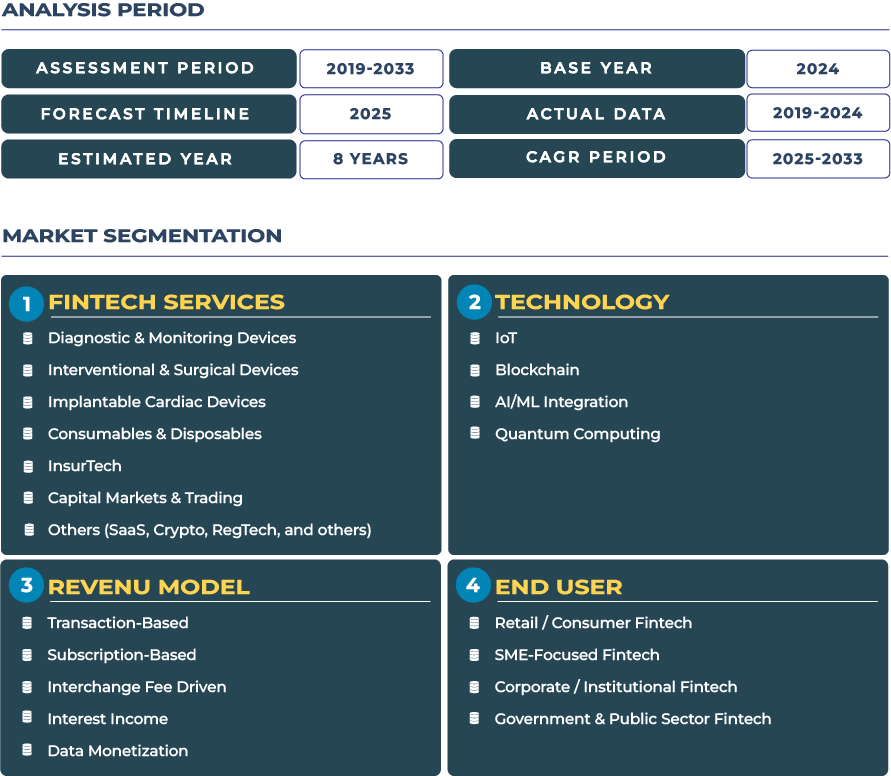
Brazil Fintech Market Segmentation
Frequently Asked Questions
PIX enables instant settlement of premiums, improving insurer liquidity and customer convenience, while reducing transaction costs compared to card-based payments.
Neobanks integrate micro-insurance into digital accounts, democratizing access and embedding risk protection directly into consumer financial journeys.
Complex tax and compliance rules increase operational costs for insurtechs, but regulatory innovation around PIX and open banking creates scalable opportunities.
Related Reports

South Korea Generative AI ASICs Market Size | 2019-2033
- Report ID: SEM252 | Coverage: Country |
- Category: Semiconductors | Sub-Category: AI Chips |
- Published Date: Dec 2025 | US$495 |
Mexico Medical Device Market Size | 2019-2033
- Report ID: HEA26 | Coverage: Country |
- Category: Healthcare | Sub-Category: Medical Devices |
- Published Date: Feb 2026 | US$495 |
Latin America Media Market Size | 2019-2033
- Report ID: MAE40 | Coverage: Regional |
- Category: Media and Entertainment | Sub-Category: Media |
- Published Date: May 2025 | US$1,345 |
Poland Rural Banking Market Size | 2019-2033
- Report ID: BAF913 | Coverage: Country |
- Category: Banking and Finance | Sub-Category: Banking Services |
- Published Date: Oct 2025 | US$495 |
South Korea Generative AI ASICs Market Size | 2019-2033
- Report ID: SEM252 | Coverage:Country |
- Category:Semiconductors | Sub-Category: AI Chips |
- Publishing Soon |US$495 |
Mexico Medical Device Market Size | 2019-2033
- Report ID: HEA26 | Coverage:Country |
- Category:Healthcare | Sub-Category: Medical Devices |
- Published Date: Feb 2026 |US$495 |
Latin America Media Market Size | 2019-2033
- Report ID: MAE40 | Coverage:Regional |
- Category:Media and Entertainment | Sub-Category: Media |
- Published Date: May 2025 |US$1,345 |
Poland Rural Banking Market Size | 2019-2033
- Report ID: BAF913 | Coverage:Country |
- Category:Banking and Finance | Sub-Category: Banking Services |
- Published Date: Oct 2025 |US$495 |
Why Choose Us

24/5 Research Support
Get your queries resolved prior to and post purchasing research study

Customize As Per Specific Requirements
Get in-depth analysis based on your tailored research needs

Expertise in Tracking Niche Markets
Comprehensive view of latest technologies and opportunities across markets

360-Degree Analysis
Fact-based insights derived through supply & demand side analysis

Assured Quality
Deliver most accurate industry insights to maintain research quality

Information Security
Your confidential and personal data is secure and safe