
BRICS In-vitro Diagnostic Market Size and Forecast by Product Type, Technology, Application, Disease Type, End User, and Distribution Channel: 2019-2033
Oct 2025
| Format:

 |
Pages: 160+
|
Type: Sub-Industry Report
|
Authors:
Mahesh Y
(Assistant Research Manager)
|
Pages: 160+
|
Type: Sub-Industry Report
|
Authors:
Mahesh Y
(Assistant Research Manager)
MARKET OUTLOOK
BRICS as Demand Engines: Population Scale and Diagnostic Imperatives Fuel Growth
The BRICS bloc, Brazil, Russia, India, China, South Africa, represents a formidable driver of global in-vitro diagnostic (IVD) demand, driven by demographic scale, rising chronic disease prevalence, and expanding healthcare access. These countries command significant patient volumes that require diagnostics across infectious, metabolic, oncology, and cardiovascular care pathways. In 2025, the BRICS IVD market is projected at USD 10.76 Billion, expanding to USD 16.92 billion by 2033 at a compound annual growth rate (CAGR) of 5.8%. This growth reflects their evolving healthcare systems, greater funding allocations, and a push toward diagnostic self-reliance in the face of geopolitical realignment and supply chain pressures.
BRICS IVD Market Outlook: Strategic Imperatives and Growth Levers in the BRICS IVD Landscape
The outlook for the BRICS IVD market is shaped by several convergent forces. First, the transition from episodic to preventive care is increasing demand for routine biomarker panels, molecular screening, and multiplex immunoassays. Second, national health programs, such as India’s Ayushman Bharat diagnostics drive or China’s Healthy China initiative, are pushing diagnostics deeper into district-level care, expanding the addressable market. Third, geopolitical friction and import constraints are motivating localization of reagent and kit production, bolstering domestic supply chains. Together, these trends support sustained instrument upgrades, consumables consumption, and software-enabled diagnostic management systems. But the path forward requires balancing affordability, regulatory harmonization, and adoption across disparate health systems within the BRICS block.
Drivers & Restraints: Structural Imbalances and Systemic Friction in BRICS IVD Growth
Rapid Urbanization, Aging Cohorts, and Domestic Manufacturing as Growth Engines
BRICS economies are marked by intense urbanization and a rising middle class increasingly demanding quality care. In China and India, accelerated transition to noncommunicable diseases among aging populations is driving volumes for diabetes panels, cardiac biomarkers, cancer diagnostics, and companion diagnostics. Government incentives in many BRICS countries favor local manufacturing, reducing dependency on imports and enabling cost efficiencies. In Russia and Brazil, state-backed procurement channels are incorporating advanced diagnostic platforms into public health networks. These dynamics create a virtuous cycle where instrument placements feed reagent consumption and drive installation of sophisticated diagnostic services across hospital tiers.
Divergent Regulatory Systems, Protectionism & Tariff Barriers as Growth Inhibitors
Yet, the BRICS IVD landscape is not without headwinds. Each country maintains its own regulatory framework, often with different classification, clinical evidence, and post-market surveillance requirements. Intellectual property climates vary, and protectionist policies can create entry barriers for global firms. Tariff and import logistics costs raise average selling prices, which put pressure on affordability in emerging segments. Furthermore, in some BRICS nations, reimbursement rules lag behind technological advances, limiting adoption of premium diagnostic assays. These frictions can slow rollouts, especially in smaller cities and rural areas where procurement cycles are more conservative and capital-constrained.
Trends & Opportunities: Driven by Localization, Tiered Products & Public Programs
Trend: Rise of Local OEMs, Price Competition, and Public Health Diagnostic Expansion
A prominent trend is the emergence of powerful local original equipment manufacturers (OEMs) developing reagents, diagnostic kits, and even instrument platforms tailored to local disease burdens and price sensitivity. These companies often compete on cost, service, and regulatory agility. Many BRICS governments are also expanding public health screening programs, such as national cancer screening, infectious disease surveillance, and metabolic health screening, creating demand sinks for diagnostics products at scale. These programs often bundle procurement of instruments, contracting for reagent supply, and digital reporting systems. Participants that align with these public programs can scale rapidly.
Opportunity: Licensing, Tiered Product Lines & Capacity Partnerships
Opportunities abound in licensing deals and co-manufacturing with local firms to reduce regulatory and import friction. Manufacturers can adopt tiered product lines, offering premium, mid-tier, and value versions of the same core technology to match affordability constraints across BRICS markets. Capacity building partnerships, training labs, setting up regional service hubs, enabling cloud-based diagnostic analytics, also provide differentiation. Companies willing to invest in local ecosystem development gain trust, shorten lead times, and support adoption in more price-sensitive settings.
Regional Snapshot: Trends & Diagnostics in Each BRICS Member
Brazil
Brazil IVD market is mature, with strong demand for reagents and molecular diagnostics in oncology, infectious disease, and laboratory automation. The national health system (SUS) drives high-volume testing procurement, while private labs compete on differentiation and throughput.Russia
Russia emphasizes localization under import restrictions, expanding its domestic diagnostic manufacturing and integrating diagnostics into regional hospital upgrades to support chronic disease care.India
India’s diagnostic sector is undergoing regulatory reform under the Medical Devices Rules and evolving IVD oversight by CDSCO. Diagnostics are expanding rapidly into tier-2 and tier-3 cities, supported by private lab networks.China
China commands the largest share of BRICS IVD growth, driven by state-led health initiatives, precision diagnostics adoption, and local OEM scaling across diagnostics, genomics, and digital pathology.South Africa
South Africa’s public-private mix creates substantial diagnostic demand for infectious disease (HIV, tuberculosis), as well as noncommunicable disease panels. It also serves as a gateway to sub-Saharan Africa for diagnostic firms.
Competitive Landscape: Licensing, Tiered Strategy & Institutional Engagements
The competitive landscape in BRICS IVD is shaped by indigenous champions and global players pursuing localized strategies. Global firms such as Roche, Abbott, Siemens Healthineers, and bioMérieux establish strategic alliances with local manufacturers, co-manufacture reagent lines, or license instruments under regional branding. They also adopt tiered pricing models, adjusting feature sets for affordability. Engagement with national public health programs (cancer screening, infectious control, diagnostics modernization) is central for visibility and large-scale contracts. Companies that invest in training, technical support networks, and data-driven diagnostic partnerships reinforce trust in local laboratories and differentiate their offerings in competitive marketplaces.
*Research Methodology: This report is based on DataCube’s proprietary 3-stage forecasting model, combining primary research, secondary data triangulation, and expert validation.
[Learn more]
BRICS In-vitro Diagnostic Market Segmentation
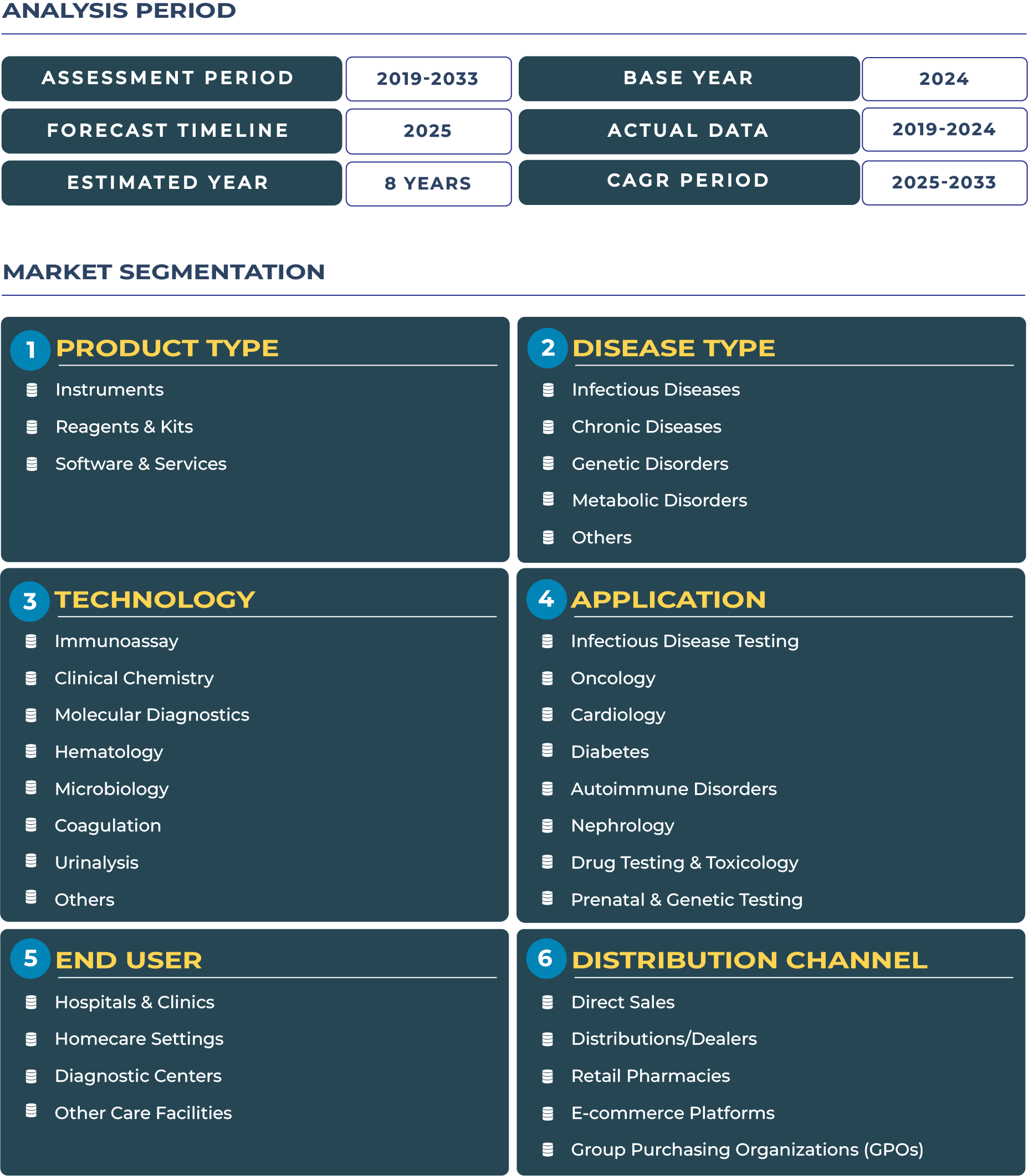
BRICS In-vitro Diagnostic Market Countries Covered

Frequently Asked Questions
BRICS nations contribute massive volume demand due to large populations, rising chronic disease prevalence, and ever-expanding healthcare access. Their increasing investment in diagnostics and unique disease burdens make them core engines of global IVD growth.
Key restraints include divergent regulatory regimes, protectionist import policies, currency fluctuation, cost pressures in public procurement, and limited reimbursement support for advanced diagnostics and implants.
Urbanization concentrates patient and hospital density, enabling central adoption of implants and associated diagnostics. Diagnostics become essential in managing preoperative screening, perioperative monitoring, and long-term biomarker follow-up.
Related Reports

Nordics PaaS Market Size | 2019-2033
- Report ID: IT1885 | Coverage: Country |
- Category: Information Technology | Sub-Category: Cloud Computing Technology |
- Published Date: Dec 2025 | US$495 |
MEA Investment Banking Market Size | 2019-2033
- Report ID: BAF871 | Coverage: Regional |
- Category: Banking and Finance | Sub-Category: Banking Services |
- Published Date: Oct 2025 | US$1,345 |
UK Diagnostic Imaging Devices Market Size | 2019-2033
- Report ID: HEA321 | Coverage: Country |
- Category: Healthcare | Sub-Category: Medical Devices |
- Published Date: Oct 2025 | US$495 |
Kuwait Diagnostic Imaging Devices Market Size | 2019-2033
- Report ID: HEA357 | Coverage: Country |
- Category: Healthcare | Sub-Category: Medical Devices |
- Published Date: Nov 2025 | US$495 |
Nordics PaaS Market Size | 2019-2033
- Report ID: IT1885 | Coverage:Country |
- Category:Information Technology | Sub-Category: Cloud Computing Technology |
- Published Date: Dec 2025 |US$495 |
MEA Investment Banking Market Size | 2019-2033
- Report ID: BAF871 | Coverage:Regional |
- Category:Banking and Finance | Sub-Category: Banking Services |
- Published Date: Oct 2025 |US$1,345 |
UK Diagnostic Imaging Devices Market Size | 2019-2033
- Report ID: HEA321 | Coverage:Country |
- Category:Healthcare | Sub-Category: Medical Devices |
- Published Date: Oct 2025 |US$495 |
Kuwait Diagnostic Imaging Devices Market Size | 2019-2033
- Report ID: HEA357 | Coverage:Country |
- Category:Healthcare | Sub-Category: Medical Devices |
- Published Date: Nov 2025 |US$495 |
Why Choose Us

24/5 Research Support
Get your queries resolved prior to and post purchasing research study

Customize As Per Specific Requirements
Get in-depth analysis based on your tailored research needs

Expertise in Tracking Niche Markets
Comprehensive view of latest technologies and opportunities across markets

360-Degree Analysis
Fact-based insights derived through supply & demand side analysis

Assured Quality
Deliver most accurate industry insights to maintain research quality

Information Security
Your confidential and personal data is secure and safe