
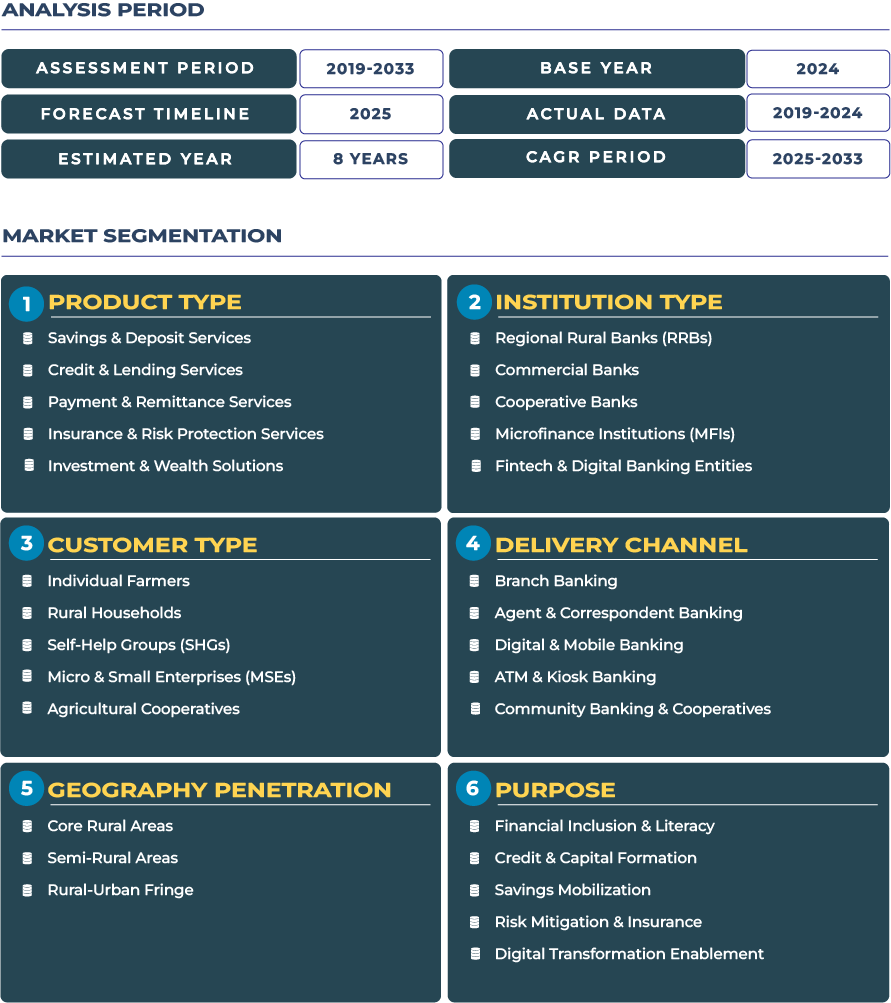
Canada Rural Banking Market Size and Forecast by Product Type, Institution Type, Customer Type, Delivery Channel, Geographic Penetration, and Purpose: 2019-2033
Oct 2025
| Format:

 |
Pages: 110+
|
Type: Sub-Industry Report
|
Authors:
Jayson Gomes
(Manager – BFSI)
|
Pages: 110+
|
Type: Sub-Industry Report
|
Authors:
Jayson Gomes
(Manager – BFSI)
MARKET OUTLOOK
Indigenous Empowerment and Rural Inclusion: Reimagining Canada Rural Banking Landscape
In Canada rural banking market, the landscape is being redefined by growing partnerships among Indigenous communities, regional financial institutions and digital technology providers. Long-standing efforts to support Indigenous-led enterprises and community-based co-operatives now intersect with innovations in rural finance aimed at closing the inclusion gap. In this rural banking ecosystem, traditional models of branch-based deposit mobilisation are supplemented by digital wallet pilots, remote lending programmes and co-designed agricultural credit products. These developments reflect a broader transformation of Canada rural banking sector, where resiliency, sustainable practices and community ownership are key pillars. By 2025, the Canadian rural banking market is projected at approximately USD 3.9 billion and is forecast to grow to roughly USD 4.2 billion by 2033 at a CAGR of around 1.2%. While the growth rate is modest, the strategic significance of this market lies in its potential to deliver financial services to remote communities, support climate-resilient agriculture and foster economic self-determination in rural Canada.
Note:* The market size refers to the total fees/revenue generated by banks through various services.
Canada Rural Banking Market Outlook: Navigating Inclusion, Infrastructure and Innovation in Canada Rural Banking Segment
Looking ahead, the Canada rural banking sector is positioned to deliver steady expansion rooted in public-private collaboration and technological enablement. The forecast to 2033 anticipates growth to USD 4.2 billion, driven by evolving savings products tailored for rural cooperatives, asset-financing solutions for agricultural transition and enriched risk-protection services for off-farm income diversification. Yet, this growth must be contextualised within a landscape of low population density, rising compliance costs and branch rationalisation pressures. Reports from the Bank of Canada indicate that rural branch access in Canada contracted by roughly 7.2% from 2019 to 2022, amplifying the need for digital delivery models. Moreover, macro-economic and geopolitical pressures, including inflation, global trade disruptions and climate-related crop shocks, place additional emphasis on resilience and adaptability. The rural banking ecosystem is increasingly marshalled around partnerships with Indigenous co-operatives, fintech lenders and agricultural credit agencies. As connectivity improves and financial literacy programmes spread through remote regions, the sector’s modest growth hides an opportunity to reshape rural economies by enhancing credit access, redirecting capital into sustainable practices and embedding investment and wealth solutions into the rural banking framework.
Drivers & Restraints: Catalysts and Barriers Shaping Canada Rural Banking Sector
Driving growth: One of the principal drivers for Canada rural banking industry is the expanding role of provincial and federal initiatives that target remote-area finance. For example, agricultural lenders engage in the federal Canadian Agricultural Loans Act (CALA) programme, enabling new and existing farmers to access loans for land purchase and equipment improvement through participating banks. This institutional backing increases the credit capacity of rural borrowers and strengthens deposit mobilisation via regional banks. In parallel, a surge in Indigenous-led agricultural and enterprise initiatives, supported by co-operative financing models and community-owned banks, has created demand for tailored deposit, credit and investment offerings in rural landscapes. The convergence of digital payments, remote onboarding technologies and data-driven risk assessment is enabling rural financial inclusivity, bridging the gap between remoteness and accessibility.
Constraining growth: Despite the momentum, structural restraints remain evident. Canada’s vast geography and sparsely populated rural regions drive high transaction costs and elevated cost-to-serve for lenders. The Bank of Canada’s 2023 study identifies that rural residents travel double the distance to the nearest deposit or cash access point compared to urban counterparts, highlighting infrastructure and accessibility gaps. Moreover, regulatory fragmentation across provincial jurisdictions adds complexity for national institutions expanding rural operations, raising compliance burdens and slowing digital rollout. The modest CAGR reflects these constraints. Economic headwinds, from pandemic recovery to global supply-chain disruptions and climate volatility, further challenge credit portfolios and revenue models in the rural banking sector. As branch closures persist in remote towns, lenders must invest in digital capacity, alternative delivery channels and sustainable product design to sustain viability.
Trends & Opportunities: Next-Wave Innovation and Growth Pathways in Canada Rural Banking Sphere
Emerging trends: A key trend in Canada rural banking market is the rise of Indigenous-financial-inclusion programmes. Financial institutions are co-designing products with Indigenous co-operatives to deliver savings and credit solutions aligned with local enterprise and land-use priorities. Mobile wallet adoption is expanding in remote communities, enabling access to basic banking services, remittances and payment functionality without physical branches. Also, the sector increasingly utilises precision-farming data, satellite imagery and IoT sensors to extend credit and insurance services to smaller-scale farms, enabling risk-pricing that previously excluded remote borrowers.
Opportunity hotspots: In the Canadian prairies and Atlantic provinces, opportunities are emerging around tailored fisheries credit and shared-asset financing for community-owned solar installations. For example, lenders are launching micro-leasing for on-farm sensors and equipment upgrades, unlocking investment/wealth solutions for rural households. Community-shared financing models enable multiple smallholders to co-finance cold-chain infrastructure that supports regional value-chains. These innovations allow rural banks to deepen customer engagement, diversify revenue streams and embed longer-term wealth solutions within the rural ecosystem.
Competitive Landscape: Strategic Alliances and Rural-First Banking Models in Canada’s Market
The competitive dynamics in Canada rural banking market are shaped by strategic collaborations and a focus on rural digital transformation. In October 2025, the Business Development Bank of Canada (BDC) announced a CAD 100 million initiative alongside Community Futures to boost rural and remote entrepreneur finance across Canada. In July 2025, BDC partnered with Royal Bank of Canada (RBC) to guarantee CAD 800 million in loans targeting underserved rural regions. These developments reflect a shift toward co-design of financial products, shared-asset lending pools and financing innovation tailored to rural realities. Indigenous-owned credit unions, agricultural co-operatives and regional banks are evolving from transaction-based models towards platform-enabled ecosystems that integrate savings, lending, insurance and investment solutions into a unified offering. Digital onboarding, remote servicing and satellite-based risk analytics are increasingly standard, reducing cost-to-serve and enabling rural outreach at scale. With regulatory and infrastructure initiatives evolving, Canada rural banking sector is poised to deliver both community impact and financial returns.
*Research Methodology: This report is based on DataCube’s proprietary 3-stage forecasting model, combining primary research, secondary data triangulation, and expert validation.
[Learn more]
Canada Rural Banking Market Segmentation
Frequently Asked Questions
Indigenous communities are co-designing financing models with regional lenders and credit unions, establishing community-owned banking platforms and directing capital toward local enterprise, land stewardship and rural economic regeneration.
Initiatives include micro-leasing for solar and equipment upgrades, shared financing of cold-chain infrastructure, and integrated investment/wealth solutions that link rural households to regional value-chain returns and sustainable agriculture.
Through federal loan-guarantee programmes such as CALA, partnerships with Indigenous credit unions and remote-onboarding technologies, government and cooperative institutions lower barriers to credit, expand deposit access and enhance financial inclusion in remote regions.
Related Reports

GCC Fintech-enabled Neobanking Market Size | 2019-2033
- Report ID: BAF510 | Coverage: Regional |
- Category: Banking and Finance | Sub-Category: FinTech |
- Published Date: Jan 2026 | US$1,345 |
South Korea Diabetes Care Devices Market Size | 2019-2033
- Report ID: HEA181 | Coverage: Country |
- Category: Healthcare | Sub-Category: Medical Devices |
- Published Date: Sep 2025 | US$495 |
Bahrain AI Text-based NLP Market Size | 2019-2033
- Report ID: IT1953 | Coverage: Country |
- Category: Information Technology | Sub-Category: Artificial Intelligence |
- Published Date: Dec 2025 | US$495 |
Taiwan Fintech-enabled NFT Market Size | 2019-2033
- Report ID: BAF1016 | Coverage: Country |
- Category: Banking and Finance | Sub-Category: FinTech |
- Published Date: Jan 2026 | US$495 |
GCC Fintech-enabled Neobanking Market Size | 2019-2033
- Report ID: BAF510 | Coverage:Regional |
- Category:Banking and Finance | Sub-Category: FinTech |
- Publishing Soon |US$1,345 |
South Korea Diabetes Care Devices Market Size | 2019-2033
- Report ID: HEA181 | Coverage:Country |
- Category:Healthcare | Sub-Category: Medical Devices |
- Published Date: Sep 2025 |US$495 |
Bahrain AI Text-based NLP Market Size | 2019-2033
- Report ID: IT1953 | Coverage:Country |
- Category:Information Technology | Sub-Category: Artificial Intelligence |
- Publishing Soon |US$495 |
Taiwan Fintech-enabled NFT Market Size | 2019-2033
- Report ID: BAF1016 | Coverage:Country |
- Category:Banking and Finance | Sub-Category: FinTech |
- Publishing Soon |US$495 |
Why Choose Us

24/5 Research Support
Get your queries resolved prior to and post purchasing research study

Customize As Per Specific Requirements
Get in-depth analysis based on your tailored research needs

Expertise in Tracking Niche Markets
Comprehensive view of latest technologies and opportunities across markets

360-Degree Analysis
Fact-based insights derived through supply & demand side analysis

Assured Quality
Deliver most accurate industry insights to maintain research quality

Information Security
Your confidential and personal data is secure and safe