
Chile In-vitro Diagnostic Market Size and Forecast by Product Type, Technology, Application, Disease Type, End User, and Distribution Channel: 2019-2033
Oct 2025
| Format:

 |
Pages: 110+
|
Type: Sub-Industry Report
|
Authors:
Mahesh Y
(Assistant Research Manager)
|
Pages: 110+
|
Type: Sub-Industry Report
|
Authors:
Mahesh Y
(Assistant Research Manager)
MARKET OUTLOOK
Chile’s Stable Healthcare Investments Powering a Strong Future for the In-vitro Diagnostic Market
Chile’s reputation as one of Latin America’s most financially disciplined nations extends to its healthcare system, where stability and steady investment have laid the groundwork for robust growth in the in-vitro diagnostic (IVD) market. The government’s consistent funding, combined with private sector expansion, has positioned Chile as a regional model for quality healthcare infrastructure. This foundation is now stimulating demand for advanced diagnostics, particularly as hospitals and clinics seek to enhance accuracy and turnaround times in orthopedic and surgical care diagnostics.
According to DataCube Research, the Chile In-vitro Diagnostic Market is estimated at USD 400.0 million in 2025 and projected to reach USD 478.6 million by 2033, registering a moderate CAGR of 2.3%. This stable yet positive trajectory reflects Chile’s steady healthcare funding policies and its reliance on premium technology solutions for high-income patients and private institutions. The nation’s emphasis on clinical quality rather than volume has encouraged the adoption of precise reagents, high-sensitivity diagnostic instruments, and integrated software systems. The Ministry of Health, Chile (MINSAL) continues to promote modernization programs that integrate digital diagnostics across public and private health networks, reinforcing the country’s image as a regional leader in healthcare efficiency.
Healthcare Stability and Private Insurance Strengthening Diagnostic Demand
A key driver for Chile’s in-vitro diagnostic industry is the strength of its private healthcare and insurance market. Chile’s mixed healthcare system, anchored by both the public Fondo Nacional de Salud (FONASA) and private insurers (ISAPREs), creates a balanced reimbursement environment that sustains long-term investment in diagnostic capabilities. With one of the highest per-capita healthcare spends in Latin America, Chile’s private sector accounts for a significant share of diagnostic demand, particularly for advanced immunoassays, molecular diagnostics, and specialized orthopedic testing.
Stable procurement processes and transparent health technology assessment mechanisms have reduced market entry barriers for international diagnostic providers. This environment encourages long-term supplier relationships, particularly with hospital groups and specialized laboratories in Santiago and Valparaíso. Moreover, growing awareness of personalized medicine and precision testing is fostering the expansion of reagents and kits tailored to chronic disease diagnostics, a segment gaining attention as the population ages.
Limited Population Base and Price Competition Restricting Scalability
Despite Chile’s economic and regulatory stability, the in-vitro diagnostic sector faces certain structural constraints. A relatively small population of approximately 19 million limits the scalability of diagnostic test volumes compared with larger Latin American markets like Brazil and Mexico. This demographic constraint creates pricing pressure as distributors compete aggressively for institutional contracts.
Another challenge lies in the concentrated distribution network dominated by a few large players that control reagent supply chains and laboratory automation systems. This limits smaller regional laboratories from negotiating competitive pricing. Furthermore, strong price competition among international suppliers reduces margins, particularly in segments like general chemistry and hematology analyzers. To sustain profitability, vendors are increasingly focusing on differentiated service offerings such as maintenance contracts, workflow integration software, and reagent rental models.
Private Healthcare Expansion and Diagnostic Modernization Fuel Emerging Trends
Chile’s healthcare landscape is undergoing a quiet transformation driven by private hospital expansion, diagnostic modernization, and an emerging medical tourism niche. Private healthcare groups are actively investing in advanced diagnostic laboratories equipped with digital pathology systems and high-throughput molecular analyzers. This modernization trend is especially visible in Santiago and Antofagasta, where private providers cater to both domestic and regional patients seeking reliable orthopedic and post-surgical testing.
A growing emphasis on orthobiologics and regenerative medicine has also stimulated demand for diagnostic platforms capable of analyzing biomarker response and tissue regeneration. The country’s regulatory environment, supported by Instituto de Salud Pública de Chile (ISP), ensures compliance with international diagnostic standards, further strengthening Chile’s reputation for quality healthcare. These developments signal a gradual shift from basic diagnostic testing toward precision-driven, outcome-based laboratory solutions.
New Opportunities in Private Insurer Engagement and Specialty Clinic Roll-outs
The Chilean IVD market offers promising opportunities for diagnostic manufacturers willing to align with the private insurance ecosystem and expanding specialty clinic networks. Engaging directly with ISAPRE insurers enables diagnostic firms to integrate their services into bundled care packages for orthopedic, oncology, and metabolic disorders. These collaborations allow providers to showcase measurable improvements in patient outcomes while building brand visibility.
Medical tourism also represents a strategic opportunity. Chile’s healthcare infrastructure and political stability make it a reliable destination for elective surgeries and complex treatments. Diagnostic companies can collaborate with private clinics to create comprehensive medical tourism packages that include pre-arrival testing, postoperative monitoring, and personalized diagnostics. Similarly, the rollout of specialty clinics in mid-tier cities provides a platform for offering targeted IVD services, ranging from infectious disease screening to orthopedic biomarker analysis, supported by scalable software and service models.
Competitive Landscape: Strategic Alignment with Private Insurers and Specialty Networks
Chile’s in-vitro diagnostic landscape is defined by the presence of leading multinational firms such as Roche Diagnostics, Abbott Laboratories, and Siemens Healthineers, alongside regional players like Representaciones Biotec and Technomed. In 2024, Roche Diagnostics expanded its automation and molecular testing footprint across Chilean private hospital chains, integrating real-time PCR systems and immunoassay analyzers to improve infectious disease detection. Abbott strengthened its local partnerships by launching next-generation reagent kits optimized for rapid testing environments.
Emerging strategies center on engaging private insurers to unlock new payer channels and sponsoring specialty diagnostic centers within hospital ecosystems. Diagnostic companies are also experimenting with hybrid pricing structures that combine leasing models with volume-based reagent agreements, ensuring affordability and long-term client retention. These strategic partnerships illustrate Chile’s transition toward a value-driven and integrated in-vitro diagnostic ecosystem capable of sustaining innovation amid a competitive regional market.
*Research Methodology: This report is based on DataCube’s proprietary 3-stage forecasting model, combining primary research, secondary data triangulation, and expert validation.
[Learn more]
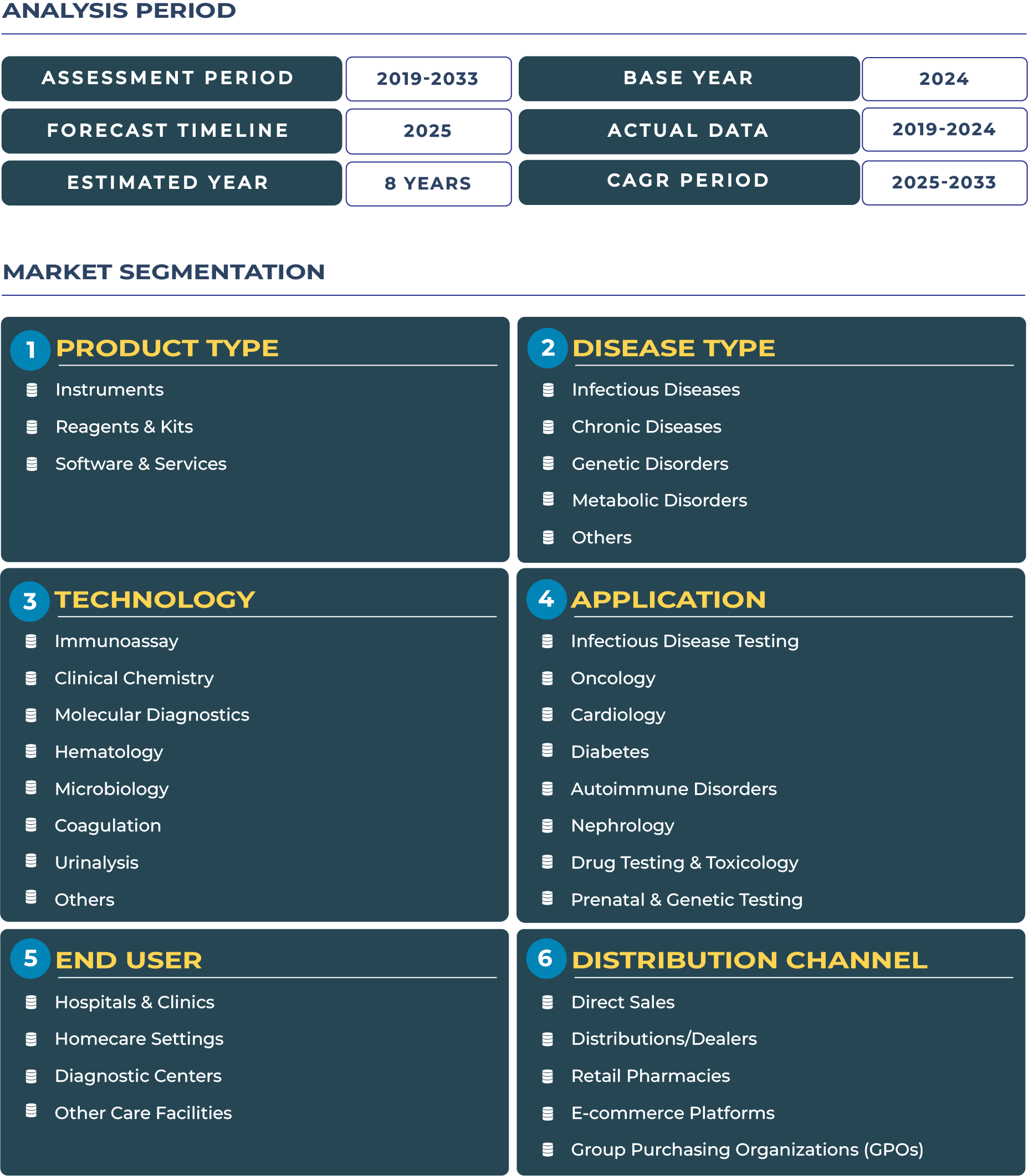
Chile In-vitro Diagnostic Market Segmentation
Frequently Asked Questions
Stable healthcare funding in Chile supports continuous investment in diagnostic modernization, allowing private hospitals and laboratories to deploy high-precision instruments and advanced testing systems sustainably.
The smaller population base and high import costs create price competition that limits large-scale procurement, affecting affordability and accessibility of advanced orthopedic diagnostics and devices in Chile.
The growing adoption of premium implants and orthopedic procedures demands precise diagnostic validation, pushing laboratories to adopt specialized reagents and analytical systems for preoperative and postoperative testing.
Related Reports

Mexico PaaS Market Size | 2019-2033
- Report ID: IT1876 | Coverage: Country |
- Category: Information Technology | Sub-Category: Cloud Computing Technology |
- Published Date: Dec 2025 | US$495 |
India Rural Banking Market Size | 2019-2033
- Report ID: BAF917 | Coverage: Country |
- Category: Banking and Finance | Sub-Category: Banking Services |
- Published Date: Oct 2025 | US$495 |
Kuwait Private Banking Market Size | 2019-2033
- Report ID: BAF978 | Coverage: Country |
- Category: Banking and Finance | Sub-Category: Banking Services |
- Published Date: Nov 2025 | US$495 |
BRICS AI Industrial Robotics Market Size | 2019-2033
- Report ID: IT1937 | Coverage: Regional |
- Category: Information Technology | Sub-Category: Artificial Intelligence |
- Published Date: Nov 2025 | US$1,345 |
Mexico PaaS Market Size | 2019-2033
- Report ID: IT1876 | Coverage:Country |
- Category:Information Technology | Sub-Category: Cloud Computing Technology |
- Published Date: Dec 2025 |US$495 |
India Rural Banking Market Size | 2019-2033
- Report ID: BAF917 | Coverage:Country |
- Category:Banking and Finance | Sub-Category: Banking Services |
- Published Date: Oct 2025 |US$495 |
Kuwait Private Banking Market Size | 2019-2033
- Report ID: BAF978 | Coverage:Country |
- Category:Banking and Finance | Sub-Category: Banking Services |
- Published Date: Nov 2025 |US$495 |
BRICS AI Industrial Robotics Market Size | 2019-2033
- Report ID: IT1937 | Coverage:Regional |
- Category:Information Technology | Sub-Category: Artificial Intelligence |
- Publishing Soon |US$1,345 |
Why Choose Us

24/5 Research Support
Get your queries resolved prior to and post purchasing research study

Customize As Per Specific Requirements
Get in-depth analysis based on your tailored research needs

Expertise in Tracking Niche Markets
Comprehensive view of latest technologies and opportunities across markets

360-Degree Analysis
Fact-based insights derived through supply & demand side analysis

Assured Quality
Deliver most accurate industry insights to maintain research quality

Information Security
Your confidential and personal data is secure and safe