
China In-vitro Diagnostic Market Size and Forecast by Product Type, Technology, Application, Disease Type, End User, and Distribution Channel: 2019-2033
Oct 2025
| Format:

 |
Pages: 110+
|
Type: Sub-Industry Report
|
Authors:
Mahesh Y
(Assistant Research Manager)
|
Pages: 110+
|
Type: Sub-Industry Report
|
Authors:
Mahesh Y
(Assistant Research Manager)
MARKET OUTLOOK
China’s Diagnostic Powerhouse: Demand Meets Manufacturing Scale in IVD Evolution
China commands a unique role in the in-vitro diagnostic (IVD) landscape: not only as one of the world’s largest consumer markets for diagnostics but also as a manufacturing and innovation hub. With its aging population, accelerating chronic disease burden, and massive procedural volumes, the country is scaling both demand and supply of diagnostic technologies. In 2025, the China IVD market is projected at USD 9.44 billion, and by 2033 it may reach approximately USD 15.29 billion, reflecting a moderate but sustainable CAGR of 6.2%, driven by hospital modernization, reagent localization, and digital integration across clinical networks.
Market Outlook: Institutional Modernization and Domestic Strength Forge Forward Path
The outlook for China’s IVD sector is anchored by institutional upgrades, regulatory reform, and local OEM ascendancy. Leading hospitals in tier-1 and tier-2 cities are retrofitting laboratories with automation, robotics, and integrated software to meet performance and accreditation requirements. Meanwhile, the government’s health policies emphasize territorial equity, expanding access into secondary cities and rural settings. Domestic reagent and instrument makers are aggressively capturing share from imported suppliers by tapping into incentive schemes and local supply chains. As a result, China is transforming from a dependency-driven diagnostic import market into a self-sustaining diagnostic ecosystem combining production, innovation, and scale.
Drivers & Restraints: High Procedure Volume, OEM Growth vs. Regulatory & Price Headwinds
Massive Patient Volumes, Strong OEMs & National Upgrade Programs Boost IVD Uptake
China’s high surgical and diagnostic procedure volumes offer a sustained base demand for biochemical, immunoassay, molecular, and point-of-care tests. Its domestic original equipment manufacturers (OEMs) such as Mindray and Snibe are rapidly scaling reagent and instrument output, leveraging local cost advantages and distribution depth. The national push for hospital infrastructure modernization, especially in medium-tier cities, is migrating diagnostic upgrade cycles across regional markets. As precision and preventive medicine become strategic priorities, China’s labs are increasingly investing in molecular panels, companion diagnostics, and digital decision-support tools.
Provincial Reimbursement Asymmetry, Regulatory Scrutiny & Local Price Competition Limit Profits
Nonetheless, China’s IVD growth is tempered by structural challenges. Reimbursement rules differ widely by province and tier, often excluding newer or higher-cost assays. Imported diagnostic reagents and instruments face deeper regulatory vetting under China’s medical device and IVD reagent policies managed under agencies such as the National Medical Products Administration (NMPA). Local OEMs aggressively price compete on margins, making it difficult for foreign brands to sustain premium pricing. Even as new reagent import tariffs have spurred localization, margins compress under volume-driven price pressure, a delicate balance between scale and profitability.
Trends & Opportunities: Robotics, Data Platforms & Partnerships with Local Champions
Trend: Rapid Robotics Adoption, Digital Diagnostics and OEM Share Gains
Leading Chinese hospitals are embracing robotic sample handling, automated assay lines, and AI-powered analytics, especially within diagnostic hubs in Shanghai, Shenzhen, Beijing, and Chengdu. Digital transformation is a central trend: laboratories now integrate cloud dashboards, LIMS systems, and cross-institutional data sharing. At the same time, local players like Snibe (a chemiluminescence immunoassay leader) are gaining ground against global incumbents. The shift from pure hardware to platform monetization, including software services, consumable contracts, and analytics, is redefining competitive models in China IVD ecosystem.
Opportunity: Joint Ventures with Local OEMs, Clinical Evidence Partnerships & Hub Expansion
Foreign diagnostic firms can accelerate market access through joint ventures or licensing with Chinese OEMs, leveraging regulatory familiarity and distribution networks. Partnerships in clinical validation, measuring outcomes in Chinese patient cohorts, are increasingly essential for procurement success. Expansion into provincial “hub labs” in second- and third-tier cities offers scalable rollout of mid-tier assay lines. Furthermore, collaborating on reagent formulation, co-branding, or “China-plus” manufacturing enables firms to balance cost with regulatory compliance and local acceptance.
Competitive Landscape: Alliances, Localization, and Strategic City-Hub Deployment
The competitive canvas in China IVD sector blends established domestic champions and global incumbents adapting to local constraints. Global firms like Roche, Abbott, and Siemens Healthineers continue to serve high-end diagnostic demand, but increasingly through joint ventures or localized production. Local firms such as Snibe (chemiluminescence diagnostics) and Mindray are scaling aggressively domestically and in export markets. Many international players are forming licensing or co-development partnerships with these OEMs to access lower-tier markets. Strategy execution often follows a “city-hub” deployment, placing flagship systems in major metropolitan hospitals as reference labs, then cascading simplified systems into peripheral hospitals. This balance of flagship prestige and mass-tier deployment determines market share in China’s diversified terrain.
*Research Methodology: This report is based on DataCube’s proprietary 3-stage forecasting model, combining primary research, secondary data triangulation, and expert validation.
[Learn more]
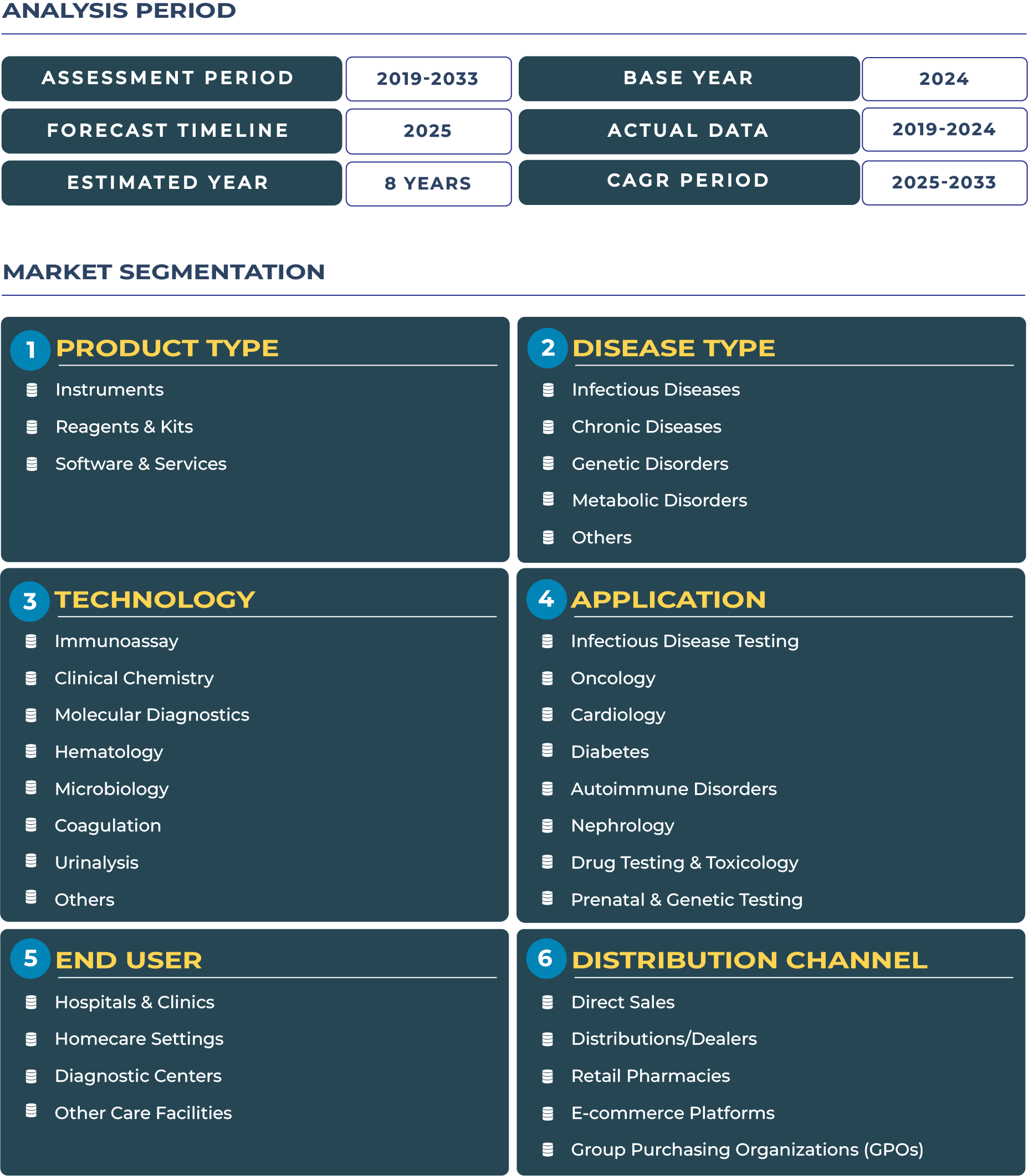
China In-vitro Diagnostic Market Segmentation
Frequently Asked Questions
Reforms mandating regional equity, accreditation, and quality standards drive diagnostic upgrades in underpenetrated areas. Policies favoring local manufacturing and accelerated approvals incentivize scale in the IVD sector.
They encounter complex provincial reimbursement differences, tariff and regulatory scrutiny, fierce pricing competition from domestic OEMs, and demand for local evidence-based clinical validation.
Local IVD innovation supports integrated orthopedics through diagnostic, implant solutions (e.g. infection markers, personalized biomarker panels). Partnerships between implant and diagnostic firms unlock new care pathways.
Related Reports

US Drone Detection System Market Size | 2019-2033
- Report ID: A&D51 | Coverage: Country |
- Category: Aerospace & Defence | Sub-Category: Defence |
- Published Date: Jul 2025 | US$495 |
Saudi Arabia Investment Banking Market Size | 2019-2033
- Report ID: BAF873 | Coverage: Country |
- Category: Banking and Finance | Sub-Category: Banking Services |
- Published Date: Oct 2025 | US$495 |
France Diagnostic Imaging Devices Market Size | 2019-2033
- Report ID: HEA323 | Coverage: Country |
- Category: Healthcare | Sub-Category: Medical Devices |
- Published Date: Oct 2025 | US$495 |
Oman Diagnostic Imaging Devices Market Size | 2019-2033
- Report ID: HEA359 | Coverage: Country |
- Category: Healthcare | Sub-Category: Medical Devices |
- Published Date: Nov 2025 | US$495 |
US Drone Detection System Market Size | 2019-2033
- Report ID: A&D51 | Coverage:Country |
- Category:Aerospace & Defence | Sub-Category: Defence |
- Published Date: Jul 2025 |US$495 |
Saudi Arabia Investment Banking Market Size | 2019-2033
- Report ID: BAF873 | Coverage:Country |
- Category:Banking and Finance | Sub-Category: Banking Services |
- Published Date: Oct 2025 |US$495 |
France Diagnostic Imaging Devices Market Size | 2019-2033
- Report ID: HEA323 | Coverage:Country |
- Category:Healthcare | Sub-Category: Medical Devices |
- Published Date: Oct 2025 |US$495 |
Oman Diagnostic Imaging Devices Market Size | 2019-2033
- Report ID: HEA359 | Coverage:Country |
- Category:Healthcare | Sub-Category: Medical Devices |
- Published Date: Nov 2025 |US$495 |
Why Choose Us

24/5 Research Support
Get your queries resolved prior to and post purchasing research study

Customize As Per Specific Requirements
Get in-depth analysis based on your tailored research needs

Expertise in Tracking Niche Markets
Comprehensive view of latest technologies and opportunities across markets

360-Degree Analysis
Fact-based insights derived through supply & demand side analysis

Assured Quality
Deliver most accurate industry insights to maintain research quality

Information Security
Your confidential and personal data is secure and safe