
France Diagnostic Imaging Devices Market Size and Forecast by Modality, Application, Technology, End User, and Portability: 2019-2033
Oct 2025
| Format:

 |
Pages: 110+
|
Type: Sub-Industry Report
|
Authors:
Mahesh Y
(Assistant Research Manager)
|
Pages: 110+
|
Type: Sub-Industry Report
|
Authors:
Mahesh Y
(Assistant Research Manager)
MARKET OUTLOOK
Expanding Diagnostic Imaging Accessibility – France’s Agenda to Transform Regional Care Delivery
France is actively pursuing a strategy of decentralization in healthcare diagnostics in order to democratize access across metropolitan and rural regions alike. Under this paradigm, the national health system is empowering regional imaging reforms and tele-imaging networks to ensure that advanced diagnostic technologies are not confined to Paris or other major cities. This course of action has direct implications for France diagnostic imaging devices ecosystem, especially as hospitals and outpatient centres reinvest in modalities such as CT, MRI and ultrasound systems. The France diagnostic imaging devices market is forecast to rise from roughly USD 1.6 billion in 2025 to USD 2.0 billion in 2033, reflecting a CAGR of approximately 3.0%. This performance is supported by the nation’s commitment to bridging geographic disparities, upgrading older equipment, and adopting digital imaging platforms that enable remote review and image sharing across care networks.
France Diagnostic Imaging Devices Market Outlook – How France’s Regional Imaging Expansion is Charting the Trajectory for the Diagnostic Imaging Devices Sector
The France diagnostic imaging devices market benefit from a dual strategy of regional upgrading and digital-enabled imaging access. Hospitals and diagnostic centres across France are phasing out outdated X-ray and CT systems in favour of higher throughput, lower dose, and network-ready devices. Further, the government’s digital health roadmap emphasises telemedicine and image sharing, thereby creating demand for interoperable imaging equipment capable of integration into cloud architectures and multi-site networks. The drive to decentralise diagnostics, moving capacity into outpatient and satellite diagnostics hubs, means modalities such as ultrasound and portable X-ray are gaining traction alongside fixed-room MRI and CT installations. Although budget pressures linger, the steady growth underscores the latent potential within this imaging devices sector. In particular, expansion is underpinned by ageing patient demographics, rising chronic disease burdens and national policies aimed at enabling faster diagnosis and reducing hospital backlogs. The digital imaging transformation, combined with strategic investments in imaging infrastructure, positions France diagnostic imaging devices market as a stable growth arena over the coming decade.
Driving Forces & Market Hurdles – What is Accelerating Growth and What is Moderating Momentum?
Expansion Drivers – Public Hospital Investment and Strong Clinical Imaging Ecosystem
Public hospital investment programmes are providing a critical backbone for growth within the France diagnostic imaging devices market. Large university hospital groups and regional CHUs (Centres Hospitaliers Universitaires) are renewing their imaging fleets, including advanced MRI, hybrid PET/CT and CT angiography systems. The centralized procurement frameworks and national digital-health initiatives facilitate budget allocation and equipment standardisation across sites. Additionally, France’s robust clinical research ecosystem, anchored in organisations such as the Institut national de la santé et de la recherche médicale (INSERM), helps accelerate adoption of advanced imaging protocols, further stimulating demand for next-generation diagnostic imaging devices. The net effect: robust momentum for modernisation, digital readiness and modality renewal across the industry.
Growth Restraints – Budgetary Constraints and Localization Requirements Slowing Uptake
However, market participants in the diagnostic imaging devices industry encounter structural constraints specific to the French context. Many public hospitals operate under strict budgetary controls that restrict discretionary capex, delaying device replacement decisions even where clinical need is established. Procurement processes often require extensive multi-site tendering and vendor compliance with French-language documentation, software localisation and regional service support – all increasing vendor entry complexity. Moreover, regulatory requirements for software and AI-enabled imaging solutions include linguistic adaptations and regional clinical validation, which may delay roll-out. Consequently, while the market is growing, these administrative and compliance factors moderate the pace of adoption and introduce lead-time risks for device suppliers seeking to scale across France’s regions.
Market Trends & Strategic Opportunities – Emerging Patterns and Where Tomorrow’s Growth Lies in the Imaging Devices Landscape
Trends – Rise of Outpatient Imaging and Cost-Driven Purchases
A dominant trend within the France diagnostic imaging devices market is the growth of ambulatory imaging centres and outpatient diagnostics as tools to ease hospital burden. Private diagnostic chains and multisite radiology networks are investing in imaging rooms located in non-hospital settings, especially in peripheral areas and suburbs of cities such as Lyon, Marseille and Toulouse. These centres typically favour modular imaging modalities – for example compact CT scanners and high-frequency ultrasound systems – enabling faster adoption cycles and lower site-preparation costs. Simultaneously, payor scrutiny on cost effectiveness is intensifying; imaging device purchases increasingly require demonstrable throughput gains and service-life efficiency, reinforcing demand for devices with integrated service contracts, remote monitoring and upgrade paths.
Opportunities – Leveraging Localisation and Flexible Financing Models
Significant opportunities exist for diagnostic imaging device vendors to align with France’s regional dynamics and procurement practices. Offering French-language clinical validation studies and training materials strengthens vendor credibility and accelerates tender success. Further, flexible financing models tied to hospital budget cycles, such as leasing, service-bundled purchase, or phased upgrades, resonate well with constrained capex environments. Partnerships with local distributors and clinical champions support regional penetration, particularly in less saturated zones such as Brittany, Normandie and Occitanie. For vendors willing to tailor their go-to-market strategies to France’s decentralized, but increasingly networked imaging ecosystem, the diagnostic imaging devices sector presents significant long-term potential.
Competitive Landscape – How Key Players and Strategic Moves Are Shaping France Diagnostic Imaging Devices Sector
The France diagnostic imaging devices ecosystem is marked by both global OEMs and domestic innovators positioning for regional growth. For instance, one leading player Siemens Healthineers has entered into long-term service and upgrade contracts with French hospital groups, anchoring device placements in large teaching institutions while offering lifecycle value. In parallel, vendors specialising in portable imaging and digital workflows are gaining traction in outpatient networks and regional centres. Notably, deployments of advanced PET/CT systems at French nuclear-medicine centres showcase the shift toward precision diagnostics, while partnerships emphasising sustainable imaging practices – for example contrast-media reduction campaigns led by major radiology associations – highlight vendor differentiation through value-added service offerings. In this context, vendors who combine device excellence with service, localisation and flexible commercial frameworks stand to capture meaningful share in France diagnostic imaging devices landscape.
*Research Methodology: This report is based on DataCube’s proprietary 3-stage forecasting model, combining primary research, secondary data triangulation, and expert validation.
[Learn more]
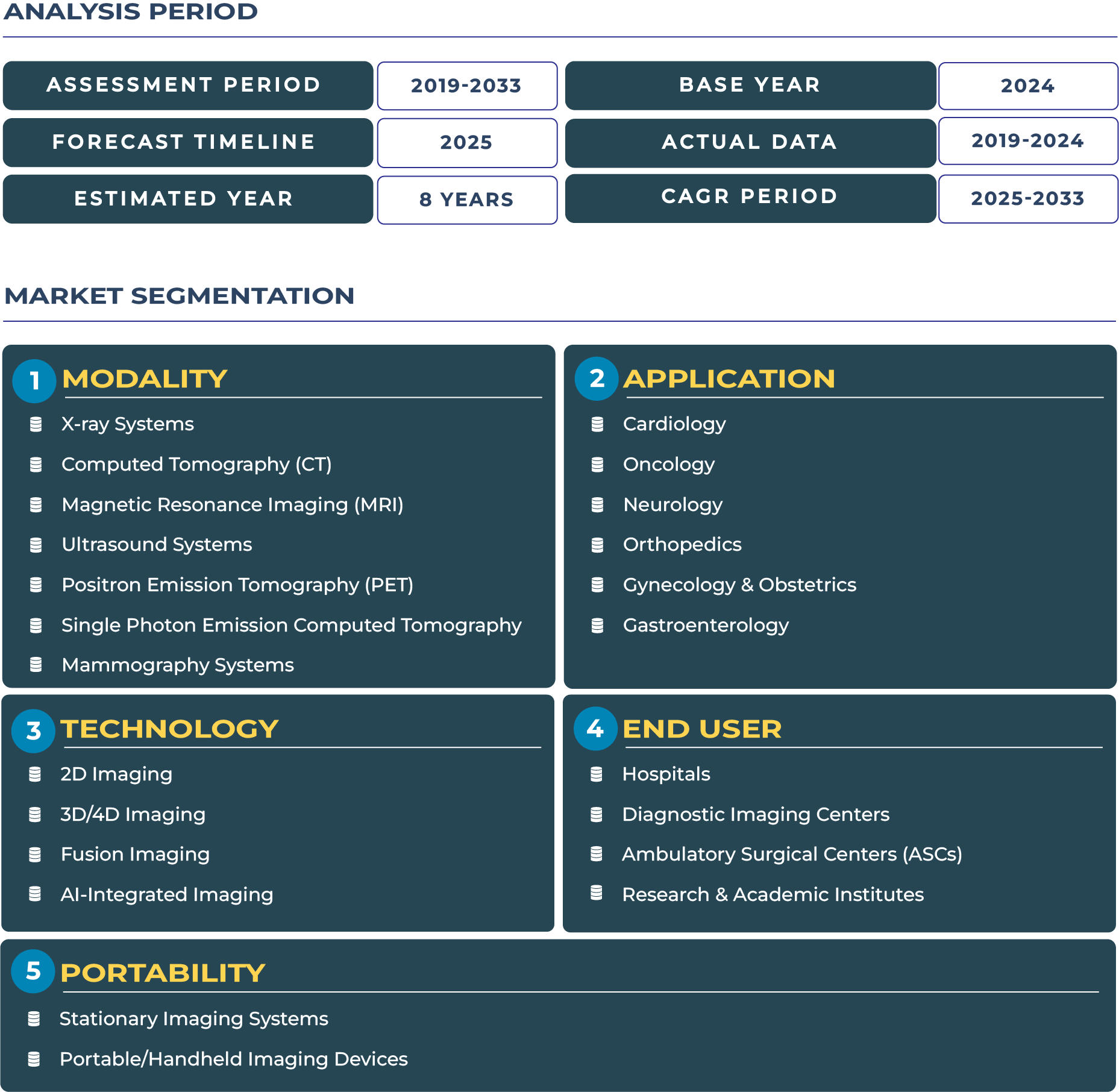
France Diagnostic Imaging Devices Market Segmentation
Frequently Asked Questions
The reforms aim to decentralize advanced imaging from major hospitals to community settings, enabling more equitable access. Investments in imaging infrastructure and tele-imaging capabilities across regions are widening the catchment of diagnostic services and boosting equipment demand.
Tele-imaging networks, cloud-based image sharing and remote reporting are enabling diagnostics to reach underserved areas. Devices that support connectivity, interoperability and remote monitoring are now in greater demand within France’s diagnostic imaging devices ecosystem.
French hospitals are increasingly deploying AI-enabled imaging platforms, especially in modalities such as MRI and CT, to support faster image reconstruction, automated lesion detection and workflow optimisation. Localization requirements still apply, but the clinical drive for AI tools is a key enabler of device refresh cycles.
Related Reports

Nigeria SaaS Market Size | 2019-2034
- Report ID: IT1870 | Coverage: Country |
- Category: Information Technology | Sub-Category: Cloud Computing Technology |
- Published Date: Dec 2025 | US$495 |
Thailand Investment Banking Market Size | 2019-2033
- Report ID: BAF861 | Coverage: Country |
- Category: Banking and Finance | Sub-Category: Banking Services |
- Published Date: Oct 2025 | US$495 |
Kuwait Rural Banking Market Size | 2019-2033
- Report ID: BAF961 | Coverage: Country |
- Category: Banking and Finance | Sub-Category: Banking Services |
- Published Date: Oct 2025 | US$495 |
Taiwan Diagnostic Imaging Devices Market Size | 2019-2033
- Report ID: HEA347 | Coverage: Country |
- Category: Healthcare | Sub-Category: Medical Devices |
- Published Date: Nov 2025 | US$495 |
Europe AI Facial Recognition Market Size | 2019-2033
- Report ID: IT1974 | Coverage: Regional |
- Category: Information Technology | Sub-Category: Artificial Intelligence |
- Published Date: Dec 2025 | US$1,345 |
UAE Diagnostic and Monitoring Devices Market Size | 2019-2033
- Report ID: HEA415 | Coverage: Country |
- Category: Healthcare | Sub-Category: Medical Devices |
- Published Date: Dec 2025 | US$495 |
Nigeria SaaS Market Size | 2019-2034
- Report ID: IT1870 | Coverage:Country |
- Category:Information Technology | Sub-Category: Cloud Computing Technology |
- Published Date: Dec 2025 |US$495 |
Thailand Investment Banking Market Size | 2019-2033
- Report ID: BAF861 | Coverage:Country |
- Category:Banking and Finance | Sub-Category: Banking Services |
- Published Date: Oct 2025 |US$495 |
Kuwait Rural Banking Market Size | 2019-2033
- Report ID: BAF961 | Coverage:Country |
- Category:Banking and Finance | Sub-Category: Banking Services |
- Published Date: Oct 2025 |US$495 |
Taiwan Diagnostic Imaging Devices Market Size | 2019-2033
- Report ID: HEA347 | Coverage:Country |
- Category:Healthcare | Sub-Category: Medical Devices |
- Published Date: Nov 2025 |US$495 |
Europe AI Facial Recognition Market Size | 2019-2033
- Report ID: IT1974 | Coverage:Regional |
- Category:Information Technology | Sub-Category: Artificial Intelligence |
- Publishing Soon |US$1,345 |
UAE Diagnostic and Monitoring Devices Market Size | 2019-2033
- Report ID: HEA415 | Coverage:Country |
- Category:Healthcare | Sub-Category: Medical Devices |
- Publishing Soon |US$495 |
Why Choose Us

24/5 Research Support
Get your queries resolved prior to and post purchasing research study

Customize As Per Specific Requirements
Get in-depth analysis based on your tailored research needs

Expertise in Tracking Niche Markets
Comprehensive view of latest technologies and opportunities across markets

360-Degree Analysis
Fact-based insights derived through supply & demand side analysis

Assured Quality
Deliver most accurate industry insights to maintain research quality

Information Security
Your confidential and personal data is secure and safe