
Hong Kong In-vitro Diagnostic Market Size and Forecast by Product Type, Technology, Application, Disease Type, End User, and Distribution Channel: 2019-2033
Oct 2025
| Format:

 |
Pages: 110+
|
Type: Sub-Industry Report
|
Authors:
Mahesh Y
(Assistant Research Manager)
|
Pages: 110+
|
Type: Sub-Industry Report
|
Authors:
Mahesh Y
(Assistant Research Manager)
MARKET OUTLOOK
Policy-Driven Shifts Reshaping Hong Kong In-Vitro Diagnostic Market Landscape
Hong Kong’s healthcare ecosystem is undergoing a quiet but significant transformation, largely influenced by evolving public policy and hospital procurement frameworks. The city’s well-established tertiary care system, coupled with stringent regulatory alignment under the Department of Health Hong Kong, continues to play a decisive role in the evolution of its In-vitro Diagnostic (IVD) market. However, policy-driven uncertainties and post-pandemic realignments have introduced complexities that affect procurement timelines, tender approvals, and investment decisions across the diagnostic sector.
The Hong Kong In-vitro Diagnostic Market is estimated at USD 579.6 million in 2025 and is projected to reach USD 764.5 million by 2033, growing at a CAGR of 3.5% during 2025, 2033. This moderate growth trajectory is reflective of the city’s constrained domestic scale, a cautious regulatory environment, and reliance on imported diagnostic technologies. Yet, Hong Kong’s role as a regional referral hub, supported by clinical expertise and sophisticated laboratory networks, continues to uphold its relevance in the global IVD ecosystem.
Hong Kong IVD Market Outlook: How Policy Uncertainty and Institutional Procurement Are Shaping Diagnostic Modernization
Hong Kong IVD market operates within a highly institutionalized framework, with most procurement decisions routed through public hospitals managed by the Hospital Authority (HA). This centralized model ensures quality assurance but limits flexibility for new entrants and private diagnostic service providers. The government’s evolving policy toward greater healthcare integration with the Mainland, through initiatives under the “Health Bay” framework, has created opportunities for joint ventures but also uncertainty about the autonomy of local procurement policies.
Nevertheless, Hong Kong’s healthcare sector continues to invest in advanced testing instruments, high-sensitivity reagents, and cloud-integrated laboratory software. Hospitals are modernizing their infrastructure to align with ISO 15189 standards and enhance cross-border diagnostic data exchange with Greater Bay Area partners. The city’s stability as a financial hub enables continuous reinvestment in healthcare technologies, sustaining demand for high-end diagnostics despite its limited population base.
Drivers & Restraints Defining Hong Kong IVD Industry Performance
Growth Drivers: High-End Diagnostic Demand and Regional Referral Advantage
Hong Kong IVD market benefits from its reputation as a high-cost, high-value healthcare destination. Its clinician specialization, particularly in oncology, cardiovascular testing, and infectious disease management, sustains the need for advanced diagnostic systems. Leading hospitals such as Queen Mary and Prince of Wales have adopted fully automated testing platforms to improve efficiency and throughput. Hong Kong’s strategic position as a referral center for complex medical cases from Macau, Mainland China, and Southeast Asia continues to stimulate demand for precise molecular diagnostics and immunoassays.
Additionally, partnerships between hospital networks and multinational manufacturers such as Roche Diagnostics and Siemens Healthineers have strengthened Hong Kong’s access to the latest diagnostic innovations. The city’s regulatory emphasis on quality, combined with robust clinician training and high patient expectations, contributes to steady demand for diagnostic reagents and precision instruments.
Restraints: Policy Uncertainty, Market Saturation, and Limited Scale
Hong Kong’s market growth remains constrained by several structural challenges. Firstly, the relatively small population limits the scale of domestic diagnostic consumption, making the city dependent on cross-border patients to sustain high-volume operations. Secondly, political and regulatory shifts have introduced uncertainty in healthcare funding and approval cycles, particularly affecting public tenders for diagnostic equipment. Furthermore, market saturation among premium diagnostic service providers has intensified competition, reducing margins and slowing expansion opportunities.
Another critical restraint lies in the limited presence of domestic manufacturing. Most IVD products are imported from Europe, Japan, and the United States, subject to fluctuating supply costs and currency volatility. These factors collectively moderate the market’s expansion rate and highlight the need for diversified supply chains and local innovation in diagnostic reagent formulation.
Trends & Opportunities: Cross-Border Integration and High-End Diagnostic Evolution
Trend: Integration with Mainland Diagnostic Networks and Digital Laboratory Expansion
Hong Kong’s participation in the Greater Bay Area healthcare initiative is reshaping its diagnostic landscape. Cross-border healthcare collaborations enable shared laboratory data, telepathology consultations, and unified patient monitoring systems. Hospitals are increasingly investing in AI-powered pathology scanners, advanced chemistry analyzers, and automated workflow management systems to enhance efficiency. This digital transformation aligns with global trends in precision medicine while reinforcing Hong Kong’s role as a diagnostic intermediary between Mainland China and Southeast Asia.
Opportunity: Premium Diagnostic Offerings and Telehealth-Enabled Patient Care
Opportunities in the Hong Kong IVD market are concentrated around premium diagnostic services and telehealth integration. Private hospitals are increasingly offering personalized diagnostic packages targeting high-income and expatriate patients. Telehealth-linked laboratory services, where patients receive diagnostic testing in Hong Kong and follow-up consultations remotely, are gaining traction, especially among cross-border clients. This model enhances continuity of care and promotes diagnostic accessibility in the post-pandemic era.
Additionally, the growing trend toward preventive healthcare creates demand for early detection testing, genetic screening, and companion diagnostics. Local private laboratories are expanding their test portfolios to meet international accreditation standards, strengthening Hong Kong’s position as a high-trust diagnostic hub.
Competitive Landscape: International Collaboration and Premium Service Models Redefining Competition
Hong Kong IVD market features a strong presence of global leaders such as Roche Diagnostics, Siemens Healthineers, bioMérieux, and Abbott Laboratories, alongside specialized local distributors and service providers. These companies are focusing on strategies that align with Hong Kong’s premium healthcare environment, emphasizing high analytical performance, reduced turnaround times, and seamless integration with hospital information systems. For instance, Roche’s 2024 collaboration with local hospital chains introduced next-generation immunoassay platforms with advanced workflow automation, improving diagnostic throughput in tertiary care facilities.
International players are also offering cross-border diagnostic service bundles tailored to Mainland Chinese patients seeking specialized care in Hong Kong. By combining high-value testing instruments with post-diagnostic teleconsultation systems, these companies are capitalizing on Hong Kong’s growing role as a medical bridge within Asia. Localization strategies, including targeted reagent distribution and regional packaging adjustments, further enhance competitiveness in this highly regulated market.
*Research Methodology: This report is based on DataCube’s proprietary 3-stage forecasting model, combining primary research, secondary data triangulation, and expert validation.
[Learn more]
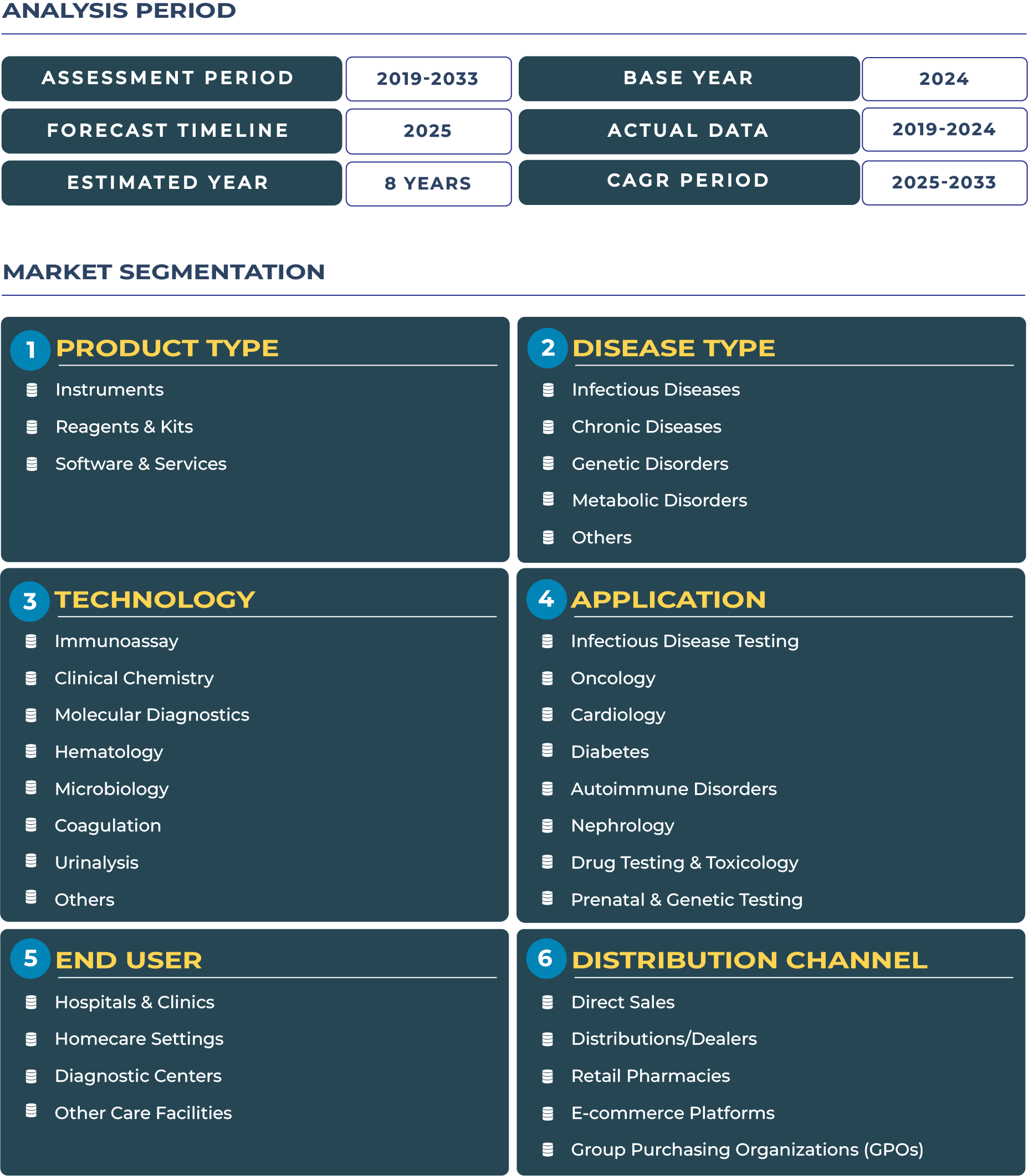
Hong Kong In-vitro Diagnostic Market Segmentation
Frequently Asked Questions
Policy uncertainties surrounding healthcare funding and procurement have slowed innovation adoption and elongated tender approval cycles, impacting the pace of IVD modernization in Hong Kong.
Orthopedic and diagnostic manufacturers face hurdles due to rigid institutional procurement, limited flexibility in tender participation, and high entry barriers created by stringent regulatory and policy constraints.
Hospital-centric procurement encourages demand for integrated solutions, combining diagnostics, imaging, and implants, allowing manufacturers to create bundled offerings targeting high-value tertiary hospitals.
Related Reports

Taiwan Insurance Market Size | 2019-2033
- Report ID: IAS25 | Coverage: Country |
- Category: Insurance and Securities | Sub-Category: Insurance |
- Published Date: Jul 2025 | US$495 |
South Africa Investment Banking Market Size | 2019-2033
- Report ID: BAF879 | Coverage: Country |
- Category: Banking and Finance | Sub-Category: Banking Services |
- Published Date: Oct 2025 | US$495 |
Russia Diagnostic Imaging Devices Market Size | 2019-2033
- Report ID: HEA329 | Coverage: Country |
- Category: Healthcare | Sub-Category: Medical Devices |
- Published Date: Nov 2025 | US$495 |
Kenya Diagnostic Imaging Devices Market Size | 2019-2033
- Report ID: HEA365 | Coverage: Country |
- Category: Healthcare | Sub-Category: Medical Devices |
- Published Date: Nov 2025 | US$495 |
Taiwan Insurance Market Size | 2019-2033
- Report ID: IAS25 | Coverage:Country |
- Category:Insurance and Securities | Sub-Category: Insurance |
- Published Date: Jul 2025 |US$495 |
South Africa Investment Banking Market Size | 2019-2033
- Report ID: BAF879 | Coverage:Country |
- Category:Banking and Finance | Sub-Category: Banking Services |
- Published Date: Oct 2025 |US$495 |
Russia Diagnostic Imaging Devices Market Size | 2019-2033
- Report ID: HEA329 | Coverage:Country |
- Category:Healthcare | Sub-Category: Medical Devices |
- Published Date: Nov 2025 |US$495 |
Kenya Diagnostic Imaging Devices Market Size | 2019-2033
- Report ID: HEA365 | Coverage:Country |
- Category:Healthcare | Sub-Category: Medical Devices |
- Published Date: Nov 2025 |US$495 |
Why Choose Us

24/5 Research Support
Get your queries resolved prior to and post purchasing research study

Customize As Per Specific Requirements
Get in-depth analysis based on your tailored research needs

Expertise in Tracking Niche Markets
Comprehensive view of latest technologies and opportunities across markets

360-Degree Analysis
Fact-based insights derived through supply & demand side analysis

Assured Quality
Deliver most accurate industry insights to maintain research quality

Information Security
Your confidential and personal data is secure and safe