
Israel Fintech Market Size and Forecast by Fintech Services, Technology, Revenue Model, and End User: 2019-2033
Sep 2025
| Format:

 |
Pages: 110+
|
Type: Industry Report
|
Authors:
Jayson Gomes
(Manager – BFSI)
|
Pages: 110+
|
Type: Industry Report
|
Authors:
Jayson Gomes
(Manager – BFSI)
MARKET OUTLOOK
Israel Fintech Market Outlook: Cybersecurity-First Fintech and Cross-Border Innovation
Israel fintech market has rapidly gained recognition as a fintech exporter where cybersecurity-first innovation underpins trust in global cross-border financial markets. The country’s expertise in fraud prevention, identity verification, and regulatory technology (RegTech) has enabled local fintech firms to scale internationally, positioning Israel as a regional and global hub for secure financial technology. This cybersecurity-centered advantage allows Israel fintech ecosystem to support the next wave of financial inclusion, capital markets digitalization, and compliance automation worldwide.
Market performance reflects this momentum. Valued at USD 0.7 billion in 2025, the Israel fintech market is projected to reach USD 2.7 billion by 2033, growing at a CAGR of 17.6% during 2025–2033. This expansion is fueled by Israel vibrant startup ecosystem, heavy VC investments in financial cybersecurity solutions, and international partnerships with banks and payment providers seeking secure transaction layers. While global geopolitical uncertainty and domestic constraints pose risks, Israel fintech industry continues to gain traction as a trusted source of compliance and cybersecurity-enabled products.
Deep Cybersecurity and Startup Innovation Driving Market Momentum
The growth of Israel fintech industry is deeply linked to its world-leading cybersecurity expertise. Companies leverage Israel strengths in encryption, fraud analytics, and AI-driven threat detection to design highly secure digital payment systems and regtech SaaS tools. This expertise not only accelerates B2B fintech SaaS adoption but also allows Israeli firms to partner with major global banks and payment providers who face rising regulatory scrutiny. Tel Aviv and Herzliya, the country’s technology epicenters, have become magnets for venture capital, accelerating the adoption of AI-powered financial analytics and blockchain security infrastructure. The strength of the startup ecosystem, often referred to as the “Startup Nation,” is a core driver of fintech innovation in Israel.
Domestic Constraints and Global Scaling Challenges Restricting Growth
Despite its strengths, Israel fintech market faces structural challenges that temper growth. The domestic market size remains limited, forcing fintechs to scale globally to achieve meaningful revenues. This reliance on international expansion introduces challenges such as adapting to foreign regulatory frameworks and building brand trust in competitive regions like Europe and North America. High labor costs further challenge scaling, as skilled cybersecurity and data science professionals demand premium wages in Israel. Additionally, ongoing geopolitical tensions in the Middle East and the risk of economic volatility due to security concerns can deter some international investors from sustained engagement. These restraints underscore why most Israeli fintech startups prioritize exports and foreign partnerships rather than relying solely on the domestic market.
Cybersecurity-Powered Digital Finance and SaaS Innovation Defining Trends
Trends shaping the Israel fintech landscape strongly emphasize cyber-fintech integration. A growing number of startups are embedding AI-driven cybersecurity into payment gateways, lending platforms, and wealth management systems to ensure transaction integrity. This has given rise to “cyber-fintech” hybrids that offer SaaS solutions for fraud detection, anti-money laundering (AML) compliance, and biometric-based digital onboarding. B2B fintech SaaS platforms, particularly in regtech, are gaining traction across Europe, North America, and Asia, where compliance costs are surging. Furthermore, blockchain-enabled capital markets platforms developed in Israel are helping institutional clients streamline trading while ensuring regulatory compliance through real-time monitoring.
Expanding Opportunities in Cross-Border RegTech and Secure Payments
The most significant opportunities lie in expanding exports of RegTech SaaS products and cybersecurity-enhanced payment solutions. With global banks facing stringent compliance regulations, Israeli fintech firms are well-positioned to export compliance automation, AI-based fraud detection, and secure onboarding solutions. Additionally, digital wealth management platforms tailored with strong cybersecurity safeguards are opening new opportunities in Asia and Europe, where investor confidence depends heavily on data security. The growing global demand for real-time payments also creates room for Israel cybersecurity-enabled payments platforms to scale in international markets. These opportunities align directly with Israel positioning as a fintech exporter, especially in regtech and secure digital infrastructure.
Strengthening Oversight: Regulatory Support for Fintech and Cybersecurity in Israel
Government regulation has played a pivotal role in shaping Israel fintech ecosystem. The Bank of Israel has advanced open banking frameworks, requiring banks to share consumer data securely with fintech providers, spurring innovation while maintaining trust. Additionally, regulatory sandboxes launched by the Israel Securities Authority have created controlled environments for fintech pilots in regtech and digital investments. Policies supporting cross-border data flows and cybersecurity innovation continue to strengthen Israel position as a global fintech partner. By balancing innovation with oversight, Israel ensures that its fintech industry is not only competitive but also aligned with international regulatory expectations.
Patents, Exports, and Cybersecurity Investments Reshaping Market Dynamics
Patent filings in cybersecurity and regtech continue to accelerate, reflecting the industry’s innovation drive. Israel fintech ecosystem increasingly focuses on B2B exports, with regtech SaaS solutions forming a key growth pillar. For example, several firms in Tel Aviv are filing patents for AI-driven transaction monitoring tools that help global banks reduce compliance costs. Venture capital inflows into cyber-fintech startups rebounded strongly in 2024 after global slowdowns, enabling new investment into AI, blockchain, and identity security technologies. This combination of patents, exports, and venture funding signals a sustainable trajectory for Israel fintech market despite external uncertainties.
Global Partnerships and Cybersecurity-Led Expansion Defining Competitive Landscape
The competitive landscape of Israel fintech industry is characterized by innovation and global reach. Local firms such as Fintica are leveraging AI and cybersecurity to provide advanced investment and compliance solutions, while international players continue to form strategic partnerships with Israeli startups. Expansion strategies heavily emphasize securing foreign venture capital and building alliances with European and U.S. institutions seeking advanced security layers. In July 2024, funding for Israeli cyber-fintech startups rebounded significantly in the first half of 2024, reflecting investor confidence in secure financial technology. Israeli firms are also leading in niche areas such as AML-focused regtech SaaS and secure blockchain-based trading platforms, reinforcing their position in global fintech supply chains.
Conclusion: Israel Fintech Market as a Cybersecurity-First Export Powerhouse
Israel fintech market is evolving into a cybersecurity-first global exporter, underpinned by its unparalleled cyber expertise, entrepreneurial culture, and regtech innovation. While the domestic market is small and labor costs remain high, Israeli fintech firms have successfully leveraged their strengths to expand globally. Their focus on cybersecurity-enabled solutions allows them to differentiate in a crowded international market where trust and compliance are critical factors. Government-backed regulatory sandboxes, open banking initiatives, and patent-driven innovation further strengthen Israel fintech positioning. Looking ahead, the industry’s ability to scale through exports, secure cross-border partnerships, and adapt to shifting geopolitical realities will define its success. By focusing on regtech, secure payments, and compliance-driven SaaS platforms, Israel is cementing its role as a trusted partner in the global fintech ecosystem, delivering not just growth but resilience to international financial markets.
*Research Methodology: This report is based on DataCube’s proprietary 3-stage forecasting model, combining primary research, secondary data triangulation, and expert validation.
[Learn more]
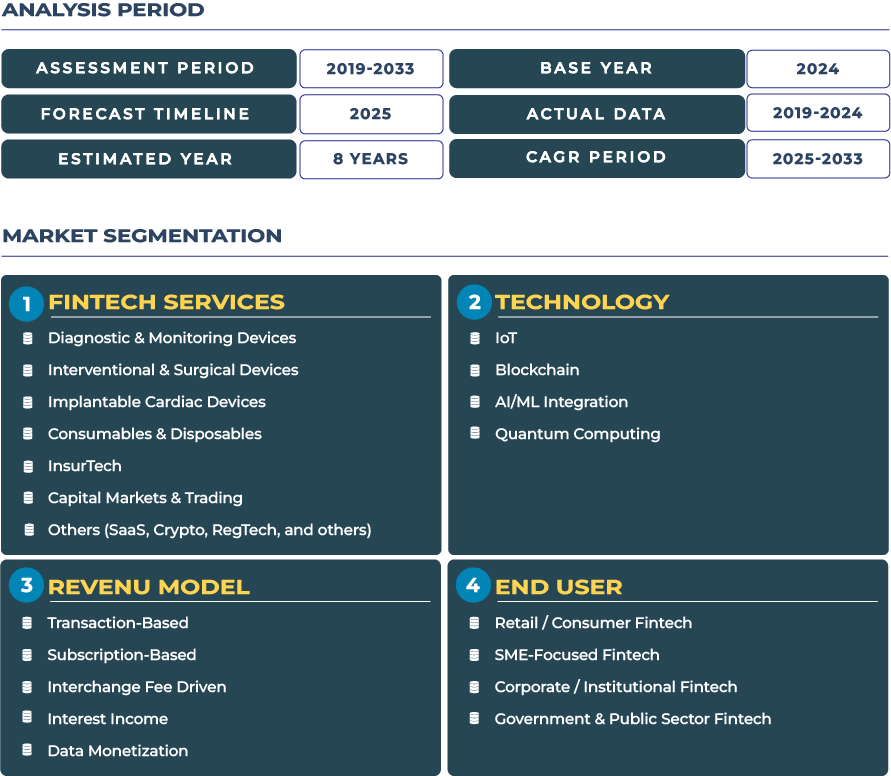
Israel Fintech Market Segmentation
Frequently Asked Questions
Israel cybersecurity strengths drive the development of fintech platforms with advanced fraud detection, biometric verification, and AML compliance, ensuring trust in global markets.
They focus on B2B SaaS exports, form partnerships with international banks, and leverage venture capital to scale operations beyond Israel limited local market.
Israeli fintechs attract global VC interest in cyber-fintech, using funds to expand cross-border regtech, compliance SaaS, and secure digital payment products.
Related Reports

Peru Generative AI ASICs Market Size | 2019-2033
- Report ID: SEM263 | Coverage: Country |
- Category: Semiconductors | Sub-Category: AI Chips |
- Published Date: Dec 2025 | US$495 |
Germany Medical Device Market Size | 2019-2033
- Report ID: HEA30 | Coverage: Country |
- Category: Healthcare | Sub-Category: Medical Devices |
- Published Date: Feb 2026 | US$495 |
Kuwait Media Market Size | 2019-2033
- Report ID: MAE44 | Coverage: Country |
- Category: Media and Entertainment | Sub-Category: Media |
- Published Date: May 2025 | US$495 |
Australia Private Banking Market Size | 2019-2033
- Report ID: BAF927 | Coverage: Country |
- Category: Banking and Finance | Sub-Category: Banking Services |
- Published Date: Oct 2025 | US$495 |
Peru Generative AI ASICs Market Size | 2019-2033
- Report ID: SEM263 | Coverage:Country |
- Category:Semiconductors | Sub-Category: AI Chips |
- Publishing Soon |US$495 |
Germany Medical Device Market Size | 2019-2033
- Report ID: HEA30 | Coverage:Country |
- Category:Healthcare | Sub-Category: Medical Devices |
- Published Date: Feb 2026 |US$495 |
Kuwait Media Market Size | 2019-2033
- Report ID: MAE44 | Coverage:Country |
- Category:Media and Entertainment | Sub-Category: Media |
- Published Date: May 2025 |US$495 |
Australia Private Banking Market Size | 2019-2033
- Report ID: BAF927 | Coverage:Country |
- Category:Banking and Finance | Sub-Category: Banking Services |
- Published Date: Oct 2025 |US$495 |
Why Choose Us

24/5 Research Support
Get your queries resolved prior to and post purchasing research study

Customize As Per Specific Requirements
Get in-depth analysis based on your tailored research needs

Expertise in Tracking Niche Markets
Comprehensive view of latest technologies and opportunities across markets

360-Degree Analysis
Fact-based insights derived through supply & demand side analysis

Assured Quality
Deliver most accurate industry insights to maintain research quality

Information Security
Your confidential and personal data is secure and safe