
Italy Connector Market Size and Forecast by Product Type, Price Range, End Product, Voltage Range, and Distribution Channel: 2019-2033
July 2025
| Format:

 |
Pages: 110+
|
Type: Industry Report
|
Authors:
David Gomes
(Manager – Semiconductor)
|
Pages: 110+
|
Type: Industry Report
|
Authors:
David Gomes
(Manager – Semiconductor)
MARKET OUTLOOK
Italy Connector Market Outlook
Maritime Modernization and Railway Renaissance Powering the Connector Market Surge
Italy connector industry is undergoing a transformative shift as the nation reinvests in its maritime infrastructure, railway networks, and mining systems. These critical industries are placing new demands on the connector sector, especially for ruggedized and hybrid wireless-wired solutions capable of operating under extreme environmental conditions. With forecasts suggesting the Italy connector market will grow to USD 2.18 billion by 2033. This represents a compound annual growth rate (CAGR) of 5.4% from 2025 to 2033, driven by increased digitization in industrial sectors and the integration of Industrial Internet of Things (IIoT) applications.
The adoption of circular connectors with environmental sealing and shock-proof designs has seen a marked rise in Italy's transport and heavy-duty sectors. Hybrid modules that connect wireless chips to wired backbones are also gaining traction, especially in smart ports and rolling stock digitization projects. These solutions allow real-time communication between machinery and control centers, enhancing system responsiveness and fault diagnosis while minimizing downtime. With port automation projects underway in Genoa and Trieste, and the expansion of Italy’s railway electrification programs, rugged, high-bandwidth connector systems are quickly becoming indispensable.
Growth Driven by Maritime and Rail Upgrades
A key growth driver in Italy connector sector is the government-backed modernization of maritime logistics and railway infrastructure. These verticals demand connectors that can withstand vibration, saltwater exposure, dust ingress, and temperature extremes. Circular and terminal block connectors are gaining ground, especially in undersea cabling systems, shipboard data systems, and onboard train control modules.
Simultaneously, the mining sector is adopting more electronic instrumentation for environmental compliance and productivity monitoring. This requires ruggedized interfaces between control units, telemetry systems, and on-site power distribution boards. The presence of underground and open-pit mining operations in regions such as Tuscany and Sardinia continues to provide demand for shock-resistant, waterproof, and corrosion-proof connectors.
Despite this momentum, challenges such as OEM vertical integration are limiting external connector supplier opportunities. Larger industrial players are opting to develop proprietary connector solutions to protect intellectual property and achieve design compatibility. In parallel, the increasing complexity of testing high-speed data connectors for industrial automation poses performance validation hurdles, particularly for smaller domestic manufacturers.
Trends in Rugged Hybrid Modules and Smart Systems
The Italian connector landscape is shifting toward hybrid designs that bridge traditional wired systems with wireless protocols such as LoRa, NB-IoT, and 5G. This is particularly relevant in Italy’s expanding network of smart agriculture, logistics, and autonomous machinery systems. Connector designs that integrate antenna capabilities and rugged mechanical interfaces are now a competitive differentiator.
Agriculture and mining operations are seeing the deployment of more telemetry-driven systems where hybrid connectors allow edge computing devices to function seamlessly in dusty or vibration-heavy environments. Additionally, modular connector systems with snap-in functionality are rising in popularity across industrial automation lines. These systems reduce downtime, enhance serviceability, and allow fast retrofitting in case of component obsolescence or regulatory change.
Italy’s connector firms are also tapping into export-oriented opportunities in Latin America, North Africa, and Australia—regions with similar demands for durable and multi-environment communication modules. Industrial players are forming partnerships with IoT integrators and systems design companies to offer bundled solutions that include ruggedized connector hardware preconfigured for specific application needs.
Enabling Safe, Durable, and Compliant Deployments
Italy connector market is subject to regulatory frameworks enforced by both national and EU institutions. Key oversight is provided by the Italian Electrotechnical Committee (CEI) and CE marking under European conformity standards. Connectors designed for rail and maritime applications must meet specific environmental compliance standards under ISO/IEC 60529 for ingress protection (IP ratings), as well as EU directives such as RoHS and REACH.
With Italy’s commitment to digital and green transitions under the National Recovery and Resilience Plan (NRRP), stricter scrutiny is being placed on the environmental performance and recyclability of industrial electronics, including connectors. Manufacturers are increasingly expected to disclose lifecycle data and materials provenance, pushing the market toward eco-compliant, traceable component designs.
Local Logistics and Sectoral Specialization
The performance of Italy’s connector industry is shaped by several macro and microeconomic forces. Italy ranks competitively in the Logistics Performance Index (LPI), allowing connector firms to deliver rapidly across the European continent. This geographic advantage is particularly important for mid-sized manufacturers serving just-in-time clients in France, Germany, and Eastern Europe.
In parallel, Italy connector sector benefits from deep specialization in niche markets such as shipbuilding, railway component manufacturing, and underground automation systems. Regional industrial clusters in Lombardy, Emilia-Romagna, and Piedmont offer a dense network of component vendors, engineering firms, and test labs that facilitate high-quality, sector-specific connector innovation.
However, persistent challenges in energy pricing and inflation volatility require cost-control mechanisms in material procurement and production cycles. Segment-specific targeting, supported by digital supply chain platforms and predictive demand modeling, is emerging as a key strategy among leading players.
Channel Optimization and Strategic Alliances
Italy connector ecosystem features a strong mix of local innovators and global heavyweights. Major international players like Amphenol, Molex, and TE Connectivity operate alongside specialized Italian firms such as LEMO Italia and Elettroservice. These companies are increasingly leveraging online channels and e-commerce to reach diverse industrial buyers with small-batch and quick-ship connector solutions.
Strategic alliances are also playing a larger role. Local OEMs and connector manufacturers are collaborating to co-develop ruggedized connector kits designed for harsh-use deployment in Italy’s smart rail terminals and coastal communication systems. The emphasis is on modularity, rapid deployment, and repairability in sectors where maintenance windows are narrow and downtime costs are high.
Built for Toughness, Designed for Connectivity
Italy connector industry stands at a pivotal moment, driven by the convergence of rugged design requirements, digital infrastructure investments, and advanced automation rollouts. From port terminals to mountain railways and mining shafts, the demand for connectors that offer resilience, speed, and modularity is escalating.
Companies that emphasize hybrid wired-wireless architectures, environmental durability, and e-commerce channel readiness are well positioned to capitalize on Italy’s industrial transformation. As global supply chains continue to adapt, the connector sector in Italy offers a unique blend of engineering precision, sectoral insight, and export viability.
*Research Methodology: This report is based on DataCube’s proprietary 3-stage forecasting model, combining primary research, secondary data triangulation, and expert validation.
[Learn more]
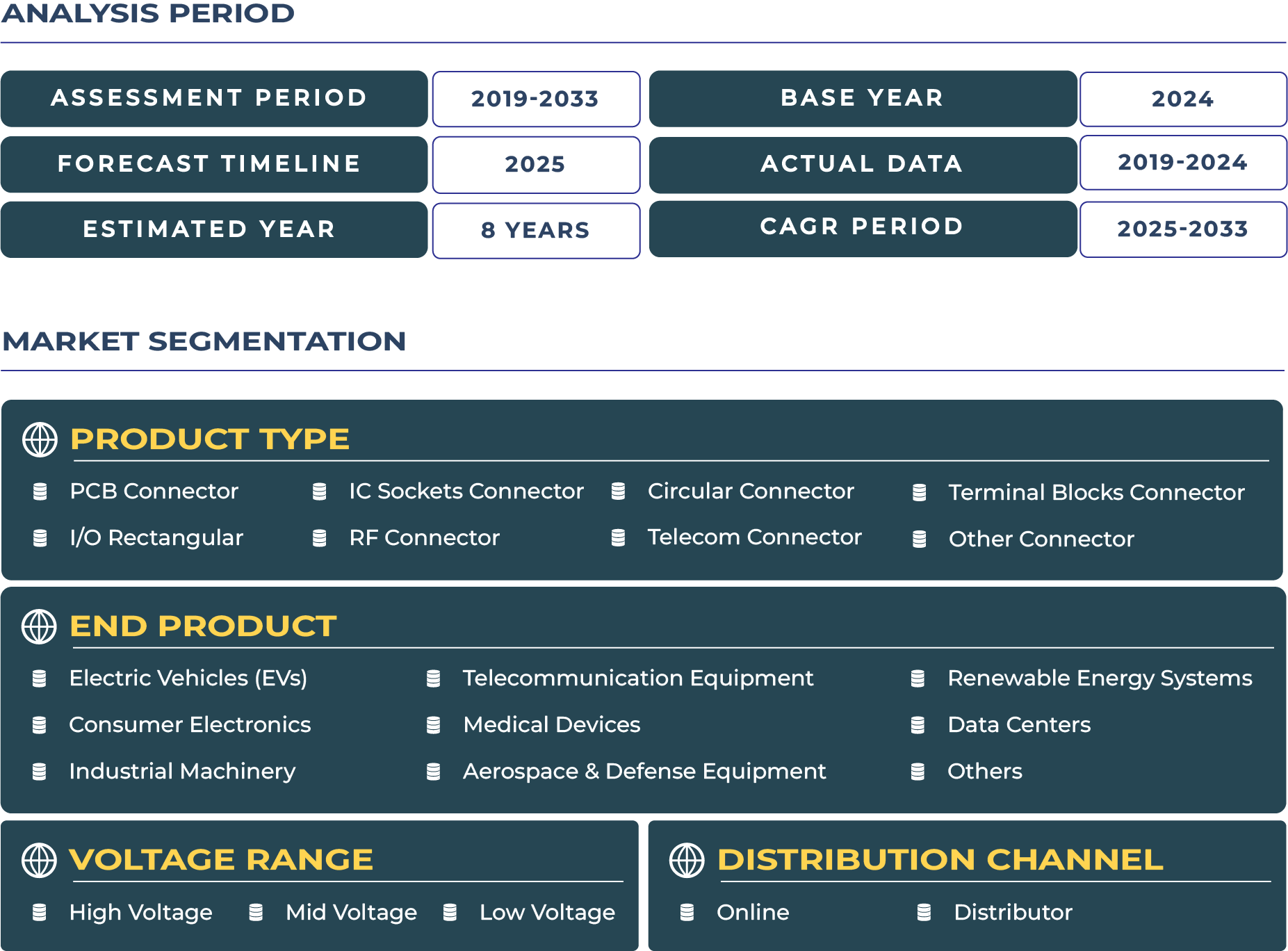
Italy Connector Market Segmentation
Frequently Asked Questions
Ruggedization ensures resistance to vibration, corrosion, and environmental extremes essential for harsh-use applications like ports, railways, and mines.
Wireless-bridging connectors enable real-time telemetry and automation by linking wireless chips to wired networks in industrial IoT ecosystems.
Italy’s specialized sectors and modernization projects in transport and heavy industries provide diverse environments ideal for hybrid module validation.
Why Choose Us

24/5 Research Support
Get your queries resolved prior to and post purchasing research study

Customize As Per Specific Requirements
Get in-depth analysis based on your tailored research needs

Expertise in Tracking Niche Markets
Comprehensive view of latest technologies and opportunities across markets

360-Degree Analysis
Fact-based insights derived through supply & demand side analysis

Assured Quality
Deliver most accurate industry insights to maintain research quality

Information Security
Your confidential and personal data is secure and safe