
Italy Diagnostic Imaging Devices Market Size and Forecast by Modality, Application, Technology, End User, and Portability: 2019-2033
Oct 2025
| Format:

 |
Pages: 110+
|
Type: Sub-Industry Report
|
Authors:
Mahesh Y
(Assistant Research Manager)
|
Pages: 110+
|
Type: Sub-Industry Report
|
Authors:
Mahesh Y
(Assistant Research Manager)
MARKET OUTLOOK
Public-Private Synergies Redefining the Italy Diagnostic Imaging Devices Market Landscape
Italy diagnostic imaging devices sector is undergoing a structural transformation, driven by a unique blend of public-private partnerships (PPPs) that are reshaping national healthcare delivery. The convergence of government reforms and private diagnostic investments is revitalizing imaging infrastructure, from major hospitals in Milan to community diagnostic centers in Sicily. The Ministry of Health (Ministero della Salute) has been accelerating its modernization initiatives under the National Recovery and Resilience Plan (PNRR), earmarking significant funds to renew imaging equipment and digitalize workflows across regional health authorities. As a result, the Italy Diagnostic Imaging Devices Market is projected to grow from USD 1.2 billion in 2025 to approximately USD 1.7 billion by 2033, expanding at a CAGR of 3.7% during 2025–2033. This trajectory underscores the nation’s steady transition toward efficiency-driven, value-based healthcare models supported by both public and private sector momentum.
Italy Diagnostic Imaging Devices Market Outlook: PPP Frameworks Fuel Italy’s Imaging Infrastructure Evolution
Italy’s healthcare modernization strategy is distinctly characterized by PPP-led capital investment programs and strategic collaborations that are modernizing imaging infrastructure. The ongoing distribution of diagnostic capacity is supported by the Italian Ministry of Health and regional health agencies under PNRR’s “Mission 6 – Health,” which emphasizes technological renewal and equitable access to diagnostics. This has led to the replacement of outdated CT and MRI systems with energy-efficient, AI-integrated imaging units across northern and central regions. Simultaneously, private operators are expanding specialized outpatient diagnostic centers to reduce waiting lists for MRI and PET scans. The resulting synergy between public healthcare modernization and private clinical efficiency has positioned Italy as one of the fastest-improving imaging markets in Southern Europe. Rising demand for non-invasive diagnostics, particularly in oncology and cardiology, continues to drive the adoption of PET and CT technologies, signaling a mature yet growth-oriented diagnostic imaging devices ecosystem.
Drivers & Restraints: Regional Modernization and Fragmented Procurement Define Market Dynamics
Public and Private Sector Investment Shaping Diagnostic Modernization: Italy’s northern regions such as Lombardy, Emilia-Romagna, and Veneto are leading large-scale imaging modernization initiatives, leveraging regional health authority funding to upgrade hospital diagnostic systems. The growing footprint of private diagnostic networks in southern regions and islands, like Apulia, Sicily, and Sardinia, is filling systemic service gaps in imaging accessibility. Multimodality adoption, particularly in ultrasound and CT, is rising as hospitals integrate digital platforms for cross-site image sharing and tele-radiology. The country’s steady economic stabilization and healthcare funding resilience have supported sustained capital expenditure in medical imaging technologies, positioning Italy as a strategic hub for European healthcare investments.
Procurement Complexity and Bureaucratic Cycles Hindering Speed of Adoption: Despite progress, Italy diagnostic imaging devices industry faces administrative constraints stemming from regionalized procurement processes. Lengthy public tender cycles and diverse compliance requirements between regions slow down technology deployment, particularly in PET and hybrid modalities. Additionally, pricing constraints in public procurement limit rapid replacement of aging X-ray and MRI systems. These challenges are further compounded by an uneven geographic distribution of advanced imaging infrastructure, with southern Italy still lagging behind northern and central regions. Addressing these procurement inefficiencies through centralized frameworks and harmonized standards remains critical to sustaining long-term market growth.
Trends & Opportunities: Outpatient Expansion and Technological Integration Drive Next-Generation Diagnostics
Outpatient Diagnostic Expansion Alleviating Hospital Workload: A defining trend within the Italy diagnostic imaging devices market is the shift toward outpatient imaging centers, designed to decongest hospitals and bring services closer to communities. Cities such as Rome, Turin, and Naples are witnessing an expansion of privately operated centers equipped with high-end CT and MRI systems. Portable ultrasound technologies are also being rapidly adopted for community obstetrics and rural healthcare initiatives. These trends reflect the country’s growing focus on accessible, decentralized diagnostics to support preventive healthcare objectives.
Localized Solutions and PPP-Driven Opportunities for Equipment Providers: For manufacturers and integrators, Italy offers a favorable environment for tailored solutions and PPP-based collaborations. Tender-compliant, region-specific proposals, supported by local clinical partners, have shown higher success rates in recent years. Equipment providers are increasingly offering hybrid procurement models that combine refurbished and new systems to address budget constraints in smaller regions. Opportunities also lie in creating mobile imaging fleets and digital reporting systems for underserved provinces, fostering new business models within the diagnostic imaging devices sector.
Competitive Landscape: Strategic Partnerships and Digital PET Expansion Transform Market Competition
Italy diagnostic imaging devices landscape is anchored by both global OEMs and emerging technology providers that are deepening their engagement through localized strategies. Companies such as United Imaging, Canon Medical, and Siemens Healthineers are actively expanding installations and partnerships. In 2024, United Imaging and its partners introduced mobile digital PET/CT services in Italy, marking the country’s first deployment of on-site oncology imaging capabilities. The same year, United Imaging highlighted total-body PET/CT (uExplorer) installations at leading Italian hospitals, reflecting a shift toward precision molecular diagnostics. Canon Medical’s advanced imaging systems are gaining momentum through adaptive designs suited for regional hospital networks. These developments signal a maturing market emphasizing digital integration, remote diagnostics, and continuous imaging innovation.
*Research Methodology: This report is based on DataCube’s proprietary 3-stage forecasting model, combining primary research, secondary data triangulation, and expert validation.
[Learn more]
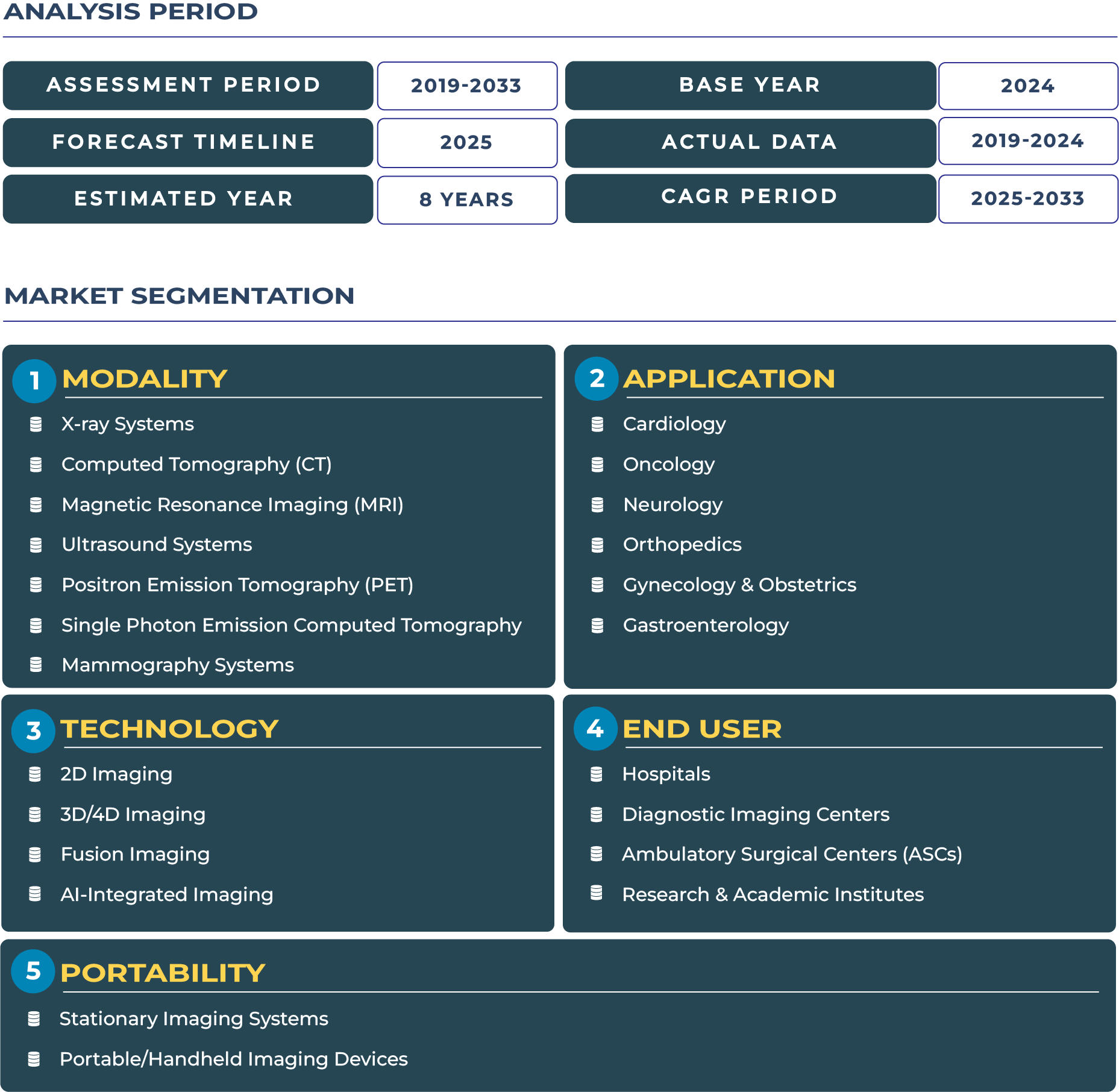
Italy Diagnostic Imaging Devices Market Segmentation
Frequently Asked Questions
Public-private partnerships (PPPs) are critical in expanding diagnostic capacity across Italy. They enable the modernization of imaging infrastructure by combining government funding with private operational efficiency, particularly in underserved regions.
Italy’s hospital modernization is being propelled by the National Recovery and Resilience Plan, which prioritizes digital upgrades, energy-efficient systems, and the replacement of obsolete imaging equipment under unified national standards.
Private diagnostic providers are expanding rapidly in southern and island regions, leveraging advanced CT, MRI, and ultrasound systems to offer faster, community-based imaging access outside traditional hospital settings.
Related Reports

Israel SaaS Market Size | 2019-2034
- Report ID: IT1869 | Coverage: Country |
- Category: Information Technology | Sub-Category: Cloud Computing Technology |
- Published Date: Dec 2025 | US$495 |
Vietnam Investment Banking Market Size | 2019-2033
- Report ID: BAF862 | Coverage: Country |
- Category: Banking and Finance | Sub-Category: Banking Services |
- Published Date: Oct 2025 | US$495 |
UAE Rural Banking Market Size | 2019-2033
- Report ID: BAF962 | Coverage: Country |
- Category: Banking and Finance | Sub-Category: Banking Services |
- Published Date: Oct 2025 | US$495 |
Latin America Diagnostic Imaging Devices Market Size | 2019-2033
- Report ID: HEA348 | Coverage: Regional |
- Category: Healthcare | Sub-Category: Medical Devices |
- Published Date: Nov 2025 | US$1,345 |
ASEAN AI Image Recognition Market Size | 2019-2033
- Report ID: IT1981 | Coverage: Regional |
- Category: Information Technology | Sub-Category: Artificial Intelligence |
- Published Date: Dec 2025 | US$1,345 |
Kuwait Diagnostic and Monitoring Devices Market Size | 2019-2033
- Report ID: HEA417 | Coverage: Country |
- Category: Healthcare | Sub-Category: Medical Devices |
- Published Date: Dec 2025 | US$495 |
Israel SaaS Market Size | 2019-2034
- Report ID: IT1869 | Coverage:Country |
- Category:Information Technology | Sub-Category: Cloud Computing Technology |
- Published Date: Dec 2025 |US$495 |
Vietnam Investment Banking Market Size | 2019-2033
- Report ID: BAF862 | Coverage:Country |
- Category:Banking and Finance | Sub-Category: Banking Services |
- Published Date: Oct 2025 |US$495 |
UAE Rural Banking Market Size | 2019-2033
- Report ID: BAF962 | Coverage:Country |
- Category:Banking and Finance | Sub-Category: Banking Services |
- Published Date: Oct 2025 |US$495 |
Latin America Diagnostic Imaging Devices Market Size | 2019-2033
- Report ID: HEA348 | Coverage:Regional |
- Category:Healthcare | Sub-Category: Medical Devices |
- Published Date: Nov 2025 |US$1,345 |
ASEAN AI Image Recognition Market Size | 2019-2033
- Report ID: IT1981 | Coverage:Regional |
- Category:Information Technology | Sub-Category: Artificial Intelligence |
- Publishing Soon |US$1,345 |
Kuwait Diagnostic and Monitoring Devices Market Size | 2019-2033
- Report ID: HEA417 | Coverage:Country |
- Category:Healthcare | Sub-Category: Medical Devices |
- Publishing Soon |US$495 |
Why Choose Us

24/5 Research Support
Get your queries resolved prior to and post purchasing research study

Customize As Per Specific Requirements
Get in-depth analysis based on your tailored research needs

Expertise in Tracking Niche Markets
Comprehensive view of latest technologies and opportunities across markets

360-Degree Analysis
Fact-based insights derived through supply & demand side analysis

Assured Quality
Deliver most accurate industry insights to maintain research quality

Information Security
Your confidential and personal data is secure and safe