
Kenya In-vitro Diagnostic Market Size and Forecast by Product Type, Technology, Application, Disease Type, End User, and Distribution Channel: 2019-2033
Oct 2025
| Format:

 |
Pages: 110+
|
Type: Sub-Industry Report
|
Authors:
Mahesh Y
(Assistant Research Manager)
|
Pages: 110+
|
Type: Sub-Industry Report
|
Authors:
Mahesh Y
(Assistant Research Manager)
MARKET OUTLOOK
Kenya’s Expanding Healthcare Infrastructure Unlocks New Horizons for the In-vitro Diagnostic Market
Kenya’s expanding healthcare infrastructure is reshaping the nation’s medical diagnostics landscape. The government’s significant investments in public health systems, including the ongoing rollouts of county-level hospitals and diagnostic laboratories, have amplified access to advanced testing solutions across both urban and rural regions. This development mirrors Kenya’s broader goal of achieving universal health coverage, as outlined by the Ministry of Health Kenya. The progress in healthcare infrastructure is not only driving wider orthopedic accessibility but also paving the way for the rapid adoption of in-vitro diagnostic (IVD) technologies.
The Kenya In-vitro Diagnostic Market is projected to grow from USD 170.0 million in 2025 to USD 292.0 million by 2033, reflecting a robust CAGR of 7.0% from 2025–2033. This steady rise can be attributed to improved healthcare financing, increasing disease awareness, and a surge in investments from private hospitals and diagnostic chains. Additionally, the country’s growing medical training centers and partnerships with international health organizations are empowering local professionals with advanced diagnostic capabilities, accelerating the sector’s digital transformation.
Strategic Growth Drivers: Regional Hub Development and Expanding Medical Access
Kenya’s strategic position as an East African healthcare hub continues to attract multinational investments in the in-vitro diagnostic industry. Nairobi, in particular, has become a focal point for regional diagnostic operations, benefiting from improved logistics and regulatory support from bodies such as the Pharmacy and Poisons Board. The influx of foreign capital and technology transfer initiatives are enabling local laboratories to access sophisticated instruments, reagents, and diagnostic software solutions previously unavailable in the region.
Furthermore, the growing network of private hospitals and medical training institutions is propelling the adoption of automated IVD systems. The integration of AI-enabled diagnostic software and real-time testing kits has reduced diagnosis time, improved accuracy, and enhanced disease monitoring, particularly for infectious diseases, oncology, and chronic conditions. This innovation-driven ecosystem is reinforcing Kenya’s role as a regional reference hub for medical testing and analysis.
Barriers to Progress: Limited Budgets and Workforce Gaps Hampering Equitable Access
Despite its rapid expansion, the Kenya in-vitro diagnostic market faces structural challenges that hinder its equitable distribution. A significant barrier remains the limited budget allocations for healthcare within county governments. This restricts the procurement of advanced testing kits and reagents, particularly in remote and underfunded regions. Additionally, logistics issues such as transport inefficiencies and insufficient cold chain facilities complicate the delivery of temperature-sensitive diagnostic materials to rural laboratories.
Another critical bottleneck is the shortage of skilled diagnostic professionals. Many counties still rely on manual or outdated instruments due to workforce gaps in laboratory technology and bioinformatics. The slow pace of digital integration across smaller healthcare centers adds further pressure. Bridging these gaps will require strategic collaborations between the public sector, private laboratories, and global diagnostic companies like Roche, which continue to invest in training programs and skill development to address Kenya’s evolving diagnostic needs.
Transformative Trends: Regional Referral Growth and Donor-Funded Laboratory Modernization
Several transformative trends are reshaping the Kenya in-vitro diagnostic sector. The emergence of regional referral hospitals has strengthened inter-county medical cooperation, allowing patients to access specialized diagnostic services closer to home. Donor-funded initiatives, particularly through global health agencies and NGOs, have accelerated the modernization of laboratory infrastructure, enhancing testing efficiency for diseases such as malaria, HIV, and tuberculosis.
Private clinics are also expanding their diagnostic portfolios, leveraging portable testing kits and real-time software analytics to cater to the growing demand for personalized healthcare. The rising trend of cloud-based diagnostic management systems is improving test tracking and data transparency, marking a decisive shift toward a digital-first healthcare ecosystem. These developments highlight how Kenya’s diagnostic transformation is moving beyond major cities like Nairobi and Mombasa, reaching underserved counties with accessible, affordable testing options.
Emerging Opportunities: Public-Private Partnerships and Diagnostic Innovation Expansion
Kenya in-vitro diagnostic landscape offers vast opportunities for innovation and expansion. Strategic public-private partnerships (PPPs) are proving instrumental in extending diagnostic access to remote counties. Collaborations between county hospitals and international manufacturers are facilitating the introduction of mobile diagnostic units and community-based screening programs, enabling faster detection of infectious and non-communicable diseases.
Affordable reagent kits, cloud-based diagnostic management tools, and AI-integrated testing software present strong growth prospects for companies targeting Kenya’s fast-evolving healthcare sector. There is also growing interest in local reagent manufacturing and open-source software platforms to reduce dependency on imports. These innovations are expected to drive inclusivity, ensuring that rural and peri-urban populations benefit from the same diagnostic precision as urban centers.
Competitive Landscape: Global Collaborations and Local Capacity Building Defining Market Dynamics
The Kenya in-vitro diagnostic industry features a balanced mix of global and regional players actively shaping market competition. Companies like Roche, Abbott, and Siemens Healthineers have strengthened their presence through partnerships with local hospitals and government agencies. These firms are introducing advanced molecular diagnostic systems and cloud-connected devices tailored to Kenya’s healthcare needs.
Recent initiatives include the expansion of public health diagnostic capacity through international collaboration programs under the Ministry of Health Kenya. Meanwhile, local laboratories are increasingly engaging in digital diagnostic solutions, leveraging AI-driven analytics and cloud connectivity. Continuous training and capacity-building efforts are enabling Kenya’s professionals to manage modern instruments and software efficiently. This blend of global collaboration and domestic skill enhancement is reinforcing Kenya’s status as a diagnostic innovation leader in East Africa.
*Research Methodology: This report is based on DataCube’s proprietary 3-stage forecasting model, combining primary research, secondary data triangulation, and expert validation.
[Learn more]
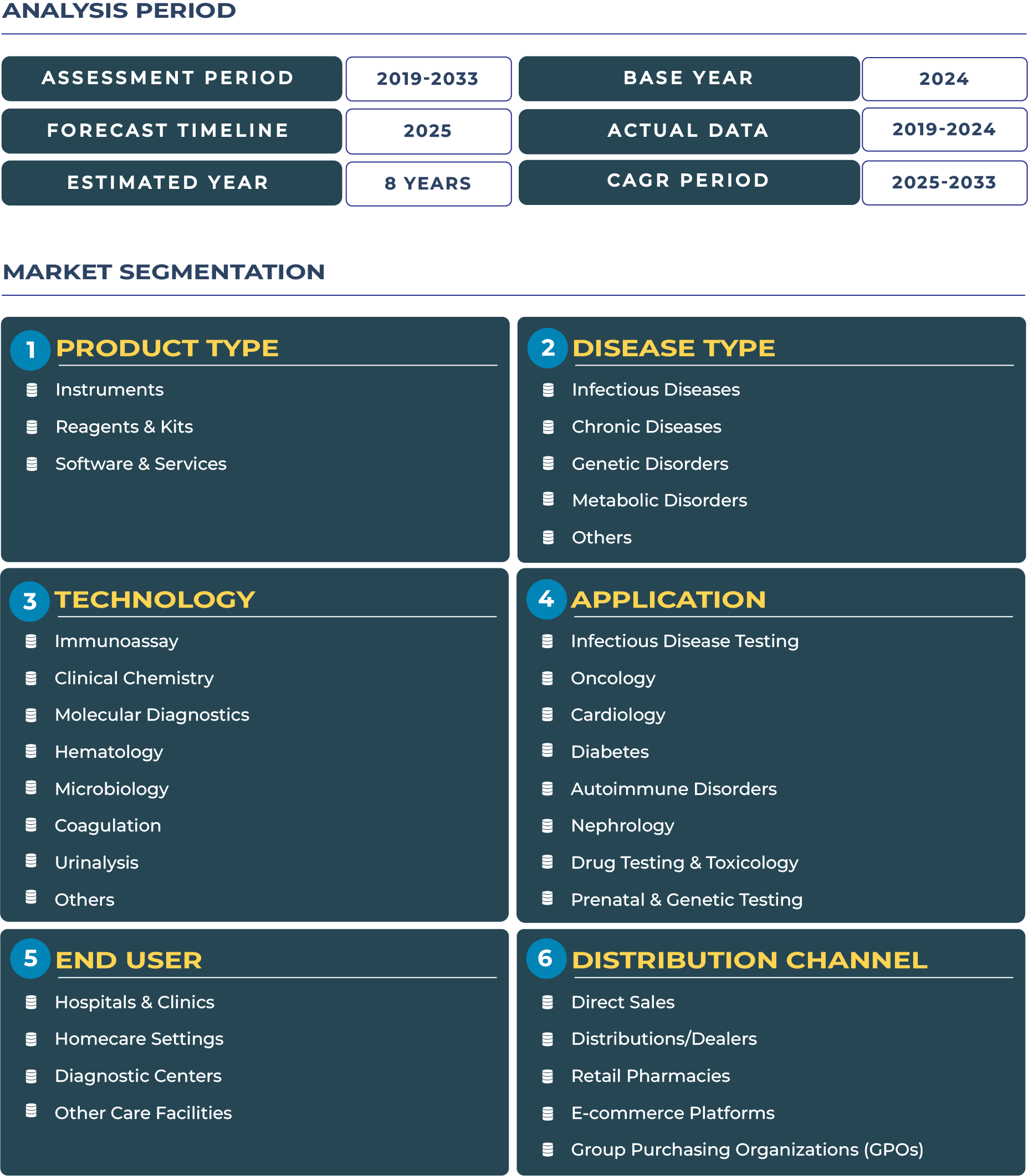
Kenya In-vitro Diagnostic Market Segmentation
Frequently Asked Questions
Healthcare infrastructure expansion in Kenya is driving greater access to diagnostic and surgical services, improving early detection, and enabling higher orthopedic and in-vitro diagnostic adoption across counties.
Rural affordability is constrained by limited budgets, inadequate cold-chain logistics, and workforce shortages, which collectively restrict access to advanced diagnostics and orthopedic procedures.
Opportunities lie in mobile diagnostic and trauma-care collaborations, expanding referral hubs, and localized manufacturing of affordable diagnostic kits that enhance emergency care efficiency.
Related Reports

Malaysia Private Banking Market Size | 2019-2033
- Report ID: BAF929 | Coverage: Country |
- Category: Banking and Finance | Sub-Category: Banking Services |
- Published Date: Oct 2025 | US$495 |
Japan Diagnostic Imaging Devices Market Size | 2019-2033
- Report ID: HEA336 | Coverage: Country |
- Category: Healthcare | Sub-Category: Medical Devices |
- Published Date: Nov 2025 | US$495 |
Malaysia Private Banking Market Size | 2019-2033
- Report ID: BAF929 | Coverage:Country |
- Category:Banking and Finance | Sub-Category: Banking Services |
- Published Date: Oct 2025 |US$495 |
Japan Diagnostic Imaging Devices Market Size | 2019-2033
- Report ID: HEA336 | Coverage:Country |
- Category:Healthcare | Sub-Category: Medical Devices |
- Published Date: Nov 2025 |US$495 |
Why Choose Us

24/5 Research Support
Get your queries resolved prior to and post purchasing research study

Customize As Per Specific Requirements
Get in-depth analysis based on your tailored research needs

Expertise in Tracking Niche Markets
Comprehensive view of latest technologies and opportunities across markets

360-Degree Analysis
Fact-based insights derived through supply & demand side analysis

Assured Quality
Deliver most accurate industry insights to maintain research quality

Information Security
Your confidential and personal data is secure and safe