
Kuwait In-vitro Diagnostic Market Size and Forecast by Product Type, Technology, Application, Disease Type, End User, and Distribution Channel: 2019-2033
Oct 2025
| Format:

 |
Pages: 110+
|
Type: Sub-Industry Report
|
Authors:
Mahesh Y
(Assistant Research Manager)
|
Pages: 110+
|
Type: Sub-Industry Report
|
Authors:
Mahesh Y
(Assistant Research Manager)
MARKET OUTLOOK
Kuwait In-vitro Diagnostic Market Outlook: A Small but High-Value Ecosystem Shaping Precision Healthcare
Introducing Kuwait’s high-value but smaller healthcare demand: Kuwait represents a distinctive model within the Middle East’s in-vitro diagnostic (IVD) ecosystem, compact in scale but rich in healthcare sophistication. With one of the world’s highest GDP per capita and strong government backing for advanced medical services, Kuwait’s healthcare sector maintains a sharp focus on premium imports and precision diagnostic tools. The Kuwait Ministry of Health continues to advance its vision of modernized healthcare by prioritizing automation, molecular testing, and predictive diagnostics across public and private hospitals.
The Kuwait In-vitro Diagnostic Market is projected to reach USD 104.4 million by 2033, growing from USD 73.1 million in 2025 at a CAGR of 4.6% from 2025–2033. This steady performance is supported by Kuwait’s high per-capita healthcare expenditure, state-sponsored hospital upgrades, and the government’s policy of sourcing best-in-class diagnostic solutions from global leaders. Despite its smaller scale, Kuwait’s diagnostic market is well-positioned within the regional context due to its high-value consumption pattern, preference for technologically advanced instruments, and a rising trend of digital integration across diagnostic workflows.
A Compact Market with Premium Diagnostic Ambitions
Kuwait’s healthcare system has evolved into a model of quality-driven modernization, fueled by wealth, government stewardship, and a growing emphasis on personalized medicine. The IVD sector, though smaller than its GCC counterparts, is strategically evolving through targeted investments in automated laboratory systems, reagent standardization, and software-driven diagnostic management. Hospitals such as Al Sabah Medical Complex and Jaber Al-Ahmad Hospital are increasingly adopting integrated laboratory information systems to enhance accuracy and efficiency in test outcomes.
The Kuwait Laboratory Accreditation Center and public health authorities have established stringent quality protocols, aligning diagnostic practices with global ISO standards. The private healthcare sector is also expanding, led by boutique hospitals and specialized diagnostic centers focusing on molecular biology, infectious disease screening, and oncology diagnostics. These dynamics reflect a growing market maturity supported by a robust infrastructure, sustained health funding, and the population’s preference for premium diagnostic care. Kuwait’s strategic imports of advanced testing platforms from players like Roche Diagnostics further underline its focus on high-end, precision-driven diagnostics.
Drivers & Restraints: High-Value Market Expansion Meets Structural Constraints
High Per-Capita Healthcare Spending and Modernization Projects Drive Diagnostic Growth
Kuwait’s small but affluent population underpins strong demand for precision diagnostic tools. The government allocates a substantial portion of its national budget to healthcare, ensuring access to high-quality testing technologies across both public hospitals and private clinics. The continuous modernization of healthcare infrastructure, including laboratory digitization and automated analyzer adoption, has positioned the country as a benchmark for high-value care in the Gulf region. The Ministry of Health’s investment in AI-integrated diagnostic systems and cloud-based laboratory data solutions further amplifies market growth, particularly for reagent kits and software-enabled diagnostic services.
Small Market Scale and Talent Competition Create Structural Challenges
Despite its high-value orientation, Kuwait’s in-vitro diagnostic market faces natural scalability limits. The small population size restricts overall test volumes, reducing economies of scale for both global and local suppliers. Furthermore, competition for skilled laboratory professionals, especially biomedical engineers and molecular technologists, remains intense, with neighboring GCC countries like the UAE and Saudi Arabia offering larger ecosystems and competitive incentives. Procurement processes in Kuwait are also centralized, limiting supplier diversity and extending product approval timelines. These constraints create a challenging environment for new entrants, especially those lacking established local distribution channels or managed service capabilities.
Trends & Opportunities: Boutique Hospital Partnerships and High-End Diagnostic Integration
Targeted Hospital Upgrades and Adoption of High-ASP Diagnostic Instruments
Kuwait’s ongoing hospital expansion programs are increasingly focused on equipping smaller, specialized facilities with top-tier diagnostic instruments. High-ASP (Average Selling Price) analyzers and molecular testing platforms are gaining traction in tertiary care and boutique hospitals, especially those catering to expatriate populations seeking advanced screening services. The digitization of diagnostic workflows is another defining trend, with hospital networks integrating laboratory information systems to improve interoperability and patient data analytics. These technology-driven transformations are fostering demand for software and service-oriented diagnostic solutions that enhance operational efficiency and patient outcomes.
Boutique Hospital Partnerships and Managed Service Models Create New Growth Channels
One of the most promising opportunities in Kuwait IVD landscape lies in the rise of boutique healthcare facilities that prioritize patient experience, precision medicine, and rapid testing. International IVD manufacturers are partnering with these facilities to provide managed diagnostic services, wherein equipment, reagents, and maintenance are bundled under long-term contracts. This model helps small hospitals and diagnostic centers overcome capital constraints while ensuring consistent test quality. Moreover, local partnerships are being encouraged by the government to boost knowledge transfer and create a more sustainable diagnostic supply chain aligned with the national development vision.
Competitive Landscape: Localization and Service Excellence Define Market Strategies
The Kuwait In-vitro Diagnostic Market features a mix of multinational and regional companies operating through distributor networks and service partners. Global leaders such as Roche Diagnostics, Abbott Laboratories, and Siemens Healthineers continue to dominate through product innovation and hospital partnerships. Local distributors like Advanced Technology Company (ATC) play a crucial role in connecting international suppliers with public hospitals and private clinics. Market strategies increasingly revolve around offering managed service models, specialized training programs for local technicians, and niche diagnostic solutions for premium hospitals. The ongoing collaboration between the Ministry of Health and private entities is strengthening Kuwait’s diagnostic resilience, ensuring that even a small market can deliver high clinical value.
*Research Methodology: This report is based on DataCube’s proprietary 3-stage forecasting model, combining primary research, secondary data triangulation, and expert validation.
[Learn more]
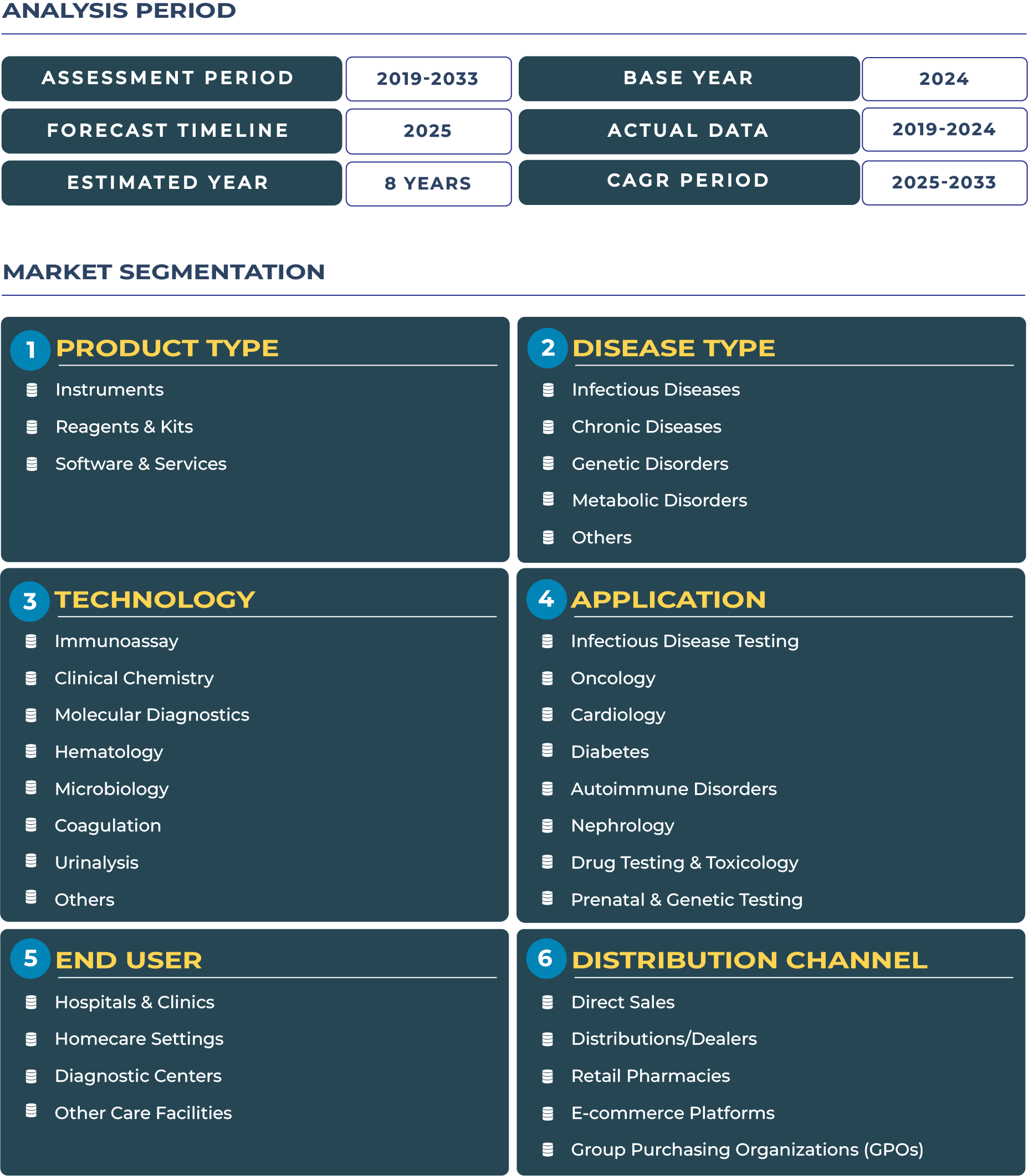
Kuwait In-vitro Diagnostic Market Segmentation
Frequently Asked Questions
Kuwait’s affluent population drives demand for advanced medical technologies, including premium diagnostic systems. High disposable income encourages patients and hospitals to invest in precision-driven healthcare solutions.
The smaller population limits test volumes and procurement frequency, challenging scalability. However, niche premium offerings and managed service partnerships mitigate these limitations effectively.
Demand for premium and specialized diagnostic and medical products reflects Kuwait’s focus on high-end healthcare delivery. Hospitals prefer imported, proven-quality solutions over cost-competitive alternatives.
Related Reports

Brazil SaaS Market Size | 2019-2034
- Report ID: IT1858 | Coverage: Country |
- Category: Information Technology | Sub-Category: Cloud Computing Technology |
- Published Date: Dec 2025 | US$495 |
ASEAN Private Banking Market Size | 2019-2033
- Report ID: BAF921 | Coverage: Regional |
- Category: Banking and Finance | Sub-Category: Banking Services |
- Published Date: Oct 2025 | US$1,345 |
Qatar Private Banking Market Size | 2019-2033
- Report ID: BAF982 | Coverage: Country |
- Category: Banking and Finance | Sub-Category: Banking Services |
- Published Date: Nov 2025 | US$495 |
Europe AI Service Robotics Market Size | 2019-2033
- Report ID: IT1941 | Coverage: Regional |
- Category: Information Technology | Sub-Category: Artificial Intelligence |
- Published Date: Dec 2025 | US$1,345 |
Brazil SaaS Market Size | 2019-2034
- Report ID: IT1858 | Coverage:Country |
- Category:Information Technology | Sub-Category: Cloud Computing Technology |
- Published Date: Dec 2025 |US$495 |
ASEAN Private Banking Market Size | 2019-2033
- Report ID: BAF921 | Coverage:Regional |
- Category:Banking and Finance | Sub-Category: Banking Services |
- Published Date: Oct 2025 |US$1,345 |
Qatar Private Banking Market Size | 2019-2033
- Report ID: BAF982 | Coverage:Country |
- Category:Banking and Finance | Sub-Category: Banking Services |
- Published Date: Nov 2025 |US$495 |
Europe AI Service Robotics Market Size | 2019-2033
- Report ID: IT1941 | Coverage:Regional |
- Category:Information Technology | Sub-Category: Artificial Intelligence |
- Publishing Soon |US$1,345 |
Why Choose Us

24/5 Research Support
Get your queries resolved prior to and post purchasing research study

Customize As Per Specific Requirements
Get in-depth analysis based on your tailored research needs

Expertise in Tracking Niche Markets
Comprehensive view of latest technologies and opportunities across markets

360-Degree Analysis
Fact-based insights derived through supply & demand side analysis

Assured Quality
Deliver most accurate industry insights to maintain research quality

Information Security
Your confidential and personal data is secure and safe