
Latin America Cardiovascular Devices Market Size and Forecast by Device Type, Patient Demographics, End User, and Distribution Channel: 2019-2033
Sep 2025
| Format:

 |
Pages: 160+
|
Type: Sub-Industry Report
|
Authors:
Mahesh Y
(Assistant Research Manager)
|
Pages: 160+
|
Type: Sub-Industry Report
|
Authors:
Mahesh Y
(Assistant Research Manager)
MARKET OUTLOOK
Latin America Cardiovascular Devices Market Outlook: Urban Private Hospitals Powering a New Era of Cardiac Modernization
The Latin America Cardiovascular Devices Market is projected to expand from USD 1.43 billion in 2025 to USD 3.74 billion by 2033, growing at a CAGR of 12.8% during 2025–2033, according to DataCube Research. This strong growth outlook is anchored in rising healthcare investments in urban hubs, increasing access to interventional and implantable devices, and the growing role of telehealth integration for monitoring patients with cardiovascular diseases. Latin America’s evolving medical tourism landscape, particularly in countries such as Costa Rica, is also reinforcing demand for world-class cardiovascular technologies. This growth is sustainable given the region’s urban-led healthcare transformation, supportive policy reforms, and rising consumer demand for premium cardiac care.
How Urban-Led Cardiac Transformation Is Reshaping the Latin America Cardiovascular Devices Market
Latin America is entering a critical phase in its cardiovascular devices market, defined by the modernization of urban private hospitals and the rising emphasis on advanced cardiology care. Countries such as Brazil, Chile, and Colombia are at the forefront of this transformation, where high-capacity hospitals in major metropolitan centers are driving the adoption of diagnostic, interventional, and implantable cardiac technologies. Despite challenges such as fragmented healthcare access across rural and urban populations, the private sector in metropolitan hubs has emerged as the anchor for modernization, investing heavily in advanced cardiovascular infrastructure. With urban healthcare institutions integrating interventional devices, implantable cardiac solutions, and digital monitoring, Latin America is progressively narrowing its gap with global standards.
Macroeconomic shifts and health policy reforms are enabling long-term growth in this sector. Growing middle-class demand for advanced care, increasing prevalence of lifestyle-related cardiovascular conditions, and improved insurance penetration in urban regions are strengthening the cardiovascular devices industry across Latin America. However, regional disparities persist, with rural areas still heavily reliant on public facilities that face resource constraints. This duality has made urban private hospitals the growth accelerators for the sector, shaping a market that reflects both opportunity and inequality.
Drivers & Restraints: Structural Forces Shaping Latin America Cardiovascular Devices Ecosystem
Large Unmet Need and Urban Private Hospitals Driving Expansion
The cardiovascular devices market in Latin America is expanding due to a large unmet need for specialized cardiac care and the modernization of urban private hospitals. Rising cardiovascular disease prevalence across the region, partly linked to sedentary lifestyles and rising obesity rates, has created sustained demand for advanced medical devices. Private hospitals in cities like São Paulo and Santiago are upgrading their surgical and interventional capabilities, enabling greater adoption of implantable cardiac devices and interventional solutions. Additionally, the growth of medical tourism, with patients from North America and Europe seeking cost-effective but advanced cardiovascular care in Brazil, is further accelerating demand. The sector’s integration with insurance providers is also improving affordability for middle-class patients in urban areas, making advanced procedures more accessible.
Wide Country Variability and Price Sensitivity as Growth Barriers
Despite rapid urban growth, the Latin America cardiovascular devices sector faces challenges due to wide variability across countries and strong price sensitivity among patients. Public healthcare systems often lag in adoption of advanced technologies due to budgetary constraints, leaving rural populations underserved. Heavy reliance on imported devices creates price fluctuations, making access inconsistent across socioeconomic groups. Furthermore, diverse regulatory frameworks across countries delay market entry and complicate commercialization strategies for global companies. This fragmented environment hampers consistent adoption across the region, meaning growth is concentrated primarily in large urban markets with strong private-sector participation.
Trends & Opportunities: Shaping the Future of the Latin America Cardiovascular Devices Industry
Private Hospital Expansion and Telehealth Integration Redefining Care Delivery
Private hospitals across Latin America are spearheading modernization through expansion and integration of advanced cardiovascular devices. Large private healthcare chains in Brazil are investing in hybrid catheterization labs and advanced monitoring systems to improve treatment outcomes. Telehealth adoption, accelerated by the pandemic, is enabling long-term monitoring of cardiovascular patients in remote regions, helping reduce readmissions and improve outcomes. This trend is expected to create a sustainable demand for diagnostic and monitoring devices that connect seamlessly with telemedicine platforms, improving care quality across fragmented geographies.
Regional Distribution Hubs and Local Assembly Unlocking Opportunities
As cardiovascular device demand rises, Latin America is emerging as a strategic location for regional distribution hubs and local assembly facilities. Governments across the region, particularly in Brazil, are encouraging multinational firms to localize manufacturing to reduce costs and improve supply chain resilience. Opportunities also exist in establishing partnerships between telcos and healthcare providers to expand cardiovascular monitoring through mobile connectivity. Local clinical trials and pilot programs in urban hospitals are further creating evidence-based pathways for commercialization. These opportunities highlight the potential for long-term growth, provided companies adapt strategies to the region’s heterogeneous healthcare environment.
Regional Analysis by Country
Brazil Cardiovascular Devices Market
Brazil represents the largest share of the Latin America cardiovascular devices market, fueled by advanced private hospital networks and a strong public health system under Ministério da Saúde. The country’s cardiovascular burden is high, with rising cases of hypertension and coronary artery disease. Investments in interventional cardiology labs, growing medical tourism, and expansion of implantable cardiac device usage are shaping Brazil’s leadership. However, dependence on imports and price sensitivity among public hospitals present challenges. Brazil’s ongoing efforts to incentivize local manufacturing and clinical trials are likely to accelerate adoption of next-generation cardiovascular technologies.
Argentina Cardiovascular Devices Market
Argentina cardiovascular devices market is driven by increasing demand for diagnostic and monitoring devices in metropolitan areas like Buenos Aires. The country benefits from a relatively skilled healthcare workforce and growing adoption of interventional and surgical devices. However, macroeconomic instability and import restrictions hinder consistent market growth. Private hospitals are leading modernization by adopting implantable cardiac devices and consumables, while the public sector remains under budgetary pressures. Argentina cardiovascular devices market outlook remains tied to reforms that can stabilize procurement and improve accessibility, while foreign partnerships may support technology transfer and manufacturing opportunities in cardiovascular care.
Peru Cardiovascular Devices Market
Peru is an emerging market for cardiovascular devices, with modernization concentrated in Lima’s private hospitals. Diagnostic and monitoring devices are gaining traction as healthcare providers focus on preventive cardiology. Despite improvements in urban infrastructure, rural disparities and heavy reliance on imported devices limit broad adoption. Government initiatives to expand healthcare coverage are slowly improving access, though affordability challenges persist. Private hospital investments in interventional and implantable cardiac devices are creating new opportunities. Peru’s cardiovascular devices industry is poised for gradual growth as public-private collaborations and telehealth services enhance outreach to underserved populations.
Colombia Cardiovascular Devices Market
Colombia cardiovascular devices market is strengthening with expanding private hospital networks in Bogotá, Medellín, and Cali. The country’s universal health coverage model is supporting steady adoption of diagnostic and monitoring devices, particularly for chronic disease management. Growth is also propelled by Colombia’s positioning as a regional hub for medical tourism, which attracts patients for advanced interventional procedures. Nevertheless, regulatory complexities and import reliance remain hurdles. Multinational companies are partnering with local distributors to address price sensitivity and broaden device access. Colombia is emerging as a strategic market for both global and regional cardiovascular device manufacturers.
Chile Cardiovascular Devices Market
Chile cardiovascular devices market is supported by high healthcare spending per capita and advanced infrastructure in Santiago and other urban centers. Diagnostic and monitoring devices, along with interventional cardiology solutions, are increasingly adopted to manage rising cardiovascular disease prevalence. The country’s well-regarded healthcare system and openness to technology imports make it an attractive destination for international players. However, the small population base limits absolute market size. Ongoing investments in private hospitals and telehealth integration are expected to drive incremental growth. Chile continues to play an outsized role as a testbed for innovation within the Latin America cardiovascular devices sector.
Competitive Landscape: Strategic Moves Reshaping the Latin America Cardiovascular Devices Sector
The competitive landscape in the Latin America cardiovascular devices market is defined by a mix of international giants and emerging regional players. Global leaders such as Medtronic continue to expand their presence by offering implantable cardiac devices, interventional tools, and bundled telehealth-enabled solutions. Local manufacturers are also gaining momentum, especially in Brazil, through cost-competitive consumables and partnerships with private hospitals. Key strategies include regional hub development, distributor network expansion, and flexible pricing models to address price-sensitive segments. In recent years, private hospital investments in cardiac infrastructure, growth of consumables demand, and telehealth integration have accelerated competitive activity, positioning Latin America as a dynamic and evolving cardiovascular devices market.
*Research Methodology: This report is based on DataCube’s proprietary 3-stage forecasting model, combining primary research, secondary data triangulation, and expert validation.
[Learn more]
Latin America Cardiovascular Devices Market Segmentation
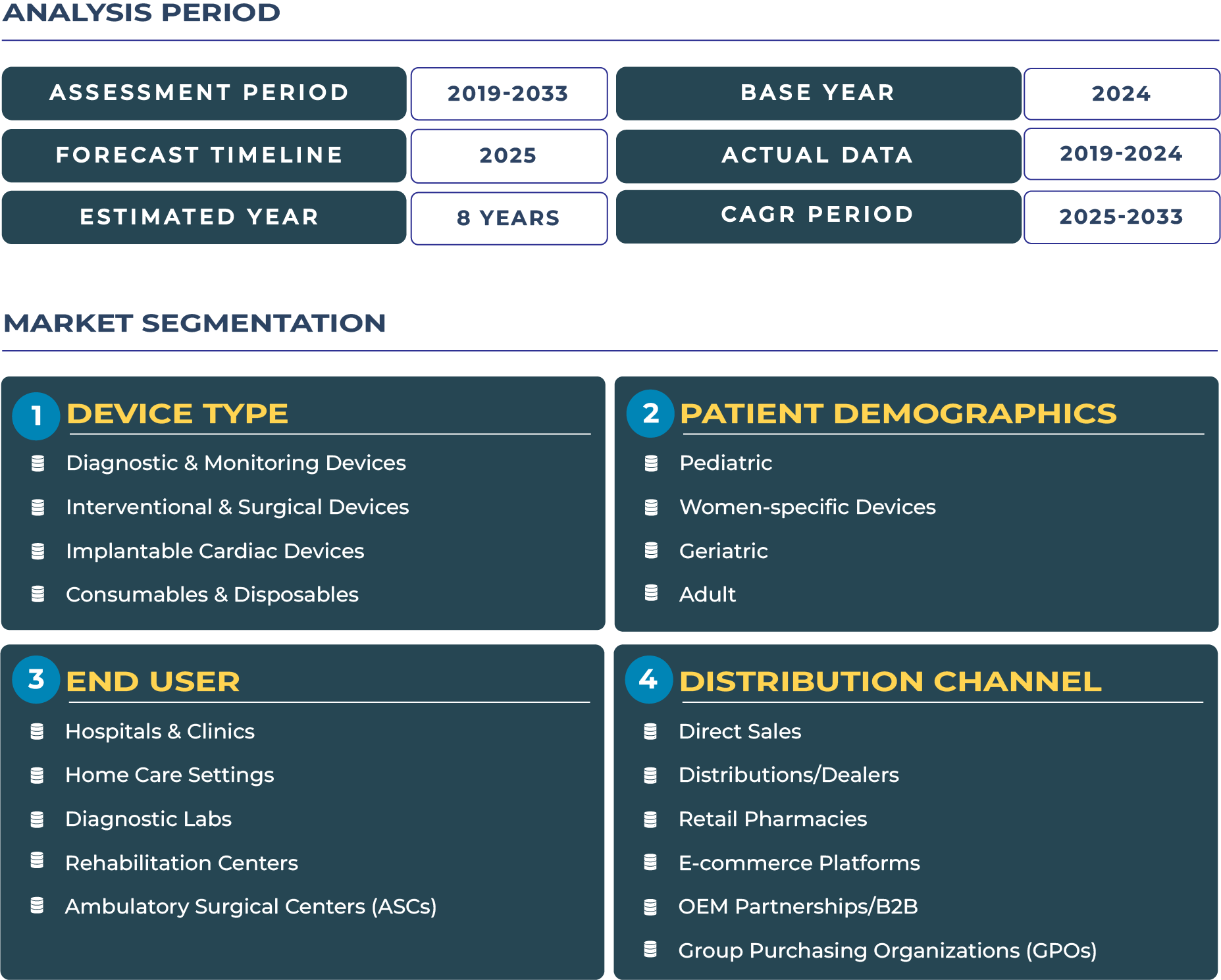
Latin America Cardiovascular Devices Market Countries Covered

Frequently Asked Questions
Brazil, Chile, and Colombia are priority markets due to their advanced private hospitals, large urban populations, and growing investments in cardiovascular care.
Flexible pricing, value-based procurement, and distributor-led bundled solutions are effective approaches, balancing affordability with access in highly price-sensitive markets.
Varying regulatory frameworks across countries, longer approval timelines, and the need for alignment with international standards create barriers to rapid commercialization.
Related Reports

Japan AI Robotics Market Size | 2019-2033
- Report ID: IT283 | Coverage: Country |
- Category: Information Technology | Sub-Category: Artificial Intelligence |
- Published Date: Dec 2025 | US$495 |
Brazil AI Facial Recognition Market Size | 2019-2033
- Report ID: IT393 | Coverage: Country |
- Category: Information Technology | Sub-Category: Artificial Intelligence |
- Published Date: Dec 2025 | US$495 |
Australia Drone Detection System Market Size | 2019-2033
- Report ID: A&D58 | Coverage: Country |
- Category: Aerospace & Defence | Sub-Category: Defence |
- Published Date: Jul 2025 | US$495 |
US PaaS Market Size | 2019-2033
- Report ID: IT1874 | Coverage: Country |
- Category: Information Technology | Sub-Category: Cloud Computing Technology |
- Published Date: Dec 2025 | US$495 |
Russia PaaS Market Size | 2019-2033
- Report ID: IT1887 | Coverage: Country |
- Category: Information Technology | Sub-Category: Cloud Computing Technology |
- Published Date: Dec 2025 | US$495 |
Japan AI Robotics Market Size | 2019-2033
- Report ID: IT283 | Coverage:Country |
- Category:Information Technology | Sub-Category: Artificial Intelligence |
- Publishing Soon |US$495 |
Brazil AI Facial Recognition Market Size | 2019-2033
- Report ID: IT393 | Coverage:Country |
- Category:Information Technology | Sub-Category: Artificial Intelligence |
- Publishing Soon |US$495 |
Australia Drone Detection System Market Size | 2019-2033
- Report ID: A&D58 | Coverage:Country |
- Category:Aerospace & Defence | Sub-Category: Defence |
- Published Date: Jul 2025 |US$495 |
US PaaS Market Size | 2019-2033
- Report ID: IT1874 | Coverage:Country |
- Category:Information Technology | Sub-Category: Cloud Computing Technology |
- Published Date: Dec 2025 |US$495 |
Russia PaaS Market Size | 2019-2033
- Report ID: IT1887 | Coverage:Country |
- Category:Information Technology | Sub-Category: Cloud Computing Technology |
- Published Date: Dec 2025 |US$495 |
Why Choose Us

24/5 Research Support
Get your queries resolved prior to and post purchasing research study

Customize As Per Specific Requirements
Get in-depth analysis based on your tailored research needs

Expertise in Tracking Niche Markets
Comprehensive view of latest technologies and opportunities across markets

360-Degree Analysis
Fact-based insights derived through supply & demand side analysis

Assured Quality
Deliver most accurate industry insights to maintain research quality

Information Security
Your confidential and personal data is secure and safe