
Mexico Diagnostic Imaging Devices Market Size and Forecast by Modality, Application, Technology, End User, and Portability: 2019-2033
Oct 2025
| Format:

 |
Pages: 110+
|
Type: Sub-Industry Report
|
Authors:
Mahesh Y
(Assistant Research Manager)
|
Pages: 110+
|
Type: Sub-Industry Report
|
Authors:
Mahesh Y
(Assistant Research Manager)
MARKET OUTLOOK
Mexico Diagnostic Imaging Devices Market Outlook: Affordable Imaging Expansion in Public Healthcare
Mexico’s healthcare sector is entering a transformative decade defined by the democratization of diagnostic imaging access. National health institutions are prioritizing affordability and modernization of medical infrastructure to serve both urban and rural populations. This reform-driven movement is shaping the Mexico Diagnostic Imaging Devices Market, projected to rise from USD 468.6 million in 2025 to USD 757.4 million by 2033, registering a compound annual growth rate (CAGR) of 6.2% during the period. The upward trajectory reflects strategic public-private partnerships, growing medical tourism, and the proliferation of mid-tier imaging systems tailored for emerging healthcare facilities. According to DataCube Research, Mexico’s diagnostic ecosystem is shifting from fragmented procurement toward value-based and sustainable imaging investments across hospitals and diagnostic centers.
Public Healthcare Modernization Driving Equitable Imaging Access
Public sector investment remains the cornerstone of market growth. The Ministry of Health is expanding imaging capabilities within Instituto Mexicano del Seguro Social (IMSS) and Instituto de Seguridad y Servicios Sociales de los Trabajadores del Estado (ISSSTE) networks to strengthen universal healthcare delivery. These institutions are prioritizing the acquisition of advanced Computed Tomography (CT) and Magnetic Resonance Imaging (MRI) systems with higher energy efficiency and remote diagnostics features. Additionally, the country is deploying mobile ultrasound units across underserved states such as Oaxaca and Chiapas to enhance rural screening capacity. The government’s continuous focus on affordability and accessibility underscores its commitment to equitable imaging infrastructure that aligns with Mexico’s public healthcare modernization goals.
Private Sector Investments and Medical Tourism Accelerating Growth
The private healthcare sector is rapidly expanding through diagnostic chain networks and hospital-owned imaging centers in major urban hubs like Mexico City, Guadalajara, and Monterrey. The rise in medical tourism, particularly from the United States and Canada, has driven private hospitals to adopt premium imaging modalities, including Positron Emission Tomography (PET) and hybrid SPECT/CT systems, to enhance diagnostic precision and attract international patients. These investments are supported by favorable foreign participation policies and stable macroeconomic conditions. Additionally, private hospital groups are integrating teleradiology solutions to manage high imaging volumes, bridging demand gaps and reducing turnaround time in patient diagnosis.
Barriers of Cost and Procurement Delays Impacting Market Consistency
Despite steady expansion, the market faces fiscal and operational barriers that limit its full potential. Import tariffs and logistics inefficiencies increase the landed cost of diagnostic imaging systems, especially for high-end MRI and PET units. Complex public procurement frameworks involving multiple health institutions often lead to delays in equipment replacement cycles. Moreover, budget fragmentation across states complicates long-term capital investments, affecting uniformity in imaging service availability. These systemic challenges necessitate streamlined procurement reforms and stronger collaboration between government bodies and private suppliers to maintain consistent imaging infrastructure growth.
Key Trends Transforming the Diagnostic Imaging Devices Landscape in Mexico
The Mexico diagnostic imaging devices industry is witnessing a surge in refurbished and mid-tier systems as hospitals aim to balance affordability with performance. Vendors are offering comprehensive maintenance packages and flexible leasing models to accommodate capital-sensitive buyers. Urban diagnostic centers are increasingly adopting digital X-ray systems integrated with Picture Archiving and Communication Systems (PACS) for faster data sharing. Simultaneously, teleradiology platforms are becoming indispensable in connecting radiologists across rural and metropolitan regions, enhancing both productivity and reporting accuracy. The trend toward modular and mobile imaging solutions continues to align with public health outreach programs that emphasize accessibility and preventive care.
Opportunities in Localized Support and Refurbished Equipment Solutions
Equipment manufacturers and service providers are identifying significant growth opportunities in offering localized maintenance and training facilities. Establishing regional service hubs reduces downtime and improves the lifespan of diagnostic imaging systems in remote locations. Moreover, the market shows rising acceptance of certified refurbished imaging systems with extended warranties, appealing to both private hospitals and smaller diagnostic labs. Partnerships between international OEMs and domestic distributors are further expected to improve the availability of spare parts and technical expertise. These strategies collectively support long-term ecosystem stability and operational efficiency across Mexico’s healthcare infrastructure.
Competitive Landscape: Strengthening Diagnostic Infrastructure through Partnerships and Innovation
Mexico diagnostic imaging devices landscape is dominated by global and regional players like United Imaging, GE HealthCare, Siemens Healthineers, and Olympus Latin America. Recent developments highlight the momentum in high-performance imaging installations and regional equipment launches. For instance, United Imaging installed its first PET/CT (uMI 550) at the Instituto Nacional de Pediatría in July 2024, marking a major step forward for pediatric oncology imaging. In another significant milestone, Olympus Latin America introduced its VISERA ELITE III endoscopic visualization platform in March 2024, expanding visualization solutions integrated with diagnostic imaging workflows. These advancements signify a growing emphasis on precision, efficiency, and value-based healthcare delivery within Mexico diagnostic imaging ecosystem.
*Research Methodology: This report is based on DataCube’s proprietary 3-stage forecasting model, combining primary research, secondary data triangulation, and expert validation.
[Learn more]
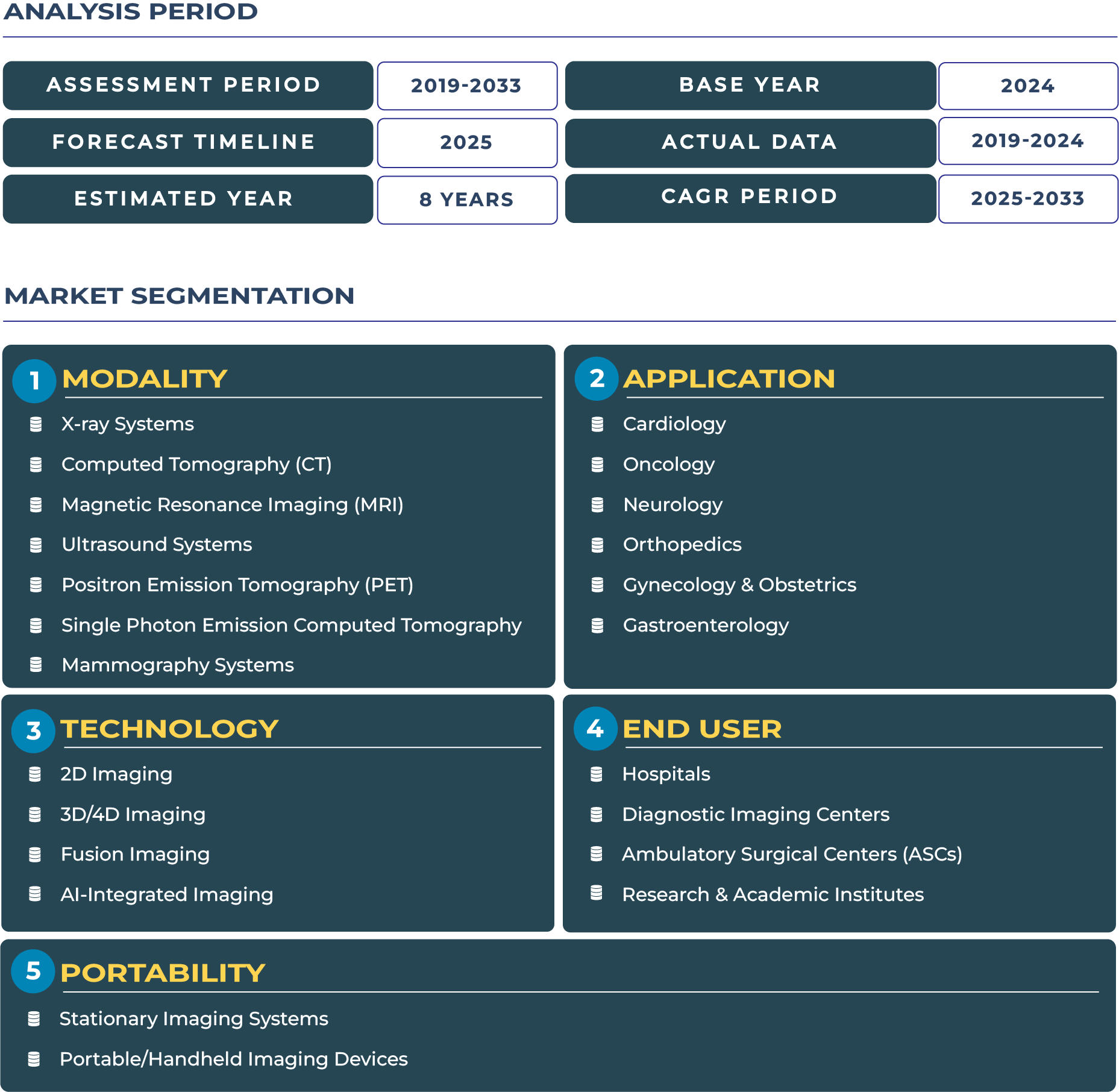
Mexico Diagnostic Imaging Devices Market Segmentation
Frequently Asked Questions
Public sector modernization, value-based procurement, and adoption of mid-tier systems are key to enhancing affordability while improving imaging coverage.
Collaborations between state hospitals and private chains are accelerating equipment installations, mobile screening projects, and maintenance coverage in underserved areas.
Mobile ultrasound units, refurbished systems, and teleradiology-enabled services are bridging diagnostic gaps across remote and semi-urban regions in Mexico.
Related Reports

UAE SaaS Market Size | 2019-2034
- Report ID: IT1864 | Coverage: Country |
- Category: Information Technology | Sub-Category: Cloud Computing Technology |
- Published Date: Dec 2025 | US$495 |
New Zealand Investment Banking Market Size | 2019-2033
- Report ID: BAF856 | Coverage: Country |
- Category: Banking and Finance | Sub-Category: Banking Services |
- Published Date: Oct 2025 | US$495 |
Philippines Private Banking Market Size | 2019-2033
- Report ID: BAF956 | Coverage: Country |
- Category: Banking and Finance | Sub-Category: Banking Services |
- Published Date: Oct 2025 | US$495 |
Indonesia Diagnostic Imaging Devices Market Size | 2019-2033
- Report ID: HEA342 | Coverage: Country |
- Category: Healthcare | Sub-Category: Medical Devices |
- Published Date: Nov 2025 | US$495 |
GCC AI Autonomous System Market Size | 2019-2033
- Report ID: IT1969 | Coverage: Regional |
- Category: Information Technology | Sub-Category: Artificial Intelligence |
- Published Date: Dec 2025 | US$1,345 |
Colombia Diagnostic and Monitoring Devices Market Size | 2019-2033
- Report ID: HEA410 | Coverage: Country |
- Category: Healthcare | Sub-Category: Medical Devices |
- Published Date: Dec 2025 | US$495 |
UAE SaaS Market Size | 2019-2034
- Report ID: IT1864 | Coverage:Country |
- Category:Information Technology | Sub-Category: Cloud Computing Technology |
- Published Date: Dec 2025 |US$495 |
New Zealand Investment Banking Market Size | 2019-2033
- Report ID: BAF856 | Coverage:Country |
- Category:Banking and Finance | Sub-Category: Banking Services |
- Published Date: Oct 2025 |US$495 |
Philippines Private Banking Market Size | 2019-2033
- Report ID: BAF956 | Coverage:Country |
- Category:Banking and Finance | Sub-Category: Banking Services |
- Published Date: Oct 2025 |US$495 |
Indonesia Diagnostic Imaging Devices Market Size | 2019-2033
- Report ID: HEA342 | Coverage:Country |
- Category:Healthcare | Sub-Category: Medical Devices |
- Published Date: Nov 2025 |US$495 |
GCC AI Autonomous System Market Size | 2019-2033
- Report ID: IT1969 | Coverage:Regional |
- Category:Information Technology | Sub-Category: Artificial Intelligence |
- Publishing Soon |US$1,345 |
Colombia Diagnostic and Monitoring Devices Market Size | 2019-2033
- Report ID: HEA410 | Coverage:Country |
- Category:Healthcare | Sub-Category: Medical Devices |
- Publishing Soon |US$495 |
Why Choose Us

24/5 Research Support
Get your queries resolved prior to and post purchasing research study

Customize As Per Specific Requirements
Get in-depth analysis based on your tailored research needs

Expertise in Tracking Niche Markets
Comprehensive view of latest technologies and opportunities across markets

360-Degree Analysis
Fact-based insights derived through supply & demand side analysis

Assured Quality
Deliver most accurate industry insights to maintain research quality

Information Security
Your confidential and personal data is secure and safe