
New Zealand Fintech Market Size and Forecast by Fintech Services, Technology, Revenue Model, and End User: 2019-2033
Sep 2025
| Format:

 |
Pages: 110+
|
Type: Industry Report
|
Authors:
Jayson Gomes
(Manager – BFSI)
|
Pages: 110+
|
Type: Industry Report
|
Authors:
Jayson Gomes
(Manager – BFSI)
MARKET OUTLOOK
New Zealand Fintech Market Outlook: Agri-Fintech and SME Lending as Catalysts for New Zealand Fintech Market Expansion
New Zealand presents a distinctive fintech opportunity where agriculture-driven economies and small business lending define the next phase of digital finance. With farming, dairy, and horticulture forming a significant portion of national GDP, the need for specialized agri-fintech solutions and rural lending platforms has become increasingly pronounced. Micro-insurance, weather-linked credit, and supply-chain finance are enabling farmers and rural SMEs to access capital and hedge against risks in ways previously unavailable. This rural-centric approach differentiates New Zealand from other mature fintech markets, positioning its financial innovation closer to the real economy.
The New Zealand fintech market is projected to grow from USD 2.3 billion in 2025 to USD 6.1 billion by 2033, reflecting a CAGR of 12.9%. This growth is underpinned by rising demand for agri-fintech, cross-border payment solutions for exporters, and SME lending tailored to regional industries. As highlighted by DataCube Research, digital finance is increasingly integrated with national strengths in agriculture, technology adoption, and export-oriented sectors, making fintech a core enabler of sustainable economic growth.
High Digital Trust and Innovation Culture Accelerating Fintech Development
A key driver of the fintech ecosystem in New Zealand is the country strong digital trust and advanced identity frameworks. With institutions like the Department of Internal Affairs spearheading initiatives in digital identity, consumers and businesses operate with high levels of trust in online financial transactions. This digital maturity enables seamless adoption of services such as mobile banking, peer-to-peer transfers, and SME-focused lending solutions.
New Zealand innovation culture, backed by entrepreneurial ecosystems in cities like Auckland and Wellington, supports agile fintech development. Open innovation models encourage collaboration between startups, banks, and government agencies. These factors collectively strengthen the fintech industry, providing a fertile ground for scaling solutions in payments, lending, and insurance-linked products.
Market Constraints: Scale Limitations and Venture Capital Gaps Hindering Growth
Despite its momentum, the New Zealand fintech sector faces structural challenges that may constrain its growth trajectory. The relatively small domestic market size limits scalability, compelling startups to expand offshore earlier in their lifecycle. This reliance on global markets requires additional resources and exposes firms to international competition.
Another barrier is the limited depth of venture capital (VC) funding. Compared to larger fintech hubs, New Zealand lacks the scale of institutional and private investors that can consistently back fintech ventures through late-stage funding rounds. While government initiatives and cross-border partnerships are beginning to bridge this gap, capital limitations remain a hurdle for sustained expansion and innovation.
Challenger Banks, Agriculture Payments, and Digital Wealth as Emerging Market Trends
Several trends are reshaping the fintech landscape in New Zealand. Challenger banks are gaining traction by offering low-cost, digital-first services that compete directly with incumbents. These platforms appeal to tech-savvy younger demographics and SMEs seeking alternatives to traditional banking structures.
In rural regions, fintech solutions for agricultural payments are transforming transaction efficiency and transparency. Platforms integrating payments with supply chain finance are ensuring timely cash flow for farmers and cooperatives. Meanwhile, digital wealth platforms are expanding access to investment tools, enabling broader participation in capital markets and retirement savings schemes.
Agri-Fintech Integration and Cross-Border Payments as Strategic Opportunities
The biggest opportunity for the fintech sector lies in the integration of fintech solutions with agritech. As New Zealand is a global exporter of dairy and agricultural products, platforms that link financial services with supply chains, insurance, and export payments can add substantial value. Embedded insurance for crop protection and weather-related risks offers untapped potential.
Cross-border payments are another high-growth opportunity. Exporters require seamless, low-cost solutions for transactions across Asia-Pacific and Europe. Fintech platforms providing real-time currency conversion, blockchain-backed trade finance, and compliance-aligned payment solutions are addressing this demand, reducing costs, and enhancing New Zealand competitive edge in global trade.
Regulatory Evolution Supporting Responsible Fintech Innovation
Government regulation in New Zealand is a cornerstone of fintech sector resilience. The Reserve Bank of New Zealand oversees banking and financial stability, while the Financial Markets Authority governs securities and consumer protection. Together, these bodies ensure fintech innovation is balanced with safeguards against systemic risks.
The introduction of open banking frameworks and regulatory sandboxes has encouraged startups to test new solutions in controlled environments. Additionally, government-backed initiatives to improve financial inclusion in rural areas align directly with the agri-fintech growth theme, expanding the reach of digital solutions across the economy.
Key Economic and Technological Factors Impacting New Zealand Fintech Market
The fintech industry’s performance is shaped by several external factors. Digital bank account adoption has accelerated, with consumers increasingly shifting to mobile-first platforms. In agriculture, pilot programs for digital agri-payments are testing innovative transaction models that may scale nationally by 2026.
Geopolitical uncertainties, including global trade tensions, influence cross-border payment strategies, prompting fintech firms to prioritize resilience and compliance in international transactions. Furthermore, rapid deployment of 5G and cloud services in New Zealand enhances digital infrastructure, enabling fintech firms to deliver real-time, data-driven solutions with stronger security protocols.
Competitive Landscape: Partnerships, Challenger Banks, and Regulatory Pressure Shaping Growth
The competitive landscape is evolving with a mix of incumbent banks, challenger platforms, and niche fintech firms. In August 2024, the New Zealand watchdog reported that the personal banking sector lacked sufficient competition, prompting government pledges to shake up market dynamics. This regulatory environment creates opportunities for challenger banks and digital lenders to capture underserved segments while forcing incumbents into partnerships with fintech startups.
Companies like Xero, though primarily an accounting software provider, are extending their influence into fintech by integrating payments and lending services into their platforms. Meanwhile, insurtech startups are focusing on micro-insurance and rural credit protection products. These strategies reflect a competitive landscape where collaboration, policy engagement, and digital-first approaches define success.
Conclusion: Building a Fintech Ecosystem That Serves Both Urban and Rural Economies
The New Zealand fintech market is evolving into a dual-structured ecosystem, balancing urban innovation with rural empowerment. Agri-fintech platforms, SME lending, and cross-border payments reflect how fintech is uniquely tailored to the country economic priorities. While structural barriers such as limited VC funding and small market scale present challenges, regulatory support and a culture of digital trust mitigate these risks, enabling sustainable expansion.
The future of fintech in New Zealand lies in integrating technology with core industries like agriculture and exports, reinforcing the nation’s economic backbone. With challenger banks, wealthtech platforms, and digital lending tools rising in prominence, the sector is poised to enhance financial inclusion, empower SMEs, and strengthen global trade competitiveness. The market’s uniqueness stems from its ability to fuse innovation with industry-specific relevance, ensuring that New Zealand fintech ecosystem remains both resilient and globally competitive.
*Research Methodology: This report is based on DataCube’s proprietary 3-stage forecasting model, combining primary research, secondary data triangulation, and expert validation.
[Learn more]
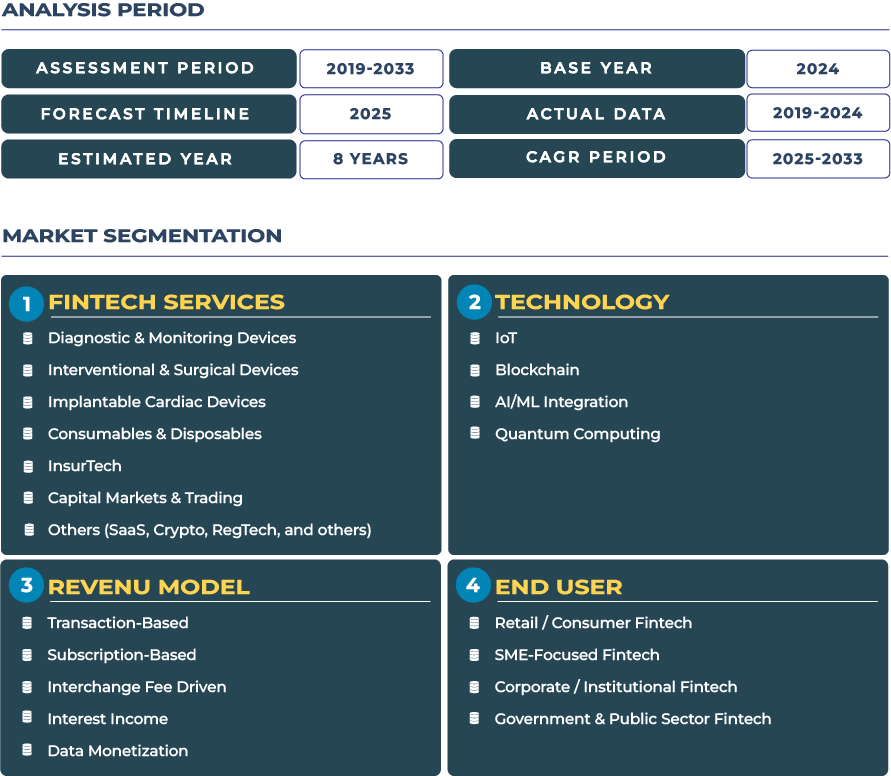
New Zealand Fintech Market Segmentation
Frequently Asked Questions
By enabling secure digital identities and consumer confidence, the ecosystem accelerates adoption of new challenger insurance and fintech solutions across markets.
Agritech-fintech integration offers crop protection, weather-linked insurance, and digitized payment systems tailored for farmers and rural cooperatives.
By embedding real-time currency conversion and blockchain-backed trade finance, insurers can provide exporters with reliable financial protection and seamless transactions.
Related Reports

Benelux Generative AI ASICs Market Size | 2019-2033
- Report ID: SEM245 | Coverage: Country |
- Category: Semiconductors | Sub-Category: AI Chips |
- Published Date: Dec 2025 | US$495 |
UAE Medical Device Market Size | 2019-2033
- Report ID: HEA21 | Coverage: Country |
- Category: Healthcare | Sub-Category: Medical Devices |
- Published Date: Feb 2026 | US$495 |
BRICS Media Market Size | 2019-2033
- Report ID: MAE34 | Coverage: Regional |
- Category: Media and Entertainment | Sub-Category: Media |
- Published Date: May 2025 | US$1,345 |
Nordics Rural Banking Market Size | 2019-2033
- Report ID: BAF910 | Coverage: Country |
- Category: Banking and Finance | Sub-Category: Banking Services |
- Published Date: Oct 2025 | US$495 |
Benelux Generative AI ASICs Market Size | 2019-2033
- Report ID: SEM245 | Coverage:Country |
- Category:Semiconductors | Sub-Category: AI Chips |
- Publishing Soon |US$495 |
UAE Medical Device Market Size | 2019-2033
- Report ID: HEA21 | Coverage:Country |
- Category:Healthcare | Sub-Category: Medical Devices |
- Published Date: Feb 2026 |US$495 |
BRICS Media Market Size | 2019-2033
- Report ID: MAE34 | Coverage:Regional |
- Category:Media and Entertainment | Sub-Category: Media |
- Published Date: May 2025 |US$1,345 |
Nordics Rural Banking Market Size | 2019-2033
- Report ID: BAF910 | Coverage:Country |
- Category:Banking and Finance | Sub-Category: Banking Services |
- Published Date: Oct 2025 |US$495 |
Why Choose Us

24/5 Research Support
Get your queries resolved prior to and post purchasing research study

Customize As Per Specific Requirements
Get in-depth analysis based on your tailored research needs

Expertise in Tracking Niche Markets
Comprehensive view of latest technologies and opportunities across markets

360-Degree Analysis
Fact-based insights derived through supply & demand side analysis

Assured Quality
Deliver most accurate industry insights to maintain research quality

Information Security
Your confidential and personal data is secure and safe