
Nigeria Corporate Banking Market Size and Forecast by Service Type, Banking Type, Delivery Channel, Customer Type, and Revenue Source: 2019-2033
Oct 2025
| Format:

 |
Pages: 110+
|
Type: Sub-Industry Report
|
Authors:
Jayson Gomes
(Manager – BFSI)
|
Pages: 110+
|
Type: Sub-Industry Report
|
Authors:
Jayson Gomes
(Manager – BFSI)
MARKET OUTLOOK
Digital SME and Corporate Lending in Nigeria: Expanding Access to Corporate Financing
Nigeria corporate banking market is entering a decisive phase as banks roll out digital lending platforms, SME-focused credit products, and liquidity solutions to support domestic enterprises. With an economy driven by oil exports, diversified trade, and a fast-growing entrepreneurial base, corporate banks are building digital ecosystems to deliver treasury, lending, and advisory services at scale. The push toward electronic payables, mobile-enabled trade finance, and workflow automation is reshaping access to capital and transactional banking for businesses across the country. As digital adoption accelerates, large corporates and SMEs are leveraging integrated platforms to manage cash flows, secure financing, and navigate currency volatility.
Note:* The market size refers to the total revenue generated by banks through interest income, non-interest income, and other ancillary sources.
The Nigeria Corporate Banking Market is forecasted to grow from USD 5.5 Billion in 2025 to USD 6.5 Billion by 2033, reflecting a CAGR of 2.2%. This growth trajectory is underpinned by the banking sector’s strategic shift toward digital SME lending, corporate treasury management, and fintech partnerships. Despite FX instability and inflationary pressures, trade corridors within Africa, expanding manufacturing clusters, and digitized enterprise services are creating new revenue pathways for banks. Liquidity management, supply-chain financing, and digital risk management are shaping the competitive landscape, especially as corporates seek hedging solutions and alternative channels for financing cross-border trade.
Market Outlook: Digital Lending and Corporate Finance Integration Defining Growth Pathways
The market outlook is shaped by Nigeria’s accelerating digital banking ecosystem, where corporate banks are now integrating credit underwriting, FX risk tools, and mobile payment channels into enterprise-facing platforms. The surge in SME bankability, supported by regulatory encouragement for financial inclusion and enterprise credit, is expanding loan portfolios across sectors such as manufacturing, logistics, agribusiness, and services. Treasury and cash management systems are increasingly embedded with enterprise software to support automation of receivables, supplier payments, and payroll disbursement.
Foreign exchange volatility and structural inflation continue to influence credit appetite and pricing models. Corporates are prioritizing liquidity optimization and rapid access to trade finance, often requiring cross-border corridors for ECOWAS transactions. Digital receivables finance and supply-chain platforms are emerging as essential mechanisms for managing working capital gaps. The corporate banking landscape is also reflecting geopolitical and regional trade realignments, with banks leveraging fintech collaborations to expand corridor-based trade financing and digital corporate payments. The sector is advancing through innovations in financial infrastructure, mobile integration, and cross-border settlement tools.
Growth Catalysts: Enterprise Financing Demand and Digital Trade Ecosystems
Large oil and commodity corporates continue to require structured trade finance, FX liquidity solutions, and cross-border payment services. Their reliance on tailored treasury products has allowed corporate banks to build specialized desks focused on procurement, export finance, and project lending. Rapid fintech expansion in segments like mobile enterprise payables, digital invoicing, and receivables discounting has improved transactional efficiencies and broadened service coverage across industries.
Intra-Africa trade growth, driven by the African Continental Free Trade Area (AfCFTA) and regional export ambitions, is accelerating the need for trade corridors, letters of credit, and FX hedging. Urban enterprise clusters in Lagos, Abuja, and Port Harcourt are driving adoption of digital treasury solutions, corporate mobile banking, and integrated payroll finance. These catalysts are laying the groundwork for deeper credit penetration among formalized SMEs and mid-sized enterprises.
Structural Constraints: FX Volatility and Banking Intermediation Challenges
High currency volatility and inflation continue to challenge long-term credit structuring, especially for corporates requiring dollar-denominated financing. Limited correspondent banking relationships for USD transactions increase transaction costs and elongate processing timelines. Inflationary pressures also influence interest rates, making access to capital more expensive for mid-sized firms and exporters.
Regulatory uncertainties and security risks in certain regions impact branch expansion, risk underwriting, and digital infrastructure development. Complex compliance requirements and infrastructural gaps further constrain the scale of enterprise lending. The informal nature of many SMEs restricts access to collateral-backed financing, limiting scalability. Together, these structural obstacles temper the pace of growth and influence product development strategies across the corporate banking landscape.
Trends Shaping the Market: Trade Corridors, Digital Corporate Payments, and Financial Innovation
Expansion of intra-Africa trade corridors is unlocking new opportunities in FX settlement, trade finance, and cross-border treasury management. Nigerian corporates are increasingly adopting mobile-based payment ecosystems to manage procurement, payroll, and vendor transactions. The rise of corporate mobile payment platforms and app-based treasury tools is enhancing visibility and cash flow efficiency.
Islamic finance is emerging as a viable alternative for corporates seeking structured financing and risk-sharing models. With sectors like agribusiness and manufacturing demanding Sharia-compliant loans, banks are diversifying their offerings. Pre-export financing, digital documentation, and mobile-enabled supplier payments are gaining traction as banks seek to differentiate through flexible liquidity solutions and integrated credit tools.
Opportunities: Commodity Finance, Mobile Treasury, and Intra-Regional Trade Solutions
Pre-export commodity financing offers banks a strong entry point to support manufacturers and exporters navigating FX challenges. Mobile wallet-enabled corporate payables are expanding reach into procurement chains, especially for SMEs with limited access to traditional treasury platforms. Banks are exploring corridor trade finance solutions targeting ECOWAS partners, enabling corporates to optimize liquidity across borders.
Digital supply-chain finance, collateral-free SME lending, and receivables-based credit models are reshaping how enterprises access capital. As intra-regional trade expands, corporate banks are deploying tailored financing products for sectors such as agriculture, energy services, logistics, and construction. These opportunities are reshaping loan portfolios and strengthening corporate ecosystems across Nigeria’s economy.
Competitive Landscape: Strategic Innovation and Sector-Focused Lending Models
Leading entities such as Access Bank Plc and multinational banks are advancing digital lending frameworks, cross-border finance platforms, and commodity-focused credit desks. Strategies focused on pre-export financing, treasury digitization, and SME cash flow tools are improving product penetration and retention across corporate segments.
Banks are exploring integrations with mobile wallets for corporate payables, enabling enterprises to align payments with domestic transaction habits. Corridor-based trade finance products are emerging to facilitate structured deals across West Africa. As risk management tools evolve, institutions are also building FX hedging and insurance-backed credit products to safeguard corporate portfolios. The market is increasingly defined by digital scalability, localized risk modeling, and sector-based lending strategies targeting high-growth enterprises.
*Research Methodology: This report is based on DataCube’s proprietary 3-stage forecasting model, combining primary research, secondary data triangulation, and expert validation.
[Learn more]
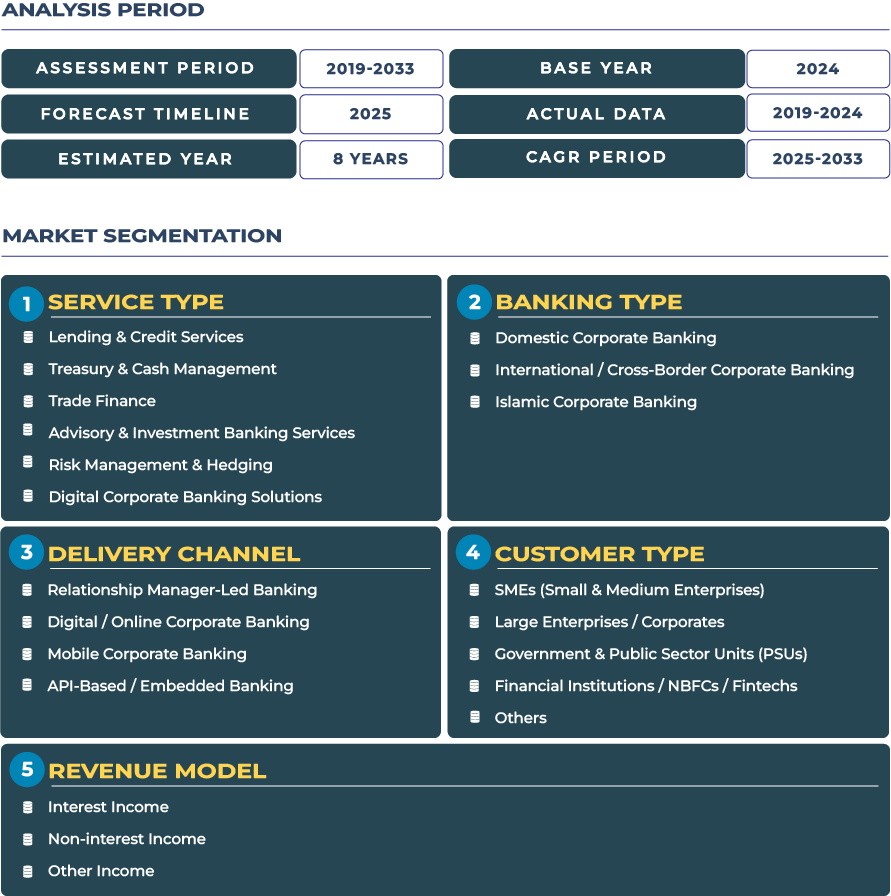
Nigeria Corporate Banking Market Segmentation
Frequently Asked Questions
Banks are creating digital underwriting models, mobile-based credit platforms, and cash management tools tailored to SME needs. These solutions integrate simplified loan applications, automated approvals, and receivables-based financing to enable faster access to funds. SME-focused treasury portals and advisory services are improving credit visibility and supporting long-term enterprise growth.
Fintech-bank collaborations are powering corporate mobile payables, digital trade documentation, and receivables discounting platforms. Intra-Africa trade growth is increasing demand for corridor finance and cross-border liquidity tools. The rise of integrated treasury software and mobile-enabled platforms is improving transaction speed, risk monitoring, and capital accessibility across industries.
Banks can develop pre-export commodity financing to support agribusiness and manufacturing exporters. Mobile wallet-enabled payables and receivables tools can improve liquidity for SMEs with limited collateral. Regional trade finance solutions across ECOWAS markets offer scalable opportunities for enterprise lending, FX management, and cash flow optimization.
Related Reports

North America Fintech-enabled DeFi Market Size | 2019-2033
- Report ID: BAF552 | Coverage: Regional |
- Category: Banking and Finance | Sub-Category: FinTech |
- Published Date: Jan 2026 | US$1,345 |
Argentina In-vitro Diagnostic Market Size | 2019-2033
- Report ID: HEA298 | Coverage: Country |
- Category: Healthcare | Sub-Category: Medical Devices |
- Published Date: Oct 2025 | US$495 |
Argentina Cloud Storage Service Market Size | 2019-2033
- Report ID: IT2016 | Coverage: Country |
- Category: Information Technology | Sub-Category: Cloud Computing Technology |
- Published Date: Dec 2025 | US$495 |
North America Fintech-enabled DeFi Market Size | 2019-2033
- Report ID: BAF552 | Coverage:Regional |
- Category:Banking and Finance | Sub-Category: FinTech |
- Publishing Soon |US$1,345 |
Argentina In-vitro Diagnostic Market Size | 2019-2033
- Report ID: HEA298 | Coverage:Country |
- Category:Healthcare | Sub-Category: Medical Devices |
- Published Date: Oct 2025 |US$495 |
Argentina Cloud Storage Service Market Size | 2019-2033
- Report ID: IT2016 | Coverage:Country |
- Category:Information Technology | Sub-Category: Cloud Computing Technology |
- Publishing Soon |US$495 |
Why Choose Us

24/5 Research Support
Get your queries resolved prior to and post purchasing research study

Customize As Per Specific Requirements
Get in-depth analysis based on your tailored research needs

Expertise in Tracking Niche Markets
Comprehensive view of latest technologies and opportunities across markets

360-Degree Analysis
Fact-based insights derived through supply & demand side analysis

Assured Quality
Deliver most accurate industry insights to maintain research quality

Information Security
Your confidential and personal data is secure and safe