
Nordics In-vitro Diagnostic Market Size and Forecast by Product Type, Technology, Application, Disease Type, End User, and Distribution Channel: 2019-2033
Oct 2025
| Format:

 |
Pages: 110+
|
Type: Sub-Industry Report
|
Authors:
Mahesh Y
(Assistant Research Manager)
|
Pages: 110+
|
Type: Sub-Industry Report
|
Authors:
Mahesh Y
(Assistant Research Manager)
MARKET OUTLOOK
Digitally Advanced Orthopedic Care Setting the Stage for Nordic In-vitro Diagnostic Transformation
The Nordics stand as the vanguard of digital-first healthcare, a model deeply rooted in technology-enabled orthopedic and diagnostic systems. The region’s early adoption of e-health frameworks, extensive medical registries, and robust telemedicine platforms has not only streamlined patient outcomes but also catalyzed the evolution of the Nordic In-vitro Diagnostic (IVD) Market. With a market size estimated at USD 1.61 billion in 2025 and projected to reach USD 2.56 billion by 2033 at a CAGR of 6.0%, the sector’s trajectory highlights the synergy between precision medicine, digital integration, and policy-driven innovation.
Governments across the Nordics, supported by regional health authorities like The Norwegian Directorate of Health and The Swedish National Board of Health and Welfare, have established national registries that feed vast data networks for diagnostic validation and population health management. This data-centric approach ensures that In-vitro Diagnostic technologies such as molecular testing kits, next-generation sequencing, and diagnostic reagents are guided by clinical evidence rather than speculative outcomes. The result is a healthcare system built on accountability, accessibility, and analytical depth, an ideal landscape for sustained IVD innovation.
Nordic Market Outlook: Data-led Healthcare and Digital Diagnostics Driving Predictive Precision
The Nordics’ healthcare ecosystem is underpinned by public funding and universal access, resulting in consistently high per-capita healthcare spending and patient trust in diagnostics. The In-vitro Diagnostic industry is benefiting from extensive national programs focused on digitalization and outcome-based medicine. Governments are actively investing in AI-enhanced pathology systems, real-time patient monitoring, and integrated laboratory automation. Moreover, initiatives such as Finland’s Ministry of Social Affairs and Health digital health framework and Sweden’s Vision eHealth 2025 aim to transform laboratory diagnostics into a fully connected, data-driven network.
Despite geopolitical uncertainties stemming from the ongoing European economic adjustments and global supply chain recalibrations, the Nordics remain relatively shielded due to their resilient healthcare budgets and localized manufacturing capabilities. Regional players are increasingly adopting reagent optimization technologies and remote diagnostic services, ensuring continuity in patient care while reducing turnaround times. The convergence of robotics, automation, and analytics is not just improving laboratory efficiency, it is redefining the very standards of medical evidence generation across the Nordic healthcare continuum.
Market Drivers: Evidence-based Healthcare and Integrated Registries Strengthening Growth Momentum
The key driver for the Nordic In-vitro Diagnostic market lies in its evidence-based clinical culture and well-integrated healthcare registries. The Nordic countries maintain centralized patient data repositories that record every diagnostic and therapeutic intervention. This unique infrastructure supports outcome validation and fuels continuous innovation in diagnostic reagents and instruments. As a result, manufacturers and healthcare providers can identify population-level disease trends with exceptional accuracy.
High per-capita healthcare spending also plays a critical role. With countries like Norway and Denmark allocating over 10% of GDP to healthcare, the investment in diagnostic innovation continues to grow. Furthermore, strong partnerships between public health institutions and private enterprises, such as the collaboration between Roche Diagnostics and Nordic healthcare networks, are advancing early disease detection and screening programs. These strategic alliances ensure that the latest molecular and immunodiagnostic technologies reach clinical practice faster, supporting better patient outcomes.
Restraints: Procurement Centralization and Scale Limitations Impacting Market Expansion
Despite the promising outlook, the Nordic IVD market faces challenges tied to its small and highly coordinated healthcare systems. Centralized procurement processes, while ensuring cost efficiency and quality, often slow the adoption of new diagnostic technologies due to complex approval cycles and public tendering frameworks. This limits the flexibility of smaller diagnostic firms aiming to introduce innovative reagents or point-of-care solutions.
Additionally, the region’s relatively small population base restricts large-scale production and market scalability. Price containment policies, particularly in Denmark and Sweden, prioritize affordability over premium feature differentiation, which can stifle revenue expansion for global players. However, companies that align their value propositions with registry-backed evidence and sustainability-driven cost models continue to find opportunities for growth within this disciplined procurement landscape.
Trends and Opportunities: Registry-driven Innovation and Telehealth Integration Defining the Future
The Nordics are witnessing an accelerated shift toward registry-driven procurement and telemedicine-supported diagnostics. The alignment of procurement decisions with national health registries allows only validated technologies to be integrated into clinical workflows, ensuring a competitive yet evidence-focused environment. This trend supports the growth of diagnostic software systems capable of seamlessly interfacing with electronic health records and regional laboratory data platforms.
Another key opportunity lies in remote-enabled testing and value-added diagnostic services. The rise of home-based testing, coupled with robust digital infrastructure, allows laboratories to decentralize services without compromising accuracy. Companies providing remote-enabled diagnostic devices and AI-supported analytics platforms can leverage the Nordics’ telemedicine maturity to enhance patient engagement and preventive care delivery. Moreover, the growing adoption of precision medicine and genetic testing presents a promising horizon for premium reagent suppliers and software-driven diagnostic ecosystems.
Competitive Landscape: Strategic Alignment with Registries and Digital Platforms Accelerating Market Positioning
The competitive landscape in the Nordic IVD market is characterized by the presence of both multinational and regional players. Leading companies such as bioMérieux, Roche Diagnostics, and Menarini Diagnostics continue to dominate the region through collaborations with national research institutes and laboratory networks. Recent initiatives have focused on digital assay platforms, remote data synchronization, and enhanced traceability across the diagnostic value chain.
Companies are increasingly aligning product development with national registries to ensure procurement readiness. Participation in government tenders now requires demonstration of real-world effectiveness and cost efficiency, pushing manufacturers to focus on outcome-based design. The post-pandemic emphasis on resilient supply chains and cross-border R&D cooperation is fostering a new wave of localization strategies. This is creating fertile ground for startups specializing in diagnostic software integration, reagent innovation, and automation systems.
*Research Methodology: This report is based on DataCube’s proprietary 3-stage forecasting model, combining primary research, secondary data triangulation, and expert validation.
[Learn more]
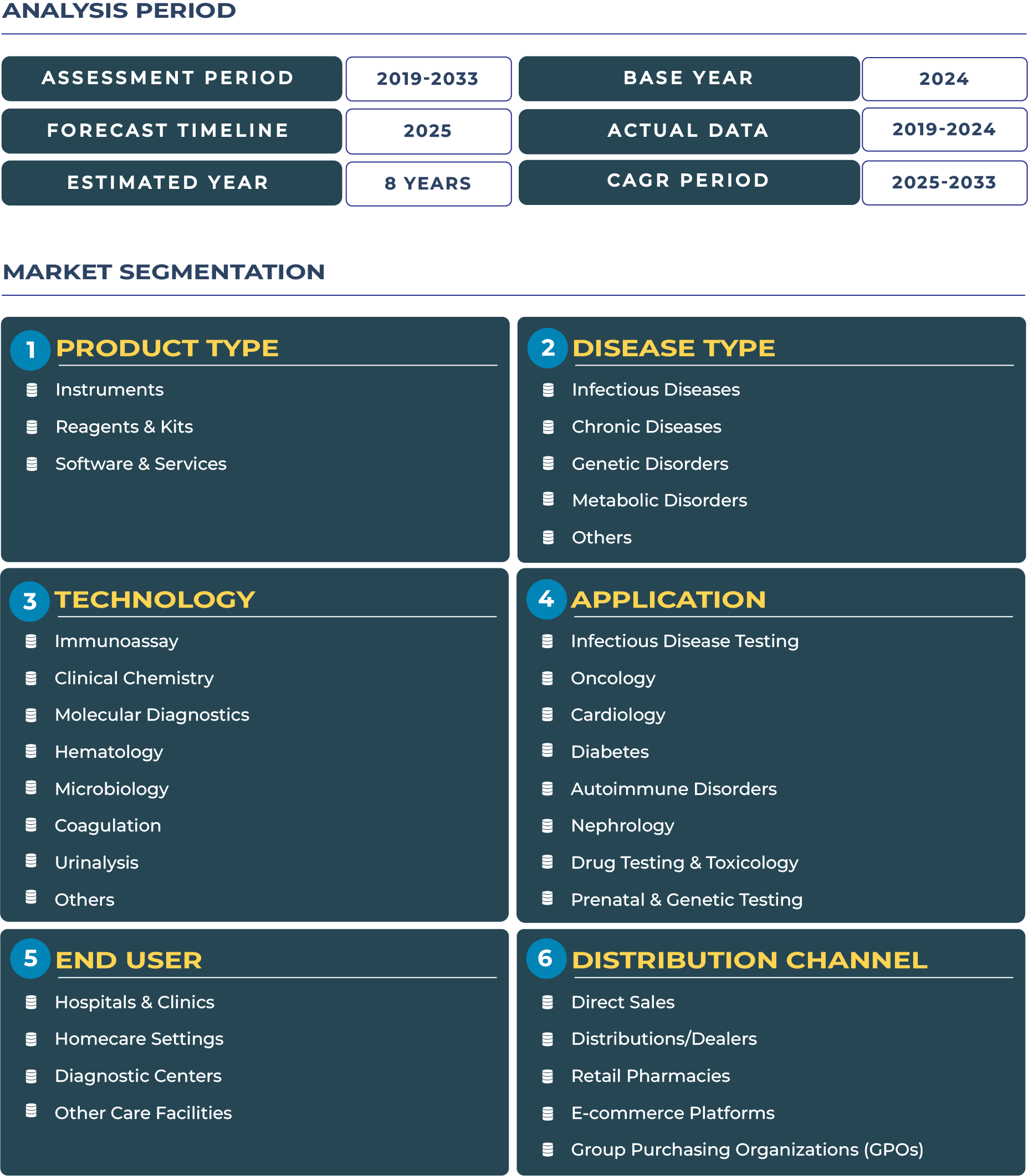
Nordics In-vitro Diagnostic Market Segmentation
Frequently Asked Questions
Nordic countries integrate digital registries through centralized databases that track patient diagnostics and treatment outcomes. This data-driven model ensures quality assurance, predictive analytics, and regulatory compliance across laboratories.
Smaller populations restrict scalability and market size, resulting in slower procurement cycles and limited return on investment for orthopedic and diagnostic manufacturers, despite strong policy and clinical infrastructure.
The increasing integration of robotic-assisted procedures with advanced diagnostic data is improving accuracy, minimizing invasiveness, and driving demand for high-precision, reagent-based IVD technologies in the Nordics.
Related Reports

North America Insurance Brokerage Market Size | 2019-2033
- Report ID: IAS63 | Coverage: Regional |
- Category: Insurance and Securities | Sub-Category: Insurance Brokerage |
- Published Date: Aug 2025 | US$1,345 |
Latin America Investment Banking Market Size | 2019-2033
- Report ID: BAF865 | Coverage: Regional |
- Category: Banking and Finance | Sub-Category: Banking Services |
- Published Date: Oct 2025 | US$1,345 |
Qatar Rural Banking Market Size | 2019-2033
- Report ID: BAF965 | Coverage: Country |
- Category: Banking and Finance | Sub-Category: Banking Services |
- Published Date: Oct 2025 | US$495 |
Peru Diagnostic Imaging Devices Market Size | 2019-2033
- Report ID: HEA351 | Coverage: Country |
- Category: Healthcare | Sub-Category: Medical Devices |
- Published Date: Nov 2025 | US$495 |
North America Insurance Brokerage Market Size | 2019-2033
- Report ID: IAS63 | Coverage:Regional |
- Category:Insurance and Securities | Sub-Category: Insurance Brokerage |
- Published Date: Aug 2025 |US$1,345 |
Latin America Investment Banking Market Size | 2019-2033
- Report ID: BAF865 | Coverage:Regional |
- Category:Banking and Finance | Sub-Category: Banking Services |
- Published Date: Oct 2025 |US$1,345 |
Qatar Rural Banking Market Size | 2019-2033
- Report ID: BAF965 | Coverage:Country |
- Category:Banking and Finance | Sub-Category: Banking Services |
- Published Date: Oct 2025 |US$495 |
Peru Diagnostic Imaging Devices Market Size | 2019-2033
- Report ID: HEA351 | Coverage:Country |
- Category:Healthcare | Sub-Category: Medical Devices |
- Published Date: Nov 2025 |US$495 |
Why Choose Us

24/5 Research Support
Get your queries resolved prior to and post purchasing research study

Customize As Per Specific Requirements
Get in-depth analysis based on your tailored research needs

Expertise in Tracking Niche Markets
Comprehensive view of latest technologies and opportunities across markets

360-Degree Analysis
Fact-based insights derived through supply & demand side analysis

Assured Quality
Deliver most accurate industry insights to maintain research quality

Information Security
Your confidential and personal data is secure and safe