
Peru Fintech Market Size and Forecast by Fintech Services, Technology, Revenue Model, and End User: 2019-2033
Sep 2025
| Format:

 |
Pages: 110+
|
Type: Industry Report
|
Authors:
Jayson Gomes
(Manager – BFSI)
|
Pages: 110+
|
Type: Industry Report
|
Authors:
Jayson Gomes
(Manager – BFSI)
MARKET OUTLOOK
Peru America Market Outlook: Mobile Wallets and Rural Inclusion via Agent Networks
Peru fintech story is defined by inclusion, where mobile wallets and agent networks are reshaping access to financial services in rural and underserved regions. The country, with nearly 40% of its adult population still unbanked, has seen rapid innovation that bridges the urban-rural divide through agent-assisted banking and wallet-led microcredit. This inclusive model makes Peru one of the most promising emerging fintech ecosystems in Latin America.
The Peru fintech market is projected to reach USD 2.2 billion in 2025 and expand to USD 5.8 billion by 2033, at a CAGR of 13.0%. This strong trajectory highlights the role of alternative digital channels in unlocking financial access for low-income and rural populations. The growth is supported by rising mobile adoption, the spread of merchant acceptance, and regulatory incentives fostering innovation. More importantly, the rural-centric approach distinguishes Peru fintech market from larger but urban-centric markets like Brazil and Mexico.
Drivers & Restraints: Balancing Growth Catalysts with Structural Challenges
Growing e-commerce penetration and mobile adoption are accelerating digital payments and wallet usage across Lima and secondary cities. Young consumers and SMEs are embracing fintech platforms for transfers, credit access, and insurance products. The startup ecosystem is also dynamic, with fintechs targeting niche areas such as alternative credit scoring and lending tech for microenterprises. International investors are increasingly drawn to Peru potential to scale mobile-first solutions in a market still underpenetrated by traditional banking.
Yet, the country large informal economy, which accounts for nearly 70% of employment, poses challenges. Informal workers often lack credit histories, complicating risk assessment for lenders. Limited banking penetration in rural areas restricts adoption of advanced services like digital investment platforms and insurtech. Economic slowdowns tied to political volatility and external shocks such as commodity price swings further create uncertainties. While fintech demand is resilient, scaling in rural Peru requires overcoming structural barriers in connectivity, literacy, and trust in digital services.
Trends & Opportunities: Rural Wallet Expansion and Alternative Credit Innovation
Agent banking is a defining trend. Peru rural economy has embraced the agent network model, where shopkeepers and local agents facilitate wallet deposits, withdrawals, and transfers. This model ensures last-mile connectivity in regions where bank branches are scarce. Mobile wallets are increasingly bundled with microcredit and microinsurance, expanding financial inclusion at scale. For example, digital platforms that integrate small-ticket credit into daily wallet usage are witnessing strong adoption in rural communities.
Opportunities lie in micro-lending to rural MSMEs and merchant acquiring solutions. Micro and small enterprises drive Peru’s employment, but their financing gaps remain wide. Fintechs offering short cycle working capital loans tied to transaction data can tap this unmet demand. Similarly, merchant acquiring solutions targeting small retailers in Cusco, Arequipa, and Trujillo are expanding the acceptance network, driving both financial inclusion and ecosystem stickiness. These innovations position Peru as a market where fintech products are not just for convenience but as lifelines for economic participation.
Regulatory Shifts and Government Initiatives Defining Peru Fintech Path
The regulatory environment has been evolving to encourage innovation while ensuring stability. The Superintendencia de Banca, Seguros y AFP (SBS) has taken active steps to regulate digital financial services, promoting consumer protection and risk management. Regulations around digital wallets and payment providers have emphasized interoperability, a critical factor in creating seamless access for consumers and merchants.
Additionally, the government national financial inclusion strategies highlight fintech as a tool to reduce inequality and enhance rural access. Policies are designed to balance innovation with oversight, particularly in credit scoring and digital lending. While regulation sometimes introduces compliance costs for startups, it also provides long-term stability and fosters trust in digital finance. Peru’s regulatory stance signals a market willing to experiment with new models while protecting consumer interests.
Key Impacting Factors: Financial Inclusion Gaps and Mobile Wallet Growth
Two factors stand out as key to Peru fintech growth trajectory. First, the high percentage of unbanked citizens continues to drive wallet and agent adoption. According to the World Bank Global Findex, over 40% of Peruvian adults lacked a bank account in 2023, creating significant room for digital-first solutions. Second, the growth in mobile wallet transactions is reshaping payment flows. Wallets are increasingly used not just for person-to-person transfers but also for bill payments, remittances, and small business operations.
These trends indicate that Peru fintech industry is maturing along inclusive lines. As adoption deepens, ecosystem players are expected to introduce wealthtech and insurtech solutions, building on consumer trust established through payments and microcredit. The interplay of financial inclusion needs and digital adoption ensures that fintech in Peru is both a social and economic enabler.
Competitive Landscape: Local Champions and International Partnerships Driving Transformation
The competitive environment is anchored by both domestic startups and global partnerships. Leading fintechs such as Kushki have expanded operations in Peru, focusing on payments and merchant acquiring. Local innovators are active in wallet-led models, micro-lending, and digital insurance pilots. International development finance also plays a critical role. In July 2024, Peru secured a €300 million credit line from KfW to modernize its digital payments infrastructure, underscoring the government’s commitment to long-term transformation.
Strategies among market players vary. Partnerships with local merchants and rural agents remain central, as they expand networks and trust in digital solutions. Product launches increasingly emphasize interoperable mobile wallets, a necessary step for large-scale adoption. Development finance institutions (DFIs) are catalyzing growth by funding digital transformation projects that extend beyond payments into lending, remittances, and insurtech. This convergence of local innovation and international support is shaping Peru’s fintech landscape into a resilient, inclusive, and forward-looking ecosystem.
Conclusion: A Fintech Market Built on Inclusion and Resilience
Peru fintech industry demonstrates how digital innovation can be tailored to address structural gaps in financial access. Unlike larger markets dominated by urban adoption, Peru unique strength lies in agent networks and mobile wallet penetration that bring services to rural and underserved populations. These solutions are redefining how financial services are consumed, making fintech both an economic necessity and a development catalyst.
While challenges such as informality, political uncertainty, and rural infrastructure gaps persist, the market’s inclusive trajectory ensures long-term resilience. The convergence of regulation, digital infrastructure investment, and entrepreneurial innovation positions Peru fintech sector as a model for inclusive finance in Latin America. Its success story highlights how fintech can bridge divides, empower micro and small enterprises, and enable financial stability even in contexts of economic volatility.
*Research Methodology: This report is based on DataCube’s proprietary 3-stage forecasting model, combining primary research, secondary data triangulation, and expert validation.
[Learn more]
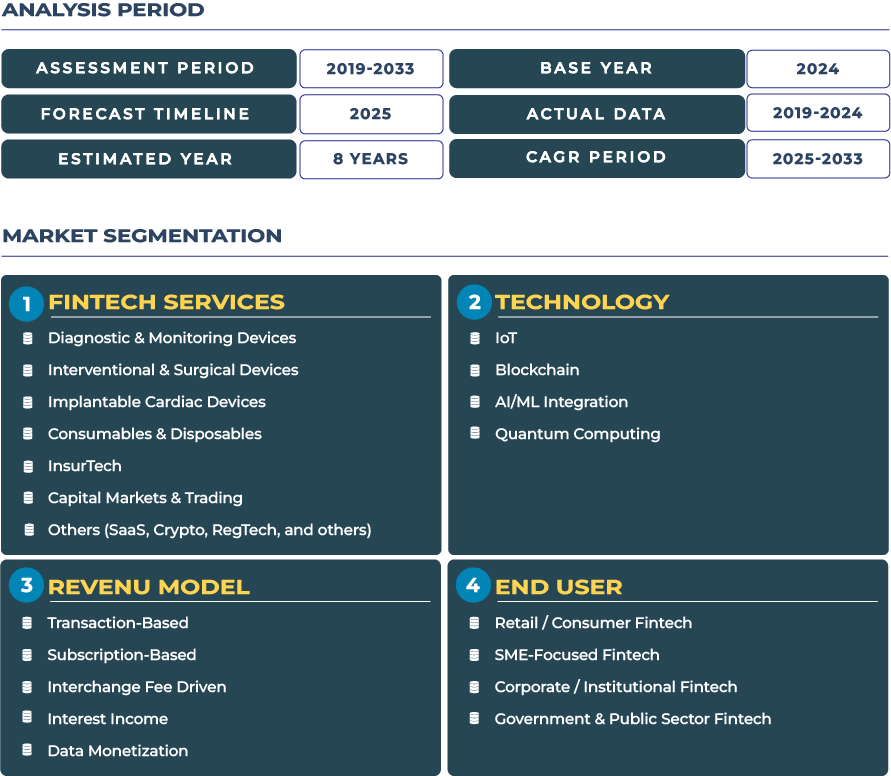
Peru Fintech Market Segmentation
Frequently Asked Questions
#REF!
What opportunities exist for micro-lending-linked insurance products in Peru?
Development finance-backed projects are modernizing payments infrastructure, enabling fintech firms to layer insurance products over interoperable digital wallets.
Related Reports

India Generative AI ASICs Market Size | 2019-2033
- Report ID: SEM253 | Coverage: Country |
- Category: Semiconductors | Sub-Category: AI Chips |
- Published Date: Dec 2025 | US$495 |
US Medical Device Market Size | 2019-2033
- Report ID: HEA27 | Coverage: Country |
- Category: Healthcare | Sub-Category: Medical Devices |
- Published Date: Feb 2026 | US$495 |
Saudi Arabia Media Market Size | 2019-2033
- Report ID: MAE41 | Coverage: Country |
- Category: Media and Entertainment | Sub-Category: Media |
- Published Date: May 2025 | US$495 |
ASEAN Rural Banking Market Size | 2019-2033
- Report ID: BAF915 | Coverage: Regional |
- Category: Banking and Finance | Sub-Category: Banking Services |
- Published Date: Oct 2025 | US$1,345 |
India Generative AI ASICs Market Size | 2019-2033
- Report ID: SEM253 | Coverage:Country |
- Category:Semiconductors | Sub-Category: AI Chips |
- Publishing Soon |US$495 |
US Medical Device Market Size | 2019-2033
- Report ID: HEA27 | Coverage:Country |
- Category:Healthcare | Sub-Category: Medical Devices |
- Published Date: Feb 2026 |US$495 |
Saudi Arabia Media Market Size | 2019-2033
- Report ID: MAE41 | Coverage:Country |
- Category:Media and Entertainment | Sub-Category: Media |
- Published Date: May 2025 |US$495 |
ASEAN Rural Banking Market Size | 2019-2033
- Report ID: BAF915 | Coverage:Regional |
- Category:Banking and Finance | Sub-Category: Banking Services |
- Published Date: Oct 2025 |US$1,345 |
Why Choose Us

24/5 Research Support
Get your queries resolved prior to and post purchasing research study

Customize As Per Specific Requirements
Get in-depth analysis based on your tailored research needs

Expertise in Tracking Niche Markets
Comprehensive view of latest technologies and opportunities across markets

360-Degree Analysis
Fact-based insights derived through supply & demand side analysis

Assured Quality
Deliver most accurate industry insights to maintain research quality

Information Security
Your confidential and personal data is secure and safe