
Philippines In-vitro Diagnostic Market Size and Forecast by Product Type, Technology, Application, Disease Type, End User, and Distribution Channel: 2019-2033
Oct 2025
| Format:

 |
Pages: 110+
|
Type: Sub-Industry Report
|
Authors:
Mahesh Y
(Assistant Research Manager)
|
Pages: 110+
|
Type: Sub-Industry Report
|
Authors:
Mahesh Y
(Assistant Research Manager)
MARKET OUTLOOK
Philippines’ Expanding Healthcare Access Fuels the Next Phase of In-Vitro Diagnostic Market Growth
The Philippines is witnessing a transformative phase in its healthcare system, driven by improved access, affordability, and insurance coverage. These developments are redefining the nation’s in-vitro diagnostic (IVD) industry, particularly as private hospitals expand and the government enhances universal healthcare programs. By 2025, the Philippines In-vitro Diagnostic Market is estimated at USD 596.1 million, with projections reaching USD 1,592.8 million by 2033, growing at a robust CAGR of 13.1%. The combination of gradual insurance penetration, urban healthcare investments, and the rising prevalence of lifestyle-related diseases positions the Philippines as a fast-evolving IVD hub in Southeast Asia.
Philippines IVD Market Outlook: Expanding Healthcare Access Strengthens Diagnostic Infrastructure
The Philippines has made significant progress in strengthening healthcare delivery and diagnostic accessibility, led by the Department of Health (DOH) and its Universal Health Care (UHC) Act initiatives. This framework aims to ensure that every Filipino has access to affordable medical services, including preventive and diagnostic testing. The country’s IVD landscape is benefiting from these reforms as laboratories, hospitals, and diagnostic centers invest in automation and data management software. Additionally, the rollout of regional medical centers and telemedicine platforms has improved access to IVD services in previously underserved provinces.
The private sector continues to play a defining role in scaling the in-vitro diagnostic ecosystem. Leading hospital groups like St. Luke’s and The Medical City are incorporating high-throughput instruments and reagent kits for faster, more accurate testing. The growing demand for molecular diagnostics and infectious disease screening, particularly for dengue, tuberculosis, and COVID-19, has encouraged laboratories to upgrade to more efficient analytical platforms. With ongoing healthcare reforms, enhanced funding, and public-private partnerships, the Philippines IVD market is poised for sustainable expansion through 2033.
Drivers and Restraints: The Dual Forces Shaping Market Momentum
Rising Insurance Penetration and Urban Healthcare Investments
One of the strongest drivers propelling the Philippines in-vitro diagnostic sector is the expanding insurance coverage through PhilHealth. This initiative has improved affordability for diagnostic procedures, particularly for routine testing and preventive screenings. Moreover, urban centers such as Manila, Cebu, and Davao are experiencing an influx of private hospitals offering specialized diagnostic services. These facilities are integrating advanced instruments and reagent automation systems to cater to a rapidly growing patient base. The ongoing infrastructure development under the Philippine Development Plan 2023, 2028 further accelerates healthcare investment and IVD adoption.
Geographic Barriers, Cost Sensitivity, and Workforce Limitations
Despite positive growth indicators, several challenges temper the market’s momentum. The Philippines’ geography, comprising over 7,000 islands, creates logistical barriers for reagent distribution and maintenance of laboratory equipment. Remote provinces face longer turnaround times and higher costs due to fragmented supply chains. Additionally, workforce shortages, particularly in clinical laboratory technicians and bioinformatics specialists, hinder operational efficiency. Price sensitivity remains a critical restraint; smaller diagnostic centers often prioritize cost over technological advancement, limiting adoption of premium IVD systems. Addressing these barriers requires strategic government partnerships and localized training programs.
Trends and Opportunities: Emerging Growth Frontiers in the IVD Landscape
Private Hospital Expansion and Medical Tourism Synergies
The rise of private hospital networks in major urban areas is redefining the Philippines in-vitro diagnostic industry. Facilities are integrating diagnostics into comprehensive care models that combine laboratory medicine with preventive health programs. Concurrently, the country’s growing medical tourism sector, particularly in Manila and Cebu, is amplifying demand for internationally accredited laboratories offering quick and reliable test results. The trend toward laboratory consolidation and automation is also creating new efficiencies that improve throughput and accuracy, aligning with global diagnostic standards.
Digital Transformation and Localization of Diagnostic Supply Chains
The Philippines is actively embracing digital health infrastructure. The Department of Information and Communications Technology (DICT) is spearheading efforts to digitize healthcare workflows and enhance data interoperability. This shift enables laboratories to adopt software-driven diagnostic management solutions that streamline reporting and regulatory compliance. Furthermore, localization of reagent and consumable production offers long-term cost advantages and supply stability. Companies investing in localized manufacturing and training academies for laboratory technicians are likely to capture emerging opportunities within the Philippines IVD sector.
Competitive Landscape: Strategic Collaborations Define Market Leadership
The competitive landscape of the Philippines in-vitro diagnostic market features a mix of international corporations and strong domestic distributors. Global leaders such as Roche Diagnostics, Abbott Laboratories, and Siemens Healthineers are reinforcing their presence through partnerships with local healthcare institutions. For instance, in 2024, Abbott expanded its point-of-care testing (POCT) portfolio through collaborations with private hospitals to address rapid infectious disease diagnostics. Meanwhile, local companies such as Hi-Precision Diagnostics and The Medical City Diagnostic Group are investing in cloud-connected laboratory systems and reagent inventory optimization.
Market participants are adopting city-hub strategies to strengthen service efficiency in urban areas like Metro Manila and Cebu, where healthcare demand is concentrated. These hubs serve as anchor points for distribution and technician training while minimizing logistical complexities across islands. Strategic initiatives, such as sponsoring diagnostic fellowships and introducing affordable reagent product lines, are enabling market entrants to build trust and expand reach. Such collaborations not only enhance accessibility but also elevate the diagnostic standard across the Philippines.
*Research Methodology: This report is based on DataCube’s proprietary 3-stage forecasting model, combining primary research, secondary data triangulation, and expert validation.
[Learn more]
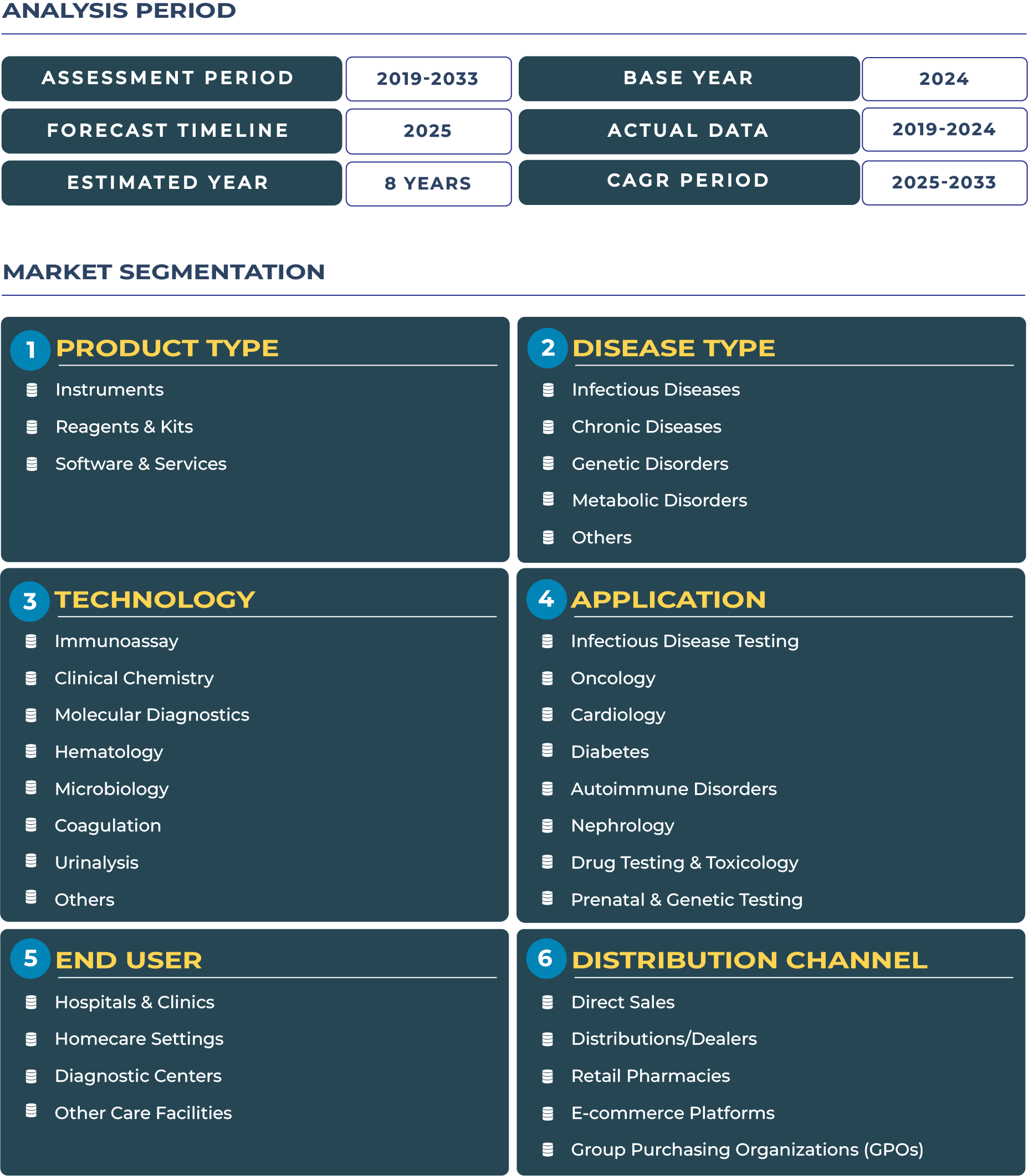
Philippines In-vitro Diagnostic Market Segmentation
Frequently Asked Questions
Expanding insurance coverage under PhilHealth has significantly increased affordability for medical and diagnostic services, encouraging wider adoption of advanced devices and diagnostic tools nationwide.
Rural populations face affordability challenges due to limited insurance coverage, logistical barriers in remote islands, and lack of local laboratory infrastructure, leading to uneven healthcare access.
The rise in sports medicine and fitness diagnostics is creating new demand for metabolic and biochemical testing, particularly in urban medical centers serving athletes and active lifestyle consumers.
Related Reports

North America Drone Detection System Market Size | 2019-2033
- Report ID: A&D55 | Coverage: Regional |
- Category: Aerospace & Defence | Sub-Category: Defence |
- Published Date: Jul 2025 | US$1,345 |
North America Private Banking Market Size | 2019-2033
- Report ID: BAF884 | Coverage: Regional |
- Category: Banking and Finance | Sub-Category: Banking Services |
- Published Date: Oct 2025 | US$1,345 |
Chile Private Banking Market Size | 2019-2033
- Report ID: BAF974 | Coverage: Country |
- Category: Banking and Finance | Sub-Category: Banking Services |
- Published Date: Nov 2025 | US$495 |
North America General Surgery Devices Market Size | 2019-2033
- Report ID: HEA370 | Coverage: Regional |
- Category: Healthcare | Sub-Category: Medical Devices |
- Published Date: Nov 2025 | US$1,345 |
North America Drone Detection System Market Size | 2019-2033
- Report ID: A&D55 | Coverage:Regional |
- Category:Aerospace & Defence | Sub-Category: Defence |
- Published Date: Jul 2025 |US$1,345 |
North America Private Banking Market Size | 2019-2033
- Report ID: BAF884 | Coverage:Regional |
- Category:Banking and Finance | Sub-Category: Banking Services |
- Published Date: Oct 2025 |US$1,345 |
Chile Private Banking Market Size | 2019-2033
- Report ID: BAF974 | Coverage:Country |
- Category:Banking and Finance | Sub-Category: Banking Services |
- Published Date: Nov 2025 |US$495 |
North America General Surgery Devices Market Size | 2019-2033
- Report ID: HEA370 | Coverage:Regional |
- Category:Healthcare | Sub-Category: Medical Devices |
- Published Date: Nov 2025 |US$1,345 |
Why Choose Us

24/5 Research Support
Get your queries resolved prior to and post purchasing research study

Customize As Per Specific Requirements
Get in-depth analysis based on your tailored research needs

Expertise in Tracking Niche Markets
Comprehensive view of latest technologies and opportunities across markets

360-Degree Analysis
Fact-based insights derived through supply & demand side analysis

Assured Quality
Deliver most accurate industry insights to maintain research quality

Information Security
Your confidential and personal data is secure and safe