
Philippines Orthopedic Devices Market Size and Forecast by Product Type, End User, Distribution Channel, and Patient Demographics: 2019-2033
Oct 2025
| Format:

 |
Pages: 110+
|
Type: Sub-Industry Report
|
Authors:
Mahesh Y
(Assistant Research Manager)
|
Pages: 110+
|
Type: Sub-Industry Report
|
Authors:
Mahesh Y
(Assistant Research Manager)
MARKET OUTLOOK
Philippines’ Expanding Healthcare Access Driving Orthopedic Devices Market Momentum
The Philippines is witnessing a gradual transformation in healthcare accessibility, particularly in orthopedic care, where affordability and insurance coverage are expanding opportunities for patients. The government’s push for broader health insurance penetration under programs like PhilHealth is reducing out-of-pocket expenses, allowing more Filipinos to seek advanced procedures such as joint replacements, spinal surgeries, and trauma fixation. This enhanced affordability is fueling the adoption of medical devices across both urban centers and emerging provincial hubs, creating strong momentum in the orthopedic devices market.
The Philippines orthopedic devices industry is projected to grow from USD 628.5 million in 2025 to USD 1,406.5 million by 2033, representing a CAGR of 10.6%. This rapid expansion is attributed to rising demand in Manila, Cebu, and Davao, where private hospitals and surgical centers are scaling capacity. Growing health awareness, coupled with increased investments in trauma care and arthroscopy, positions the Philippines as one of Southeast Asia’s key growth markets in the orthopedic devices landscape (DataCube Research).
Key Drivers and Restraints Defining the Philippines Orthopedic Devices Sector
Urban demand and hospital expansion as market accelerators
The Philippines’ archipelagic structure, combined with rapid urbanization, has created concentrated demand for orthopedic interventions in cities. Metro Manila’s large hospital networks are expanding their orthopedic wings, supported by investments in advanced arthroscopy devices and trauma fixation systems. Rising health insurance penetration is enabling broader patient access, while private hospital groups are fueling competitive adoption of orthopedic implants. In addition, the expansion of tertiary hospitals in regional hubs such as Cebu and Davao strengthens the country’s ability to deliver more advanced orthopedic procedures, thereby stimulating market growth.
Logistical challenges and affordability concerns as growth inhibitors
While urban markets are growing, rural populations face affordability barriers due to limited reimbursement and high out-of-pocket costs. Price sensitivity restricts access to advanced implants and prosthetics, especially for low-income groups. Moreover, the Philippines’ geographical challenges—spanning over 7,000 islands—create logistics difficulties in distributing orthopedic devices to provincial hospitals. Shortages of trained orthopedic surgeons in remote areas further delay the adoption of procedures, leaving a significant care gap. These challenges remain key constraints in ensuring balanced nationwide growth of the orthopedic devices ecosystem.
Trends and Opportunities Reshaping the Orthopedic Devices Landscape in the Philippines
Private hospitals and medical tourism spurring device adoption
A major trend in the Philippines is the rise of private hospital groups offering specialized orthopedic surgeries, including sports medicine and minimally invasive spinal procedures. Manila is increasingly positioned as a hub for medical tourism, attracting overseas patients for elective orthopedic surgeries at competitive pricing. Ambulatory surgery centers in major cities are also expanding, reducing wait times and improving patient convenience, which in turn accelerates the use of arthroscopy and joint reconstruction devices.
Strategic opportunities in affordability and skills development
Opportunities are emerging through city-based hub strategies, where hospitals in Manila, Cebu, and Davao act as regional anchors for advanced orthopedic procedures. Companies that launch affordable implant product lines tailored for price-sensitive markets can capture larger patient segments. At the same time, surgeon training initiatives—focusing on trauma fixation and orthobiologics—are improving capacity to meet demand. Partnerships with local universities and medical associations can further institutionalize skills development, enhancing long-term adoption of orthopedic devices across the Philippines orthopedic devices sector.
Competitive Landscape: Strategies of Global Players and Local Partners in the Philippines
The competitive dynamics of the Philippines orthopedic devices market involve a mix of multinational leaders and regional distributors. Companies like Smith+Nephew are expanding partnerships with private hospital groups to deliver advanced arthroscopy and joint replacement solutions. Local distributors continue to play a pivotal role in ensuring product availability across provincial hospitals, despite logistical challenges. Strategies such as building city hubs in Manila and Cebu, offering family ranges of cost-effective implants, and sponsoring surgical fellowships are proving effective in addressing the dual challenges of affordability and accessibility. These efforts not only deepen market penetration but also strengthen the orthopedic devices ecosystem by enhancing surgeon expertise and procedural adoption.
*Research Methodology: This report is based on DataCube’s proprietary 3-stage forecasting model, combining primary research, secondary data triangulation, and expert validation.
[Learn more]
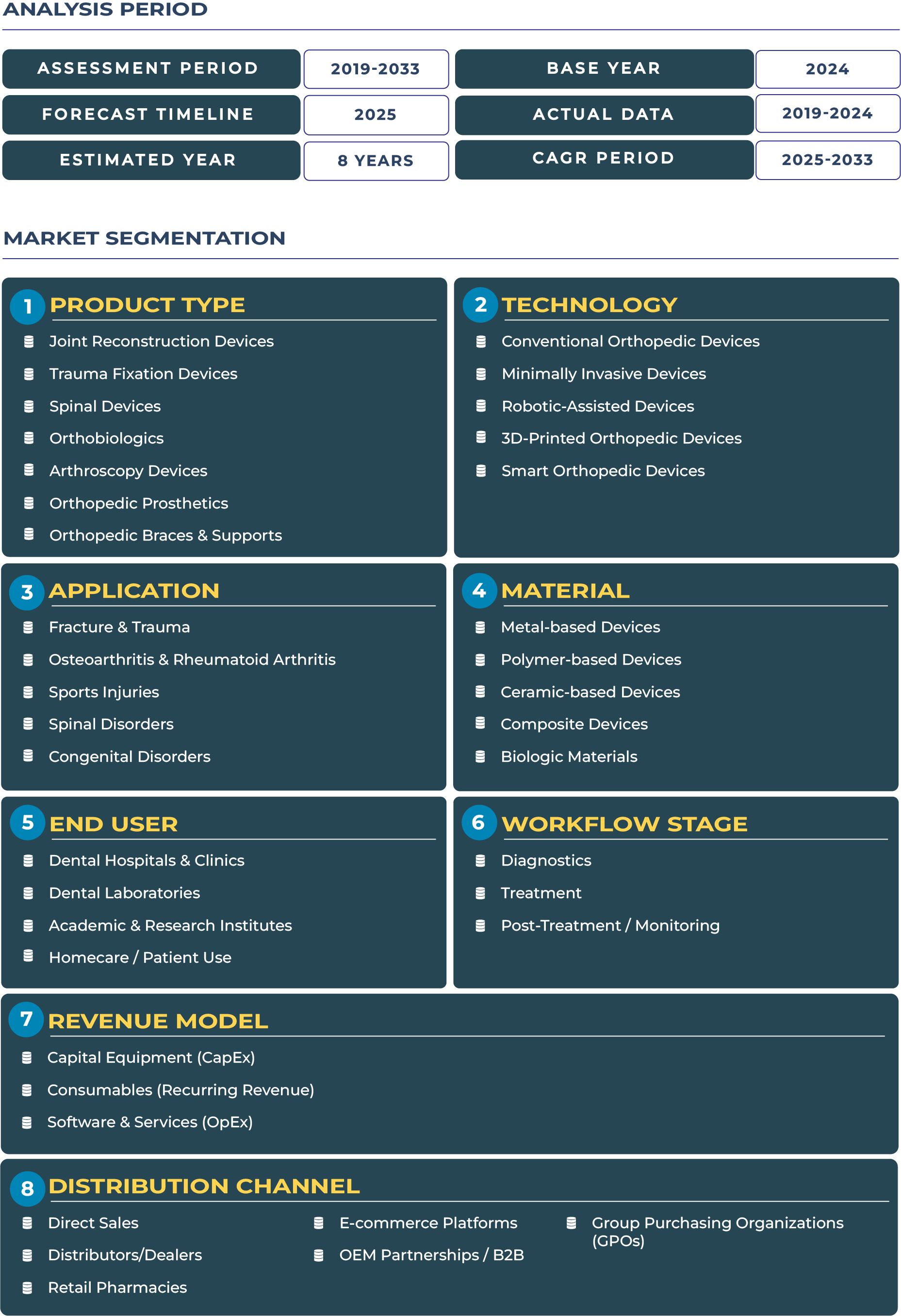
Philippines Orthopedic Devices Market Segmentation
Frequently Asked Questions
Rising insurance coverage under programs like PhilHealth is reducing patient cost burdens, enabling greater adoption of orthopedic implants and procedures across both urban and semi-urban centers.
High out-of-pocket costs, limited reimbursement structures, and logistical hurdles to deliver devices to provincial hospitals hinder rural populations from accessing advanced orthopedic care.
The growing popularity of sports and active lifestyles has increased cases of injuries, driving demand for arthroscopy devices and trauma fixation solutions in both private hospitals and specialized clinics.
Related Reports

North America Drone Detection System Market Size | 2019-2033
- Report ID: A&D55 | Coverage: Regional |
- Category: Aerospace & Defence | Sub-Category: Defence |
- Published Date: Jul 2025 | US$1,345 |
North America Private Banking Market Size | 2019-2033
- Report ID: BAF884 | Coverage: Regional |
- Category: Banking and Finance | Sub-Category: Banking Services |
- Published Date: Oct 2025 | US$1,345 |
Chile Private Banking Market Size | 2019-2033
- Report ID: BAF974 | Coverage: Country |
- Category: Banking and Finance | Sub-Category: Banking Services |
- Published Date: Nov 2025 | US$495 |
North America General Surgery Devices Market Size | 2019-2033
- Report ID: HEA370 | Coverage: Regional |
- Category: Healthcare | Sub-Category: Medical Devices |
- Published Date: Nov 2025 | US$1,345 |
North America Drone Detection System Market Size | 2019-2033
- Report ID: A&D55 | Coverage:Regional |
- Category:Aerospace & Defence | Sub-Category: Defence |
- Published Date: Jul 2025 |US$1,345 |
North America Private Banking Market Size | 2019-2033
- Report ID: BAF884 | Coverage:Regional |
- Category:Banking and Finance | Sub-Category: Banking Services |
- Published Date: Oct 2025 |US$1,345 |
Chile Private Banking Market Size | 2019-2033
- Report ID: BAF974 | Coverage:Country |
- Category:Banking and Finance | Sub-Category: Banking Services |
- Published Date: Nov 2025 |US$495 |
North America General Surgery Devices Market Size | 2019-2033
- Report ID: HEA370 | Coverage:Regional |
- Category:Healthcare | Sub-Category: Medical Devices |
- Published Date: Nov 2025 |US$1,345 |
Why Choose Us

24/5 Research Support
Get your queries resolved prior to and post purchasing research study

Customize As Per Specific Requirements
Get in-depth analysis based on your tailored research needs

Expertise in Tracking Niche Markets
Comprehensive view of latest technologies and opportunities across markets

360-Degree Analysis
Fact-based insights derived through supply & demand side analysis

Assured Quality
Deliver most accurate industry insights to maintain research quality

Information Security
Your confidential and personal data is secure and safe