
Philippines Rural Banking Market Size and Forecast by Product Type, Institution Type, Customer Type, Delivery Channel, Geographic Penetration, and Purpose: 2019-2033
Oct 2025
| Format:

 |
Pages: 110+
|
Type: Sub-Industry Report
|
Authors:
Jayson Gomes
(Manager – BFSI)
|
Pages: 110+
|
Type: Sub-Industry Report
|
Authors:
Jayson Gomes
(Manager – BFSI)
MARKET OUTLOOK
Remittance-Driven Resilience: How Rural Finance is Powering Inclusive Growth in the Philippines
The Philippines Rural Banking Market is undergoing a structural transformation as remittance inflows from overseas workers become the financial backbone for millions of rural households. These inflows, which exceed USD 36 billion annually according to the Bangko Sentral ng Pilipinas (BSP), are fueling micro-entrepreneurship, improving household liquidity, and expanding the demand for rural financial services. Rural banks across Luzon, Visayas, and Mindanao are evolving beyond traditional savings institutions into diversified community banks offering credit, payments, insurance, and investment services to rural families and small-scale businesses.
Note:* The market size refers to the total fees/revenue generated by banks through various services.
The Philippines Rural Banking Industry is expected to grow from USD 15.7 billion in 2025 to USD 25.7 billion by 2033, expanding at a CAGR of 6.4% from 2025 to 2033. This growth is supported by the digital integration of remittance-backed loans, micro-insurance, and rural digital wallets, creating a hybrid ecosystem that blends community trust with technology-enabled outreach. The rising influence of diaspora remittances in rural credit cycles has redefined household financing structures, transforming passive savings into productive capital for rural businesses, cooperative farming, and micro-retail activities.
Philippine Rural Banking Market Outlook: Remittance-Linked Credit Models Rewriting Rural Banking’s Future
The Philippine economy has demonstrated remarkable resilience despite inflationary pressures, climate risks, and global economic slowdowns. In rural provinces, the infusion of remittances has served as a financial stabilizer, driving demand for savings, lending, and insurance services. Local banks have leveraged this liquidity by developing remittance-collateralized loan products and micro-insurance bundles targeting families of overseas Filipino workers (OFWs). These initiatives have not only enhanced financial inclusion but also created new business models for the rural banking ecosystem.
The country’s regulatory reforms led by the Anti-Money Laundering Council (AMLC) and BSP’s Digital Payments Transformation Roadmap have also empowered rural banks to modernize operations and adopt real-time settlements. This digitization aligns with national goals for inclusive finance and supports the government’s strategy to reduce cash-based transactions across rural areas. Despite climate disruptions and periodic typhoons, the sector remains steady, with institutions diversifying portfolios across agriculture, micro-enterprises, and community-driven housing finance. The next decade is poised to witness the deepening of credit access through rural agent banking networks, rural fintech partnerships, and adaptive insurance for climate risks.
Drivers & Restraints: Forces Shaping the Rural Banking Landscape in the Philippines
Remittance Flows and Barangay-Level Microfinance Anchoring Growth
The primary growth driver of the Philippines Rural Banking Market is the unparalleled inflow of overseas remittances that sustains local economies. The BSP reported consistent remittance growth of over 2.8% year-on-year in 2024, ensuring a steady stream of liquidity across provincial towns. This liquidity translates into higher deposits, consumption spending, and entrepreneurial ventures, particularly in the Visayas and Mindanao regions. Microfinance institutions and barangay cooperatives are deepening penetration in remote areas, supporting self-employed farmers and women-led enterprises. In addition, mobile payment platforms integrated with rural bank accounts are enabling seamless remittance transfers, credit top-ups, and utility payments, enhancing both financial accessibility and digital literacy in rural regions.
Disaster Vulnerability and Land Tenure Limitations Hampering Lending Growth
However, structural challenges persist. The Philippines’ geographical makeup, over 7,600 islands prone to typhoons, floods, and earthquakes, creates high credit risk exposure for rural banks. Climate-related disruptions often lead to loan defaults and increased provisioning. Moreover, land-tenure complexity in agricultural regions, especially in Mindanao, limits the collateralization of rural credit. Many small farmers operate without formal titles, constraining access to larger loans. Despite these barriers, rural banks are innovating with micro-insurance and weather-indexed lending schemes to mitigate disaster impacts, although implementation remains uneven across regions. These structural constraints temper the otherwise promising trajectory of the rural banking sector.
Trends & Opportunities: Digital Agent Banking and Resilient Financing Models Redefining Rural Finance
Agent Banking and Micro-Insurance Bundling Transforming Access
One of the most transformative trends reshaping the rural banking industry is the rise of agent banking. With BSP’s approval of nationwide agent banking expansion, rural banks can now deploy accredited community agents who facilitate cash-ins, withdrawals, and digital credit applications in remote barangays. These agents bridge the gap between formal finance and underserved communities, fostering trust and convenience. Simultaneously, micro-insurance bundling, covering life, livestock, and crop protection, has become integral to household risk management. This trend enhances financial resilience, allowing rural families to sustain creditworthiness even after shocks such as typhoons or medical emergencies.
Emerging Opportunities in Climate-Resilient and Remittance-Backed Financing
Rural financial institutions are identifying new growth opportunities through climate-resilient and remittance-linked products. Programs such as typhoon-resilient home repair loans and remittance-collateralized micro-business lines are increasingly popular among rural entrepreneurs. These innovative credit mechanisms integrate social protection with financial inclusion. Moreover, rural banks in the Visayas and Northern Mindanao regions are collaborating with fintechs to launch solar pay-as-you-go (PayGo) financing for smallholder farms and rural households. These forward-looking opportunities will likely define the next growth phase for the Philippine rural banking landscape by making finance both sustainable and inclusive.
Competitive Landscape: Partnerships and Policy Reform Strengthening Rural Banking Capabilities
The Philippines Rural Banking Sector features a blend of local banks, cooperatives, and fintech startups actively expanding their digital capabilities. Institutions such as Land Bank of the Philippines continue to dominate rural lending through agricultural credit and SME financing programs, while private rural banks are strengthening their portfolios through strategic alliances with fintech firms. Furthermore, the Bangko Sentral ng Pilipinas plays a critical role in ensuring systemic stability, promoting responsible lending practices, and driving digital transformation under its inclusive finance agenda.
*Research Methodology: This report is based on DataCube’s proprietary 3-stage forecasting model, combining primary research, secondary data triangulation, and expert validation.
[Learn more]
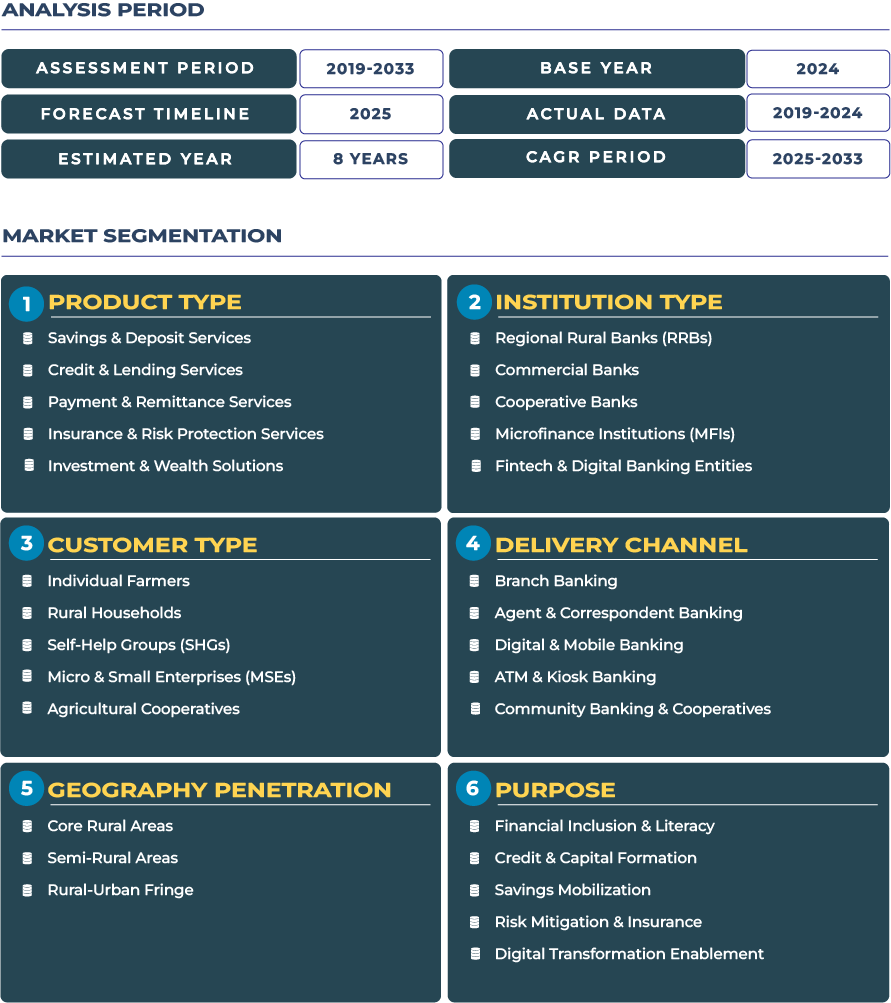
Philippines Rural Banking Market Segmentation
Frequently Asked Questions
Remittances are a lifeline for rural households, transforming household liquidity into business capital. Rural banks leverage remittance inflows to expand credit, savings, and insurance services in underserved provinces.
Microfinance cooperatives and agent-based banking are promoting access to savings, micro-loans, and micro-insurance for low-income households, boosting entrepreneurship and financial literacy in rural communities.
Digital wallets enable real-time transactions, credit repayments, and remittance-linked top-ups for rural clients, strengthening the efficiency and reach of the rural banking ecosystem.
Related Reports

Brazil Fintech-enabled Neobanking Market Size | 2019-2033
- Report ID: BAF537 | Coverage: Country |
- Category: Banking and Finance | Sub-Category: FinTech |
- Published Date: Jan 2026 | US$495 |
Benelux Orthopedic Devices Market Size | 2019-2033
- Report ID: HEA222 | Coverage: Country |
- Category: Healthcare | Sub-Category: Medical Devices |
- Published Date: Oct 2025 | US$495 |
Indonesia Diagnostic and Monitoring Devices Market Size | 2019-2033
- Report ID: HEA399 | Coverage: Country |
- Category: Healthcare | Sub-Category: Medical Devices |
- Published Date: Dec 2025 | US$495 |
Benelux Ambulatory Care Market Size | 2019-2033
- Report ID: HEA449 | Coverage: Country |
- Category: Healthcare | Sub-Category: Healthcare Services |
- Published Date: Feb 2026 | US$495 |
Brazil Fintech-enabled Neobanking Market Size | 2019-2033
- Report ID: BAF537 | Coverage:Country |
- Category:Banking and Finance | Sub-Category: FinTech |
- Publishing Soon |US$495 |
Benelux Orthopedic Devices Market Size | 2019-2033
- Report ID: HEA222 | Coverage:Country |
- Category:Healthcare | Sub-Category: Medical Devices |
- Published Date: Oct 2025 |US$495 |
Indonesia Diagnostic and Monitoring Devices Market Size | 2019-2033
- Report ID: HEA399 | Coverage:Country |
- Category:Healthcare | Sub-Category: Medical Devices |
- Publishing Soon |US$495 |
Benelux Ambulatory Care Market Size | 2019-2033
- Report ID: HEA449 | Coverage:Country |
- Category:Healthcare | Sub-Category: Healthcare Services |
- Published Date: Feb 2026 |US$495 |
Why Choose Us

24/5 Research Support
Get your queries resolved prior to and post purchasing research study

Customize As Per Specific Requirements
Get in-depth analysis based on your tailored research needs

Expertise in Tracking Niche Markets
Comprehensive view of latest technologies and opportunities across markets

360-Degree Analysis
Fact-based insights derived through supply & demand side analysis

Assured Quality
Deliver most accurate industry insights to maintain research quality

Information Security
Your confidential and personal data is secure and safe