
Poland Investment Banking Market Size and Forecast by Service Type, Client Type, Deal Size, Ownership Model, and Delivery Channel: 2019-2033
Oct 2025
| Format:

 |
Pages: 110+
|
Type: Sub-Industry Report
|
Authors:
Jayson Gomes
(Manager – BFSI)
|
Pages: 110+
|
Type: Sub-Industry Report
|
Authors:
Jayson Gomes
(Manager – BFSI)
MARKET OUTLOOK
Poland Investment Banking Market Outlook: EU Integration and SME Advisory Powering Mid-Market Resurgence
Poland investment banking sector is entering a new era driven by EU alignment, industrial resurgence, and increasing demand for cross-border financial advisory. As Warsaw secures its position as a regional financial hub, firms are capitalizing on privatization efforts, SME growth, and capital flows from European partners. According to DataCube Research, the Poland Investment Banking Market is estimated at USD 2.7 billion in 2025 and is projected to grow to USD 4.1 billion by 2033, reflecting a robust CAGR of 5.4%. This growth is fueled by mid-market merger and acquisition, ECM and DCM advisory, and growing sophistication among Polish corporates seeking EU-wide capital access and advisory excellence.
Note:* The market size refers to the total revenue generated by banks through various services.
Warsaw’s Rise as a Financial Gateway for SMEs and EU Corporates
Poland is rapidly becoming a conduit between Central Europe and the broader European financial ecosystem. Post-2024 developments have seen increasing advisory mandates from SMEs seeking cross-border expansion into Germany, Scandinavia, and the Baltics. Poland’s alignment with EU financial regulations and investor protections has unlocked new investor confidence, enabling regional banks and advisory firms to facilitate capital raising, restructuring, and debt advisory services with greater transparency. The nascent Warsaw Stock Exchange’s growing tie-ups with EU exchanges, and Poland’s role in EU structural funds, mean that ECM and DCM activity are becoming more frequent. Despite macroeconomic headwinds and regulatory uncertainty, Poland’s strategic geographic position and growing digital finance infrastructure make it a compelling hub for mid-market cross-border activities for Eastern and Western Europe alike.
Drivers & Restraints: EU Integration and Local Limitations Shape Poland Investment Banking Landscape
EU Integration and Industrial Expansion Unlock Advisory Potential
One of the strongest growth drivers for the Poland Investment Banking Market is its deepening connection with EU markets. As Polish corporations expand their footprints into EU trade zones, demand for merger and acquisition advisory, IPOs, and capital structuring has surged. Industrial consolidation in the automotive, manufacturing, and technology sectors has driven international deals requiring local advisory plus cross-border coordination. Private equity firms targeting Poland’s growth potential have also commissioned advisory mandates to structure exits and joint ventures across EU member states. This integration allows Polish banks and advisory firms to offer unique value combining local expertise with cross-border execution capabilities.
Small Domestic Capital Markets and Limited Mega-Deal Activity Constrain Growth
However, Poland investment banking market faces structural headwinds. The domestic capital markets remain relatively small compared to Western European peers, which limits mega-deal opportunities and underwriting scale. Many large transactions are routed through London or Frankfurt, rather than Warsaw, reducing local fee capture. Additionally, Polish firms often rely on international banks for cross-border execution, reducing margins for domestic advisors. Regulatory complexity, especially around EU compliance and reporting standards, adds overhead which disproportionately affects smaller firms. These constraints dampen the growth potential and make scalability difficult for local players aiming to compete regionally.
Trends & Opportunities: Fintech, SME Cross-Border Advisory, and Capital Market Expansion
Fintech and Private Equity Exit Growth Fuel Digital Advisory Platforms
The Poland Investment Banking sector is benefiting from rapid fintech integration, particularly in advisory workflows and client onboarding. Polish advisories are leveraging analytics platforms, automated valuation tools, and digital data rooms to improve turnaround times and due diligence. Private equity exits are increasingly being managed with tech-enabled platforms that streamline deal documentation and valuation modeling. As Poland’s fintech ecosystem strengthens, firms are offering new advisory channels including remote investor pitches, real-time data dashboards, and automated compliance reporting that appeal to international clients and local SMEs alike.
Emerging Opportunities in SME Cross-Border Advisory Services
SMEs are at the heart of Poland’s economic engine, and their growth into European markets has created a golden opportunity for investment banking firms. Advisory services that help SMEs manage cross-border capital raising, mergers, and acquisitions are in high demand. Firms are structuring hybrid advisory-financing products that combine debt, equity, and advisory fees to support expansion. Sectors like green energy, manufacturing, and technology are particularly active areas. As Poland continues to integrate with EU funding mechanisms and capital markets, investment banks that specialize in SME cross-border advisory are increasingly well positioned to capture this segment of growth.
Competitive Landscape: Local Specialists and Global Players Shaping Poland Investment Banking Future
Poland investment banking environment is anchored by local players like mBank Corporate & Investment Banking and PKO BP, which leverage domestic market knowledge and local network strength to capture advisory mandates. International institutions such as Citigroup and BNP Paribas are also active in Warsaw, supporting international clients and cross-border deals. Investment banks are increasingly collaborating to deliver end-to-end advisory services, merging local execution with global reach. Emerging examples of this trend include advisory mandates for EU-based infrastructure projects and cross-border merger and acquisition, positioning Poland as a vital advisory node within Europe.
*Research Methodology: This report is based on DataCube’s proprietary 3-stage forecasting model, combining primary research, secondary data triangulation, and expert validation.
[Learn more]
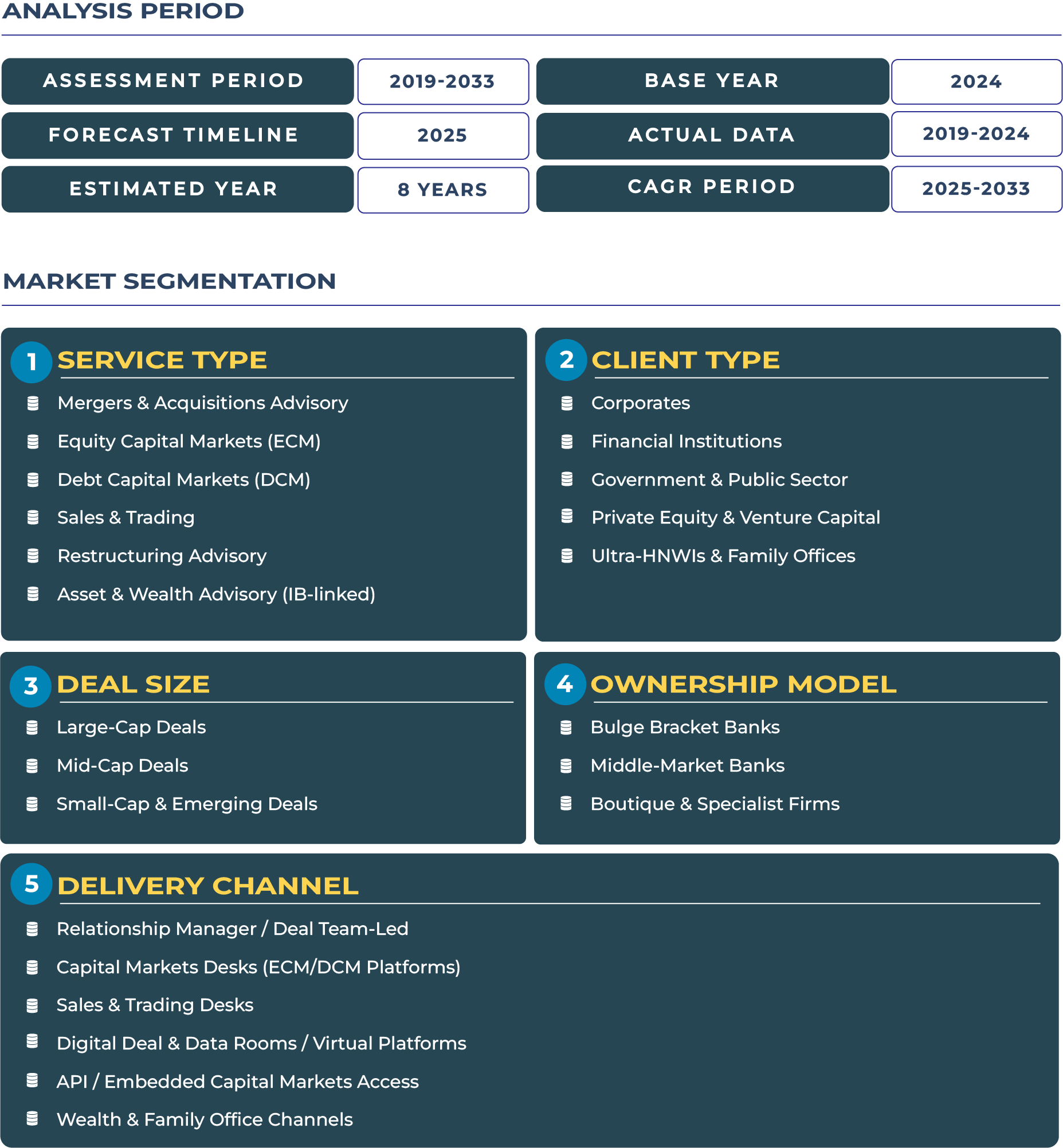
Poland Investment Banking Market Segmentation
Frequently Asked Questions
EU integration enables Polish firms to access capital, execute cross-border deals, and align regulatory standards, making Warsaw a strategic advisory hub for both domestic and EU corporates.
Limitations include a relatively small domestic capital markets, low mega-deal volume, and reliance on foreign execution partners, which reduce fee capture for Polish advisory firms.
Cross-border merger and acquisition in manufacturing, renewable energy, and tech sectors are increasingly sourced to Polish advisory firms that offer combined financing and execution services across EU boundaries.
Related Reports

Nordics Fintech-enabled Neobanking Market Size | 2019-2033
- Report ID: BAF520 | Coverage: Country |
- Category: Banking and Finance | Sub-Category: FinTech |
- Published Date: Jan 2026 | US$495 |
South Africa Diabetes Care Devices Market Size | 2019-2033
- Report ID: HEA206 | Coverage: Country |
- Category: Healthcare | Sub-Category: Medical Devices |
- Published Date: Sep 2025 | US$495 |
Argentina AI Facial Recognition Market Size | 2019-2033
- Report ID: IT1977 | Coverage: Country |
- Category: Information Technology | Sub-Category: Artificial Intelligence |
- Published Date: Dec 2025 | US$495 |
Argentina Fintech-enabled Digital Remittances Market Size | 2019-2033
- Report ID: BAF1042 | Coverage: Country |
- Category: Banking and Finance | Sub-Category: FinTech |
- Published Date: Jan 2026 | US$495 |
Nordics Fintech-enabled Neobanking Market Size | 2019-2033
- Report ID: BAF520 | Coverage:Country |
- Category:Banking and Finance | Sub-Category: FinTech |
- Publishing Soon |US$495 |
South Africa Diabetes Care Devices Market Size | 2019-2033
- Report ID: HEA206 | Coverage:Country |
- Category:Healthcare | Sub-Category: Medical Devices |
- Published Date: Sep 2025 |US$495 |
Argentina AI Facial Recognition Market Size | 2019-2033
- Report ID: IT1977 | Coverage:Country |
- Category:Information Technology | Sub-Category: Artificial Intelligence |
- Publishing Soon |US$495 |
Argentina Fintech-enabled Digital Remittances Market Size | 2019-2033
- Report ID: BAF1042 | Coverage:Country |
- Category:Banking and Finance | Sub-Category: FinTech |
- Publishing Soon |US$495 |
Why Choose Us

24/5 Research Support
Get your queries resolved prior to and post purchasing research study

Customize As Per Specific Requirements
Get in-depth analysis based on your tailored research needs

Expertise in Tracking Niche Markets
Comprehensive view of latest technologies and opportunities across markets

360-Degree Analysis
Fact-based insights derived through supply & demand side analysis

Assured Quality
Deliver most accurate industry insights to maintain research quality

Information Security
Your confidential and personal data is secure and safe