
Qatar Banking Market Size and Forecast by Banking Type, Service Type, Customer Type, Revenue Source, and Delivery Channel: 2019-2033
Oct 2025
| Format:

 |
Pages: 110+
|
Type: Industry Report
|
Authors:
Jayson Gomes
(Manager – BFSI)
|
Pages: 110+
|
Type: Industry Report
|
Authors:
Jayson Gomes
(Manager – BFSI)
MARKET OUTLOOK
Qatar Banking Market: Embedded Finance Acceleration in a Rapidly Evolving Contactless Economy
The banking sector in Qatar is undergoing a pivotal transformation, leveraging its robust financial infrastructure to drive the adoption of embedded finance across consumer and commercial ecosystems. With one of the highest bank branch densities and ATM penetration levels in the Middle East, Qatar is positioning itself as a regional hub for integrated digital financial solutions. The nation’s well-developed payment networks and supportive regulatory environment are enabling the integration of banking functions into non-banking platforms, catalyzing growth in contactless payments, subscription-based banking, and wearable financial solutions.
Note:* The banking market size refers to the total revenue generated by banks through interest income, non-interest income, and other ancillary sources.
In 2025, the Qatar banking market is projected to reach USD 26.9 billion, growing to USD 44.4 billion by 2033, registering a compound annual growth rate (CAGR) of 6.5% during 2025–2033. This expansion reflects the convergence of traditional retail banking with innovative embedded models, spurred by fintech collaboration, infrastructure modernization, and shifting consumer payment behavior. Fiscal stability, government-backed economic diversification, and strategic investments in digital transformation are anchoring this upward trajectory despite global uncertainties.
Market Outlook: Qatar’s Banking Infrastructure Lays the Groundwork for Embedded Finance Integration
Qatar’s banking landscape is characterized by high digital readiness and an extensive physical distribution network, enabling the seamless deployment of embedded financial solutions. The widespread availability of bank branches and ATMs facilitates onboarding, while digital payment infrastructure allows real-time transaction flows across various consumer touchpoints. The market’s growth is underpinned by increasing smartphone penetration, government-led digitization strategies, and rising demand for frictionless banking experiences in both urban and semi-urban areas.
Consumer and SME segments are at the forefront of this transformation. Retail banking is expanding through mobile-first products integrated into super-apps, while corporate and commercial banking are seeing growing interest in supply chain finance platforms embedded within procurement systems. Investment banking and wealth management players are experimenting with subscription-based models tailored to affluent clients. These structural shifts reflect a broader transition toward ecosystem-based financial models where banking is not confined to traditional channels but seamlessly interwoven into daily activities.
Macroeconomic resilience has supported this evolution. Despite regional geopolitical tensions and fluctuations in energy markets, Qatar maintains a strong sovereign credit profile and stable monetary policy, enabling banks to invest confidently in new technologies. Additionally, diversification away from hydrocarbons is accelerating investments in fintech and green finance, further supporting embedded finance adoption.
Drivers & Restraints: Structural Enablers Propel Growth While Operational Inefficiencies Pose Challenges
Accelerated Contactless Adoption and Neo-Bank Expansion Drive Market Momentum
One of the strongest growth drivers in Qatar banking industry is the rapid adoption of contactless payments. Supported by government initiatives and merchant infrastructure upgrades, contactless transactions now account for a significant share of point-of-sale payments in major cities such as Doha, Al Rayyan, and Al Wakrah. This is complemented by the expansion of neo-banks and digital challengers targeting underserved segments, especially younger consumers and SMEs that prefer digital-first onboarding and service models.
Corporate banking divisions are capitalizing on embedded finance to deliver specialized financing solutions, particularly in trade and logistics. Subscription-based SME banking platforms and real-time cash management solutions embedded into ERP systems are creating differentiated value propositions. Together, these factors are accelerating market penetration for both traditional banks and new entrants.
Interbank Settlement Inefficiencies and Vendor Concentration Risks Impede Seamless Scaling
Despite strong growth fundamentals, certain operational challenges could hamper market scalability. Interbank settlement inefficiencies, particularly in cross-institution transaction reconciliations, introduce delays and increase costs for participating banks. These inefficiencies are more visible during peak transaction periods, impacting corporate treasury operations and merchant settlements.
Another restraint stems from vendor and third-party concentration risks. As banks rely on a small pool of technology providers for embedded solutions, the ecosystem faces potential bottlenecks related to system outages, cybersecurity, and interoperability. Addressing these issues requires regulatory clarity, standardized protocols, and enhanced interbank coordination mechanisms.
Trends & Opportunities: Contactless Expansion, Subscription Models, and Wearable Finance Lead the Way
Contactless and Subscription Banking Gain Traction Across Urban Hubs
Contactless banking has moved beyond retail payments to include public transportation, hospitality, and event ticketing. The proliferation of NFC-enabled devices and QR-based payment solutions is transforming consumer behavior in Doha and other key economic zones. Subscription-based banking is also gaining momentum, offering personalized services such as bundled SME support, wealth advisory, and premium digital banking experiences for fixed monthly fees.
Wearable Payment Solutions and SME Subscription Platforms Offer New Growth Pathways
Opportunities are emerging in wearable payment solutions designed for urban consumers seeking seamless, secure, and convenient transactions. Banks are collaborating with technology companies to integrate payment functionality into smartwatches, fitness bands, and rings. On the SME front, subscription-based banking services are being tailored to support inventory management, payroll solutions, and micro-lending, providing a steady revenue model for banks while enhancing financial inclusion.
These trends highlight Qatar’s strategic positioning as a digital finance innovator in the Gulf region, driven by consumer-centric product development and ecosystem collaboration.
Government Regulation: A Progressive Regulatory Framework Anchors Market Expansion
The regulatory environment in Qatar plays a pivotal role in shaping the banking sector’s trajectory. The Qatar Central Bank (QCB) has introduced several initiatives to modernize payment infrastructure, enhance cybersecurity resilience, and support open banking frameworks. Regulatory sandboxes enable controlled experimentation with new financial technologies, allowing banks and fintechs to co-develop solutions under supervisory oversight.
Policy alignment with the nation’s broader digital transformation agenda under Qatar National Vision 2030 ensures that regulatory developments support long-term sector competitiveness. Enhanced governance standards, prudential regulations, and risk management guidelines further reinforce the sector’s stability and growth potential.
Key Impacting Factors: Infrastructure Density and Digital Readiness Shape Market Dynamics
Qatar’s banking market performance is significantly influenced by its infrastructure metrics. According to recent data, the number of bank branches per 100,000 adults and ATM penetration levels are among the highest in the GCC, providing a strong foundation for the rollout of embedded finance services. Urban centers such as Doha benefit from dense branch networks and extensive contactless payment acceptance, while rural areas are increasingly covered through digital onboarding and agent banking models.
Age distribution patterns also support growth. A youthful demographic with high smartphone usage drives demand for mobile-first solutions, while older cohorts continue to rely on branch-based services for complex financial transactions. This dual demand environment is creating opportunities for hybrid banking models that integrate digital and physical channels.
Competitive Landscape: Strategic Collaborations and Embedded Finance Rollouts Define Market Leadership
Qatar’s competitive banking landscape comprises leading local and international banks actively deploying embedded finance strategies. Qatar National Bank (QNB) is expanding its digital ecosystem by integrating contactless payment services across retail and corporate platforms. In 2024, QNB launched enhanced wearable payment features in collaboration with global technology providers to capture urban consumer segments.
Meanwhile, regional players are focusing on SME-oriented subscription models, while foreign banks are leveraging their global expertise to introduce new wealth management solutions for Qatar’s high-net-worth clientele. These strategic initiatives are supported by regulatory clarity and infrastructure strength, enabling banks to innovate confidently.
Key developments in 2025 include the rollout of embedded finance partnerships targeting public transportation and retail ecosystems, reflecting a broader trend toward financial service ubiquity across daily life touchpoints.
Conclusion: Qatar’s Banking Sector Transitions Toward Ecosystem-Led Financial Models
The Qatar banking market is entering a decisive growth phase driven by embedded finance integration, robust infrastructure, and a supportive regulatory environment. Contactless payment adoption, neo-bank expansion, and wearable payment innovations are redefining consumer experiences, while subscription-based SME banking platforms are creating sustainable growth channels for financial institutions.
Despite interbank settlement inefficiencies and vendor concentration challenges, the sector’s underlying strengths—economic stability, demographic trends, and regulatory foresight—position it for continued expansion through 2033. The convergence of physical and digital channels, combined with ecosystem-based financial models, is setting new benchmarks for banking innovation in the Gulf region.
Strategic investments in technology, partnerships, and customer-centric product design will be central to capturing the evolving opportunities in Qatar’s banking landscape, making it a market to watch for regional and global stakeholders alike.
*Research Methodology: This report is based on DataCube’s proprietary 3-stage forecasting model, combining primary research, secondary data triangulation, and expert validation.
[Learn more]
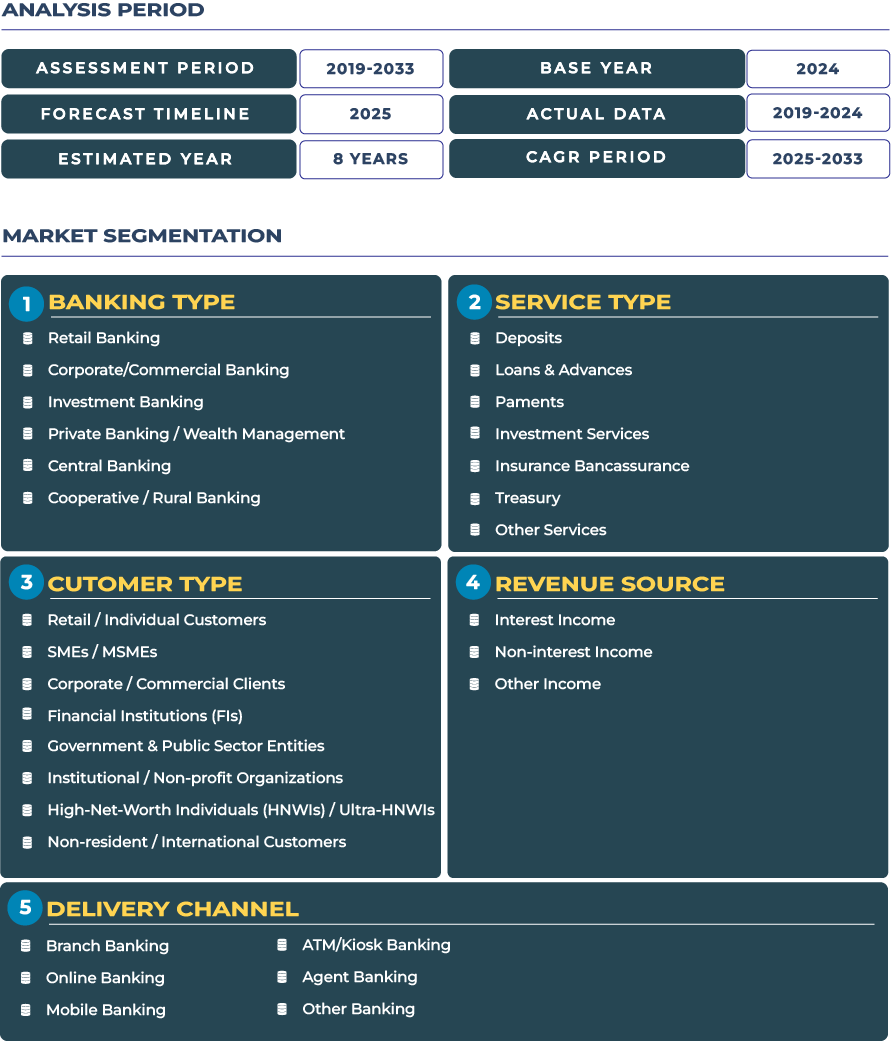
Qatar Banking Market Segmentation
Frequently Asked Questions
Embedded finance is enabling banking services to be integrated into everyday consumer and business platforms, supported by strong payment infrastructure and widespread contactless technology adoption. This integration is reshaping service delivery and enhancing user convenience.
Interbank settlement inefficiencies, particularly in cross-institution reconciliations, lead to transaction delays and operational friction. These challenges affect treasury operations and merchant settlements, highlighting the need for enhanced coordination and standardization.
Qatar’s urban population and high digital readiness are creating opportunities for wearable payment adoption and subscription-based banking for SMEs. These models offer new revenue streams for banks and deliver convenience and tailored services to consumers and businesses.
Related Reports

Nigeria Fintech-enabled Neobanking Market Size | 2019-2033
- Report ID: BAF548 | Coverage: Country |
- Category: Banking and Finance | Sub-Category: FinTech |
- Published Date: Jan 2026 | US$495 |
Hong Kong In-vitro Diagnostic Market Size | 2019-2033
- Report ID: HEA289 | Coverage: Country |
- Category: Healthcare | Sub-Category: Medical Devices |
- Published Date: Oct 2025 | US$495 |
Eastern Europe Investment Banking Market Size | 2019-2033
- Report ID: BAF845 | Coverage: Regional |
- Category: Banking and Finance | Sub-Category: Banking Services |
- Published Date: Oct 2025 | US$1,345 |
North America Diagnostic Imaging Devices Market Size | 2019-2033
- Report ID: HEA315 | Coverage: Regional |
- Category: Healthcare | Sub-Category: Medical Devices |
- Published Date: Oct 2025 | US$1,345 |
Nigeria Fintech-enabled Neobanking Market Size | 2019-2033
- Report ID: BAF548 | Coverage:Country |
- Category:Banking and Finance | Sub-Category: FinTech |
- Publishing Soon |US$495 |
Hong Kong In-vitro Diagnostic Market Size | 2019-2033
- Report ID: HEA289 | Coverage:Country |
- Category:Healthcare | Sub-Category: Medical Devices |
- Published Date: Oct 2025 |US$495 |
Eastern Europe Investment Banking Market Size | 2019-2033
- Report ID: BAF845 | Coverage:Regional |
- Category:Banking and Finance | Sub-Category: Banking Services |
- Published Date: Oct 2025 |US$1,345 |
North America Diagnostic Imaging Devices Market Size | 2019-2033
- Report ID: HEA315 | Coverage:Regional |
- Category:Healthcare | Sub-Category: Medical Devices |
- Published Date: Oct 2025 |US$1,345 |
Why Choose Us

24/5 Research Support
Get your queries resolved prior to and post purchasing research study

Customize As Per Specific Requirements
Get in-depth analysis based on your tailored research needs

Expertise in Tracking Niche Markets
Comprehensive view of latest technologies and opportunities across markets

360-Degree Analysis
Fact-based insights derived through supply & demand side analysis

Assured Quality
Deliver most accurate industry insights to maintain research quality

Information Security
Your confidential and personal data is secure and safe