
Qatar In-vitro Diagnostic Market Size and Forecast by Product Type, Technology, Application, Disease Type, End User, and Distribution Channel: 2019-2033
Oct 2025
| Format:

 |
Pages: 110+
|
Type: Sub-Industry Report
|
Authors:
Mahesh Y
(Assistant Research Manager)
|
Pages: 110+
|
Type: Sub-Industry Report
|
Authors:
Mahesh Y
(Assistant Research Manager)
MARKET OUTLOOK
Qatar In-Vitro Diagnostic Market Outlook: Orthopedic Adoption Fueled by Mega-Project Healthcare Expansion
Introduce Qatar’s healthcare mega-projects and sports medicine shaping orthopedic demand: With high-visibility infrastructure investments, especially tied to sporting events, research centers, and specialty hospitals, Qatar is elevating its diagnostic and orthopedic capacity in tandem. The IVD sector is increasingly considered a strategic component of this expansion, as accurate diagnostics underpin surgical planning and post-operative monitoring in orthopedic and sports medicine domains. In this context, the Qatar In-Vitro Diagnostic Market is projected to grow from approximately USD 49.9 million in 2025 to about USD 60.0 million by 2033. This growth is underpinned not only by infrastructure demand but also by the strategic incorporation of molecular diagnostics, AI-enhanced lab workflows, and integrated data platforms aligned with the National Health Strategy and Qatar’s digital ambitions.
Qatar’s healthcare system, spearheaded by institutions like Ministry of Public Health (Qatar), is pursuing digital transformation initiatives including AI-driven analytics to monitor disease trends and personalize care. In a recent announcement, the Ministry confirmed efforts to integrate AI-based tools across public health domains. Such initiatives reinforce demand for next-generation reagents, software suites, and high-throughput instruments that support precision diagnostics across pathology, molecular testing, and immunoassay domains. These efforts strengthen the Qatar in-vitro diagnostic ecosystem by aligning clinical demand, policy support, and technological adoption.
Drivers & Restraints: High Ambition Tempered by Scale Constraints
High Per-Capita Healthcare Spend and Strategic Hospital Projects Fuel Demand
Qatar's per-capita health expenditure is among the highest in the region, enabling strong budget support for diagnostic procurement. Major hospital complexes such as Hamad Medical City and Sidra Medicine are constantly upgrading their lab infrastructure to support subspecialty care. Furthermore, mega-projects such as Sports Medicine hubs and orthopaedic-sports injury centers tied to international events drive demand for fast, accurate diagnostics, including biomarker assays, genetic panels, and advanced imaging adjuncts. The molecular diagnostics segment in Qatar is already forecasted to grow, with projections pointing to revenues of around USD 19.2 million by 2030 at ~4.4% CAGR, underscoring its growing role in the IVD market.
Diminutive Market Size and Resource Competition Dampen Growth Velocity
Despite robust ambition, the Qatar IVD market is constrained by its limited population base, which inhibits large-volume demand for many assays. The competitive landscape for laboratory technologists, bioinformaticians, and molecular scientists is intense, as Qatar must compete regionally (e.g., UAE, Saudi) for talent. Capital-intensive diagnostic systems face greater scrutiny in procurement, particularly when per-test volumes are uncertain. Also, timing risk exists: many diagnostic upgrades are tied to major project deadlines or global event cycles, which compress purchasing windows and can delay rollouts if alignment is not perfect.
Trends & Opportunities: Centers of Excellence, AI Labs & Service Bundles
Launch of Specialist Diagnostic Centers and High-ASP Device Adoption
One key trend is the establishment of centers of excellence within healthcare clusters, molecular pathology labs, genomics cores, and immunodiagnostic hubs integrated into tertiary hospitals like Sidra Medicine and Hamad Medical Corporation. These centers increasingly adopt high-ASP (average selling price) platforms to deliver premium diagnostics. Cloud-enabled lab information systems and AI-enhanced analytics are being deployed to streamline workflows, reduce error rates, and accelerate result reporting, positioning Qatar as a showcase for digital diagnostics in the Gulf.
Opportunities in Managed Services, Training Programs & Event-Readiness Models
Given the cyclic nature of major events, diagnostic firms can offer managed service contracts, covering installation, reagent supply, calibration, and remote support, to hospitals preparing for capacity surges. Training programs targeting local lab personnel can be co-branded with public health institutions to build ecosystem credibility. Another opportunity lies in “event-readiness labs” that scale up temporarily during peak demand phases and roll into routine diagnostics thereafter. Local partnerships with research institutions, like Qatar’s Biomedical Research Center, can facilitate co-development of regional diagnostic assays tailored to Gulf health priorities.
Competitive Landscape: Strategy via Service, Integration & Domain Focus
Global diagnostic companies such as Roche Diagnostics, Siemens Healthineers, and Abbott are active in Qatar through alliances with national institutions. Their strategies emphasize service excellence, bundled software-hardware offers, and rapid-response support for flagship hospitals. The Qatar National Company for Medical Projects is also instrumental in developing diagnostic infrastructure across the country, investing in new clinics and diagnostic centers. Local players are working to distinguish themselves through faster logistics, domain specialization (e.g., infectious disease, oncology), and flexible financing models like reagent rental or lease-to-own. As the IVD sector evolves, partners that integrate clinical workflows, training, and predictive analytics will gain competitive advantage.
*Research Methodology: This report is based on DataCube’s proprietary 3-stage forecasting model, combining primary research, secondary data triangulation, and expert validation.
[Learn more]
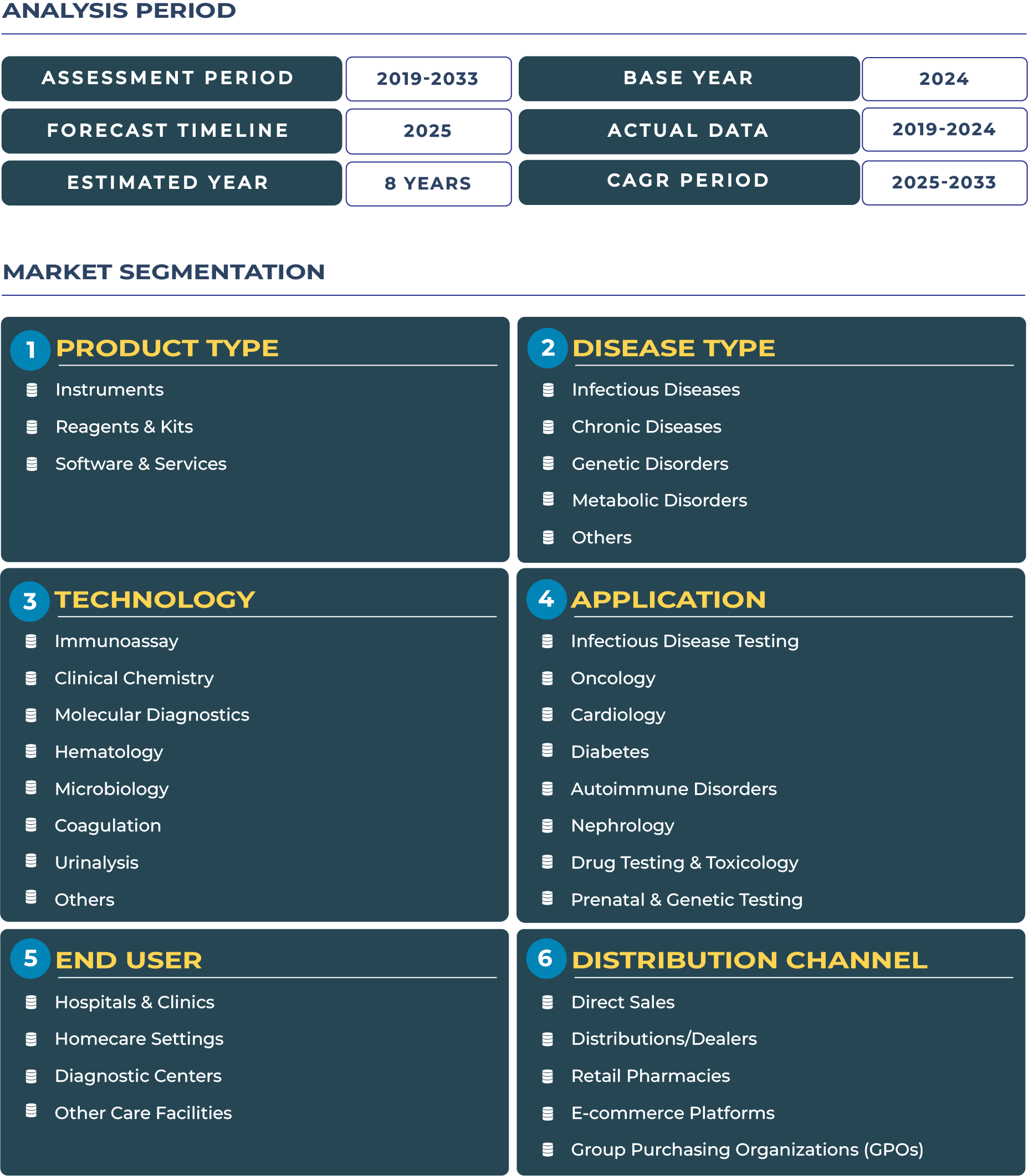
Qatar In-vitro Diagnostic Market Segmentation
Frequently Asked Questions
Large-scale hospital and orthopaedic-sports infrastructure projects create anchor demand for advanced diagnostic platforms, fueling instrument deployment, reagent contracts, and lab network expansion.
Procurement is typically centralized and may favor larger contracts over niche products. Volume thresholds, tender cycles, and regulatory compliance can delay adoption of new diagnostic technologies.
Sports medicine centers require high-precision imaging and biomarker diagnostics to guide implant selection, surgical planning, and post-operative monitoring, driving synergistic demand between diagnostics and orthopaedics.
Related Reports

GCC SaaS Market Size | 2019-2034
- Report ID: IT1861 | Coverage: Regional |
- Category: Information Technology | Sub-Category: Cloud Computing Technology |
- Published Date: Dec 2025 | US$1,345 |
Japan Private Banking Market Size | 2019-2033
- Report ID: BAF925 | Coverage: Country |
- Category: Banking and Finance | Sub-Category: Banking Services |
- Published Date: Oct 2025 | US$495 |
Kenya Private Banking Market Size | 2019-2033
- Report ID: BAF986 | Coverage: Country |
- Category: Banking and Finance | Sub-Category: Banking Services |
- Published Date: Nov 2025 | US$495 |
Europe AI Computer Vision Market Size | 2019-2033
- Report ID: IT1945 | Coverage: Regional |
- Category: Information Technology | Sub-Category: Artificial Intelligence |
- Published Date: Nov 2025 | US$1,345 |
GCC SaaS Market Size | 2019-2034
- Report ID: IT1861 | Coverage:Regional |
- Category:Information Technology | Sub-Category: Cloud Computing Technology |
- Published Date: Dec 2025 |US$1,345 |
Japan Private Banking Market Size | 2019-2033
- Report ID: BAF925 | Coverage:Country |
- Category:Banking and Finance | Sub-Category: Banking Services |
- Published Date: Oct 2025 |US$495 |
Kenya Private Banking Market Size | 2019-2033
- Report ID: BAF986 | Coverage:Country |
- Category:Banking and Finance | Sub-Category: Banking Services |
- Published Date: Nov 2025 |US$495 |
Europe AI Computer Vision Market Size | 2019-2033
- Report ID: IT1945 | Coverage:Regional |
- Category:Information Technology | Sub-Category: Artificial Intelligence |
- Publishing Soon |US$1,345 |
Why Choose Us

24/5 Research Support
Get your queries resolved prior to and post purchasing research study

Customize As Per Specific Requirements
Get in-depth analysis based on your tailored research needs

Expertise in Tracking Niche Markets
Comprehensive view of latest technologies and opportunities across markets

360-Degree Analysis
Fact-based insights derived through supply & demand side analysis

Assured Quality
Deliver most accurate industry insights to maintain research quality

Information Security
Your confidential and personal data is secure and safe