
Russia Fintech Market Size and Forecast by Fintech Services, Technology, Revenue Model, and End User: 2019-2033
Sep 2025
| Format:

 |
Pages: 110+
|
Type: Industry Report
|
Authors:
Jayson Gomes
(Manager – BFSI)
|
Pages: 110+
|
Type: Industry Report
|
Authors:
Jayson Gomes
(Manager – BFSI)
MARKET OUTLOOK
Russia Fintech Market Outlook: Ruble-Native Rails & CBDC Preparation for Domestic Resilience
The Russia fintech market is navigating an era of accelerated transformation where digital financial infrastructure has become a strategic necessity. Russia is investing heavily in Central Bank of Russia (CBR)-led initiatives such as the digital ruble pilot, ruble-native custody frameworks, and domestic settlement platforms to strengthen resilience against sanctions and external shocks. By 2025, the Russia fintech market is projected to reach USD 5.4 billion, expanding to USD 11.2 billion by 2033 at a CAGR of 9.5%. This trajectory underscores how regulatory sandboxing, Central Bank Digital Currency (CBDC) readiness, and ruble-native rails are shaping a uniquely inward-looking yet technologically dynamic ecosystem.
Sanctions-related pressures have catalyzed innovation in payment infrastructure, local custody systems, and alternative lending platforms. While international connectivity remains limited, Russia’s fintech sector has positioned itself as a resilience story—leveraging its engineering strength to rebuild secure rails that ensure financial continuity. From digital ruble pilots to P2P lending surges, the fintech ecosystem in Russia reflects a balance between constraint-driven innovation and domestic resilience. DataCube Research’s analysis highlights that the Russia fintech market has evolved into one of the few ecosystems globally where national security and financial technology are strategically intertwined.
Engineering Depth and Domestic Payment Rails Driving Russia’s Fintech Market Growth
The fintech sector in Russia benefits from a combination of technical depth, advanced software engineering, and strong national payment rails. The prominence of domestic card schemes like Mir has expanded since 2014, serving as the foundation for secure payment settlements and providing insulation from external networks. Russian fintech companies are increasingly embedding Mir and QR-based systems into digital banking, mobile wallets, and P2P applications, reinforcing nationwide financial inclusivity.
The accelerated growth of lending technology platforms, particularly peer-to-peer and SME-focused digital lending, reflects demand for credit access beyond traditional banking. Moreover, wealth management apps are integrating ruble-denominated investment products to provide domestic investors with transparent and accessible alternatives. These dynamics explain why Russia’s fintech market continues to expand despite external constraints—its capacity to create secure, ruble-native networks ensures both scalability and resilience.
Geopolitical Headwinds and Sanctions Creating Strategic Restraints in Russia’s Fintech Industry
Despite the strong growth trajectory, the Russia fintech market faces significant structural challenges stemming from international sanctions and geopolitical isolation. Restrictions on access to global capital markets, limited cross-border payment interoperability, and constraints on international partnerships have slowed down innovation in certain segments such as cross-border transfers and insurtech collaboration with foreign carriers.
The exit of international players from the Russian market has left gaps in areas like cloud infrastructure, SaaS-based regtech platforms, and crypto exchanges. Moreover, ongoing geopolitical tensions add uncertainty to foreign investment flows, limiting opportunities for large-scale global partnerships. Yet, these barriers have indirectly spurred domestic startups to innovate rapidly, filling voids left by international exits with local equivalents. The Russia fintech ecosystem illustrates a paradox: while sanctions constrain external growth, they simultaneously accelerate the evolution of secure domestic fintech solutions.
Emerging Trends and Opportunities Defining Russia’s Fintech Ecosystem
Among the strongest emerging trends is the rapid rise of crypto alternatives and P2P lending solutions. With restricted access to traditional Western platforms, Russian consumers and SMEs are exploring blockchain-based settlement mechanisms and digital wallets offering crypto integration. Cities such as Moscow and St. Petersburg are witnessing the highest adoption rates of alternative finance ecosystems, with younger demographics driving early adoption of P2P credit and digital trading platforms.
Opportunities also lie in the integration of the digital ruble pilot, which has been progressing under CBR supervision. The CBDC initiative provides an alternative settlement rail for government transfers, social benefits distribution, and retail payments, reducing reliance on SWIFT or foreign-controlled rails. As mass implementation is expected from 2025 onwards, fintech companies have a first-mover advantage to design custody and settlement products optimized for CBDC. Additionally, domestic fintech stacks focusing on secure payment gateways, digital insurance claim processing, and localized regtech solutions represent a new wave of opportunity in Russia’s evolving fintech landscape.
Regulatory Anchors: Government Bodies Shaping Russia’s Fintech Framework
Government policy has been instrumental in shaping the trajectory of Russia’s fintech industry. The Ministry of Digital Development, Communications and Mass Media and the Central Bank of Russia are central in regulatory sandbox development, digital ruble integration, and cybersecurity frameworks for digital banking. The CBR emphasis on sandbox testing for fintech pilots ensures controlled experimentation with new technologies without destabilizing existing rails.
Additionally, new guidelines on data localization and consumer protection have further driven companies to adapt their products for compliance. These policies, while restrictive for foreign firms, have enabled domestic fintechs to secure competitive advantages by aligning early with regulatory mandates. As Russia transitions toward widespread CBDC adoption, regulatory clarity remains both a driver and a constraint for fintech growth.
Macroeconomic and Structural Factors Shaping Russia Fintech Sector
Russia’s fintech market is heavily influenced by broader macroeconomic and structural realities. The ruble volatility has encouraged the development of fintech solutions that prioritize secure, ruble-denominated products to limit exposure to foreign exchange risk. The geopolitical environment has curtailed foreign capital inflows but simultaneously reinforced domestic financing channels.
Key structural factors include the rapid urban adoption of mobile wallets, the integration of AI-driven lending risk models, and the growth of alternative payment ecosystems in secondary cities. For instance, regions such as Tatarstan and Novosibirsk are becoming hotspots for SME-focused fintech platforms, diversifying adoption beyond Moscow. These factors collectively illustrate how fintech in Russia adapts not only to economic cycles but also to geopolitical and monetary conditions.
Competitive Landscape: Ruble-Native Fintech Strategies and CBDC Integration Defining Market Leadership
The Russia fintech market is shaped by both established players and innovative startups aligning with ruble-native strategies. In October 2024, the Central Bank of Russia confirmed that the digital ruble pilot had advanced toward mass implementation, signaling a pivotal milestone for the ecosystem. This move has encouraged fintech companies to focus on custody and settlement solutions compatible with CBDC infrastructure.
Local firms are building domestic payment gateways, alternative lending apps, and insurtech platforms that integrate seamlessly with ruble-native rails. Internationally recognized firms with limited exposure in Russia have taken a cautious stance, while local leaders such as QIWI continue to innovate around digital wallets, microloans, and consumer-facing fintech solutions. Strategies revolve around regulatory alignment, CBDC readiness, and protection of domestic rails from external interference, positioning Russian fintech companies for long-term resilience and market leadership.
Conclusion: Building a Resilient Ruble-Native Fintech Future in Russia
The Russia fintech industry has evolved into a resilience-driven ecosystem where geopolitical risks and economic constraints are being converted into opportunities for domestic innovation. The convergence of ruble-native settlement tools, CBDC pilots, P2P lending growth, and localized custody solutions indicates that Russia fintech landscape will remain inward-looking yet strategically robust over the next decade. While challenges in international expansion and foreign investment persist, the ability to design secure, compliant, and scalable domestic financial technologies underpins Russia unique growth trajectory.
What distinguishes the Russian fintech sector is its capacity to adapt under pressure—driven by strong engineering capabilities and state-backed regulatory sandboxes. By prioritizing ruble-native digital infrastructures and exploring CBDC readiness, Russia is ensuring that its fintech industry remains not just a financial services enabler but a pillar of national resilience. For investors, policymakers, and technology providers, the Russian fintech market illustrates how innovation can thrive under structural constraint, reshaping the future of financial technology within an economy defined by both resilience and reinvention.
*Research Methodology: This report is based on DataCube’s proprietary 3-stage forecasting model, combining primary research, secondary data triangulation, and expert validation.
[Learn more]
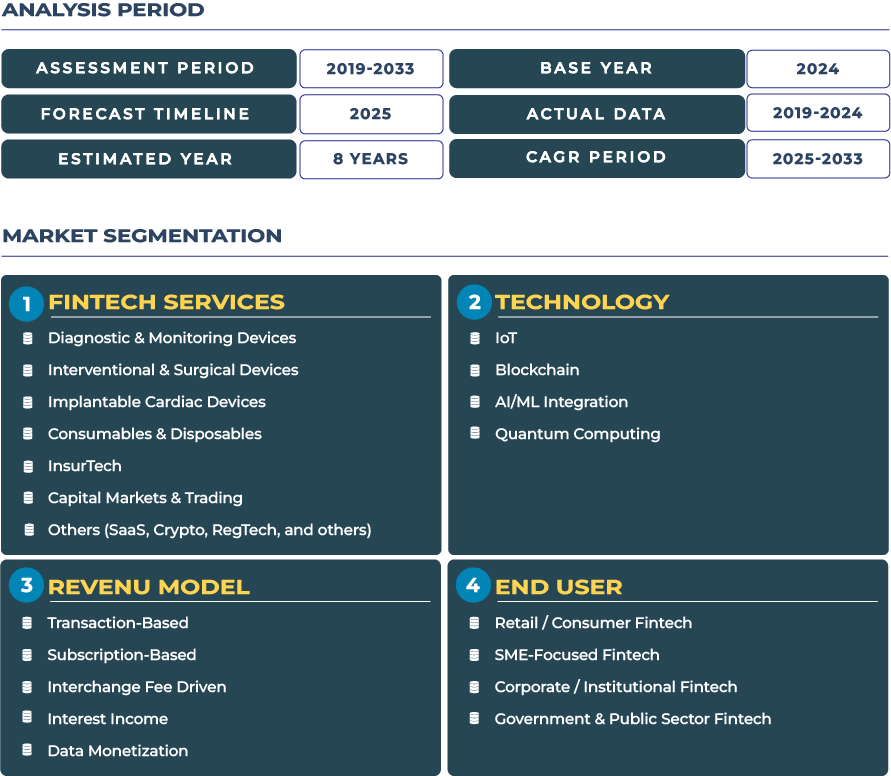
Russia Fintech Market Segmentation

Frequently Asked Questions
The digital ruble could streamline claims processing, reduce settlement delays, and provide real-time tracking of insurance disbursements through ruble-native digital rails.
Insurance providers can integrate micro-insurance into P2P lending and alternative finance platforms, offering tailored protection products to underserved consumers and SMEs.
Geopolitical risks limit foreign insurer participation but accelerate domestic innovation in localized claim systems, digital ruble readiness, and secure regtech compliance stacks.
Related Reports

BRICS Generative AI ASICs Market Size | 2019-2033
- Report ID: SEM235 | Coverage: Regional |
- Category: Semiconductors | Sub-Category: AI Chips |
- Published Date: Dec 2025 | US$1,345 |
Western Europe Consumer Electronics Market Size | 2019-2033
- Report ID: CE75 | Coverage: Regional |
- Category: Consumer Electronics | Sub-Category: Electronics |
- Published Date: Jul 2025 | US$1,345 |
Italy Media Market Size | 2019-2033
- Report ID: MAE24 | Coverage: Country |
- Category: Media and Entertainment | Sub-Category: Media |
- Published Date: May 2025 | US$495 |
Canada Rural Banking Market Size | 2019-2033
- Report ID: BAF900 | Coverage: Country |
- Category: Banking and Finance | Sub-Category: Banking Services |
- Published Date: Oct 2025 | US$495 |
BRICS Generative AI ASICs Market Size | 2019-2033
- Report ID: SEM235 | Coverage:Regional |
- Category:Semiconductors | Sub-Category: AI Chips |
- Publishing Soon |US$1,345 |
Western Europe Consumer Electronics Market Size | 2019-2033
- Report ID: CE75 | Coverage:Regional |
- Category:Consumer Electronics | Sub-Category: Electronics |
- Published Date: Jul 2025 |US$1,345 |
Italy Media Market Size | 2019-2033
- Report ID: MAE24 | Coverage:Country |
- Category:Media and Entertainment | Sub-Category: Media |
- Published Date: May 2025 |US$495 |
Canada Rural Banking Market Size | 2019-2033
- Report ID: BAF900 | Coverage:Country |
- Category:Banking and Finance | Sub-Category: Banking Services |
- Published Date: Oct 2025 |US$495 |
Why Choose Us

24/5 Research Support
Get your queries resolved prior to and post purchasing research study

Customize As Per Specific Requirements
Get in-depth analysis based on your tailored research needs

Expertise in Tracking Niche Markets
Comprehensive view of latest technologies and opportunities across markets

360-Degree Analysis
Fact-based insights derived through supply & demand side analysis

Assured Quality
Deliver most accurate industry insights to maintain research quality

Information Security
Your confidential and personal data is secure and safe