
Singapore Fintech Market Size and Forecast by Fintech Services, Technology, Revenue Model, and End User: 2019-2033
Sep 2025
| Format:

 |
Pages: 110+
|
Type: Industry Report
|
Authors:
Jayson Gomes
(Manager – BFSI)
|
Pages: 110+
|
Type: Industry Report
|
Authors:
Jayson Gomes
(Manager – BFSI)
MARKET OUTLOOK
Singapore Fintech Market Outlook: Fintech Policy Leadership: Singapore as Asia’s Hub for Tokenisation and Cross-Border Payments
Singapore has evolved into a policy-led fintech hub where regulation and innovation intersect to shape the future of financial services in Asia. At the heart of this development is the Monetary Authority of Singapore (MAS), which has positioned the country as a regional leader in tokenisation, central bank digital currency (CBDC) experiments, and cross-border payment innovation. With a population that is digitally sophisticated and a financial ecosystem closely integrated with regional markets, Singapore provides fertile ground for fintech experimentation and commercialization. In 2025, the Singapore fintech market is valued at USD 3.2 billion and is projected to expand to USD 10.8 billion by 2033, registering a CAGR of 16.3% from 2025 to 2033. This rapid expansion reflects a combination of robust regulatory frameworks, strong capital inflows, and demand for advanced solutions in payments, wealth management, lending, and insurance.
Beyond its role as a testing ground, Singapore strategic positioning as a cross-border hub is critical. Supervised sandboxes and tokenisation pilots have allowed firms to explore new asset classes while promoting stability in a high-innovation environment. At the same time, its global connectivity provides businesses with an advantage in expanding into Southeast Asia fast-growing fintech markets. The synergy of regulation, innovation, and regional integration sets Singapore apart as a cornerstone of Asia’s fintech transformation.
Growth Drivers and Barriers: Why Singapore Fintech Sector is Surging and What Could Slow It Down
Several factors drive Singapore fintech sector, making it a leader in Asia financial innovation ecosystem. First, the regulatory environment is highly enabling. The MAS regulatory sandbox allows startups and established players to pilot solutions ranging from tokenised securities to embedded payments, creating a low-risk environment to test new ideas. Second, Singapore position as a major regional financial hub attracts foreign investment and cross-border partnerships. The presence of global banks, venture capitalists, and technology providers enhances its ecosystem resilience. Third, strong consumer adoption, particularly in digital banking and payments, has fostered demand for new solutions, extending to areas such as wealthtech, insurtech, and regtech.
However, certain barriers must be addressed. The high cost of operating in Singapore remains a challenge for small and emerging fintech firms. Intense competition for talent in both financial services and technology has pushed salaries upward, creating operational pressures. Additionally, the small domestic market limits the scale potential for firms relying only on local demand, making regional expansion a necessity. While regulatory clarity provides stability, it also imposes compliance costs that smaller players must absorb. The interplay of these drivers and restraints defines the pace of Singapore fintech evolution and underscores the need for companies to balance innovation with sustainability.
Trends and Opportunities Defining the Next Growth Wave in Singapore Fintech Landscape
Key trends are shaping Singapore fintech trajectory in ways that reinforce its leadership role. One significant trend is the country’s emergence as a hub for wealthtech and tokenised assets. Digital asset tokenisation, piloted under MAS’s Project Guardian, enables fractional ownership of securities, real estate, and other assets, enhancing liquidity and expanding investor access. Another trend is cross-border payment connectivity, with Singapore actively linking its real-time payments infrastructure to systems in Thailand, Malaysia, and India, facilitating seamless transactions across borders.
Opportunities abound in areas such as regtech and compliance services. As regulations become more stringent, fintech solutions that automate compliance, identity verification, and anti-money laundering checks are gaining traction. Singapore is also increasingly serving as a regional headquarters for fintech firms targeting Southeast Asia, leveraging its advanced infrastructure and policy stability to scale across neighboring markets. With rising demand for embedded finance in digital commerce and increasing appetite for tokenised wealth products, the market outlook is defined by both technological advancement and strategic regional integration.
Regulatory Clarity and Innovation: How MAS Frameworks Anchor the Singapore Fintech Ecosystem
The fintech market in Singapore owes much of its growth to the clarity and foresight of government policy. MAS has pioneered frameworks for e-payments, digital banking, and tokenisation while maintaining strong oversight of systemic risk. Initiatives like the Payment Services Act provide a comprehensive legal foundation for regulating digital payment tokens, remittance providers, and merchant acquisition services. At the same time, the regulatory sandbox empowers firms to innovate within a supervised structure, striking a balance between experimentation and consumer protection. This unique regulatory model not only provides confidence to investors and market participants but also cements Singapore reputation as a safe yet forward-looking hub for fintech development.
Critical Market Shaping Factors: How Local and Regional Conditions Affect Performance
Singapore fintech market performance is being shaped by several quantifiable factors. As of 2024, the number of licensed fintech firms continues to increase, reflecting robust demand for approvals within the MAS licensing regime. Sandbox approvals are particularly impactful, with dozens of pilots in tokenised assets, regtech solutions, and cross-border payments underway. Regional macroeconomic conditions also influence performance. Singapore role as a trusted hub amid global geopolitical tensions enhances its attractiveness as a fintech base. Moreover, the continued strength of Singapore digital economy, supported by its Smart Nation strategy, provides a strong foundation for innovation in financial services. The interplay of these factors ensures that the Singapore fintech ecosystem remains adaptive, resilient, and globally competitive.
Competitive Landscape: Strategic Moves Reshaping Singapore Fintech Industry
The competitive landscape in Singapore is defined by consolidation, regional expansion, and regulatory-driven innovation. In June 2024, Atome Financial secured up to USD 100 million in debt facilities to expand across Southeast Asia, leveraging Singapore as its operational base. Such moves highlight how capital strategies are crucial to scaling in a competitive environment. Local super-apps, digital banks, and international players continue to use Singapore sandbox to launch tokenisation and cross-border payment products. The city-state’s unique position as a regional headquarters further enables firms to align with both domestic compliance and cross-border distribution strategies. Consolidation is also becoming more prevalent, with partnerships across banking, digital wallets, and insurance expanding embedded finance distribution. The combination of regulatory support, investor access, and regional scale potential ensures Singapore remains a focal point for global fintech strategies.
Conclusion: Singapore Distinctive Role in Shaping the Future of Fintech
Singapore fintech market is not simply growing; it is shaping the broader regional and global discourse on financial innovation. The synergy between policy clarity, consumer adoption, and international connectivity makes it a unique testbed and launchpad for advanced financial solutions. Tokenisation, CBDCs, and cross-border payments are no longer theoretical pilots but integral parts of the strategic roadmap led by both public and private sector collaboration. While challenges such as high operational costs and intense competition persist, they are balanced by unparalleled opportunities in wealthtech, regtech, and embedded finance.
The country’s ability to blend stringent regulation with innovation ensures sustainable growth that benefits both domestic and regional stakeholders. By positioning itself as a regional hub, Singapore enables firms to expand beyond its limited domestic market while still leveraging a stable and sophisticated infrastructure. As digital economies in Asia continue to expand, Singapore fintech leadership will remain central to shaping cross-border integration and technological adoption in financial services. This distinct role cements its position as one of the most influential fintech ecosystems globally, setting benchmarks for both policy and market evolution.
*Research Methodology: This report is based on DataCube’s proprietary 3-stage forecasting model, combining primary research, secondary data triangulation, and expert validation.
[Learn more]
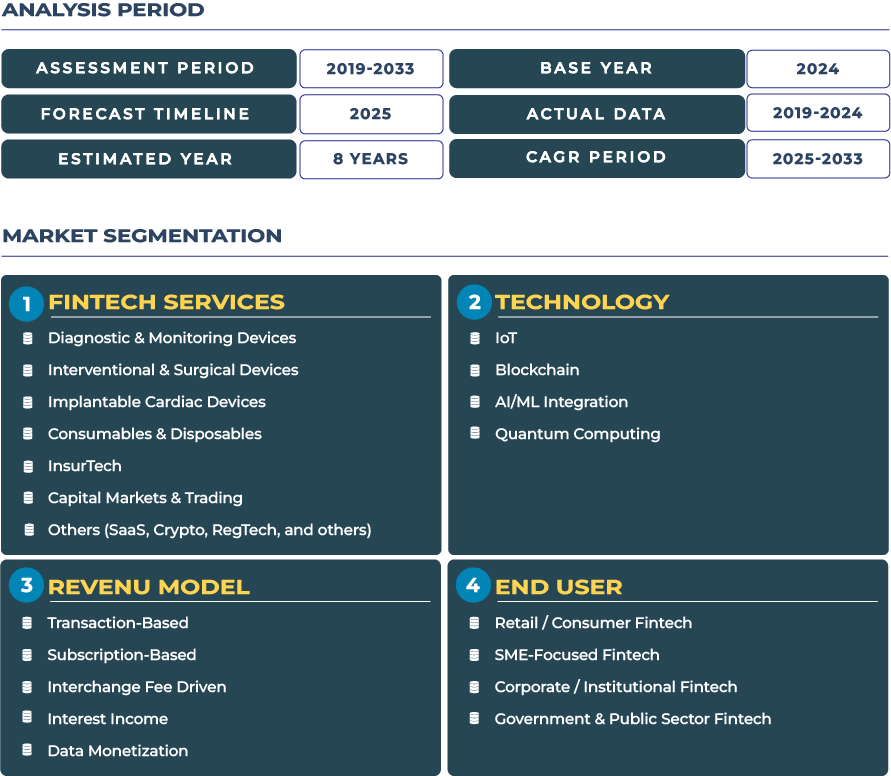
Singapore Fintech Market Segmentation
Frequently Asked Questions
MAS sandbox enables insurers to test tokenized products in controlled environments, accelerating product launches while ensuring regulatory compliance and consumer safety.
Singapore hub status gives insurers access to regional markets, allowing scalable insurtech expansion through cross-border partnerships and innovation-friendly infrastructure.
RegTech platforms automate compliance, AML checks, and risk monitoring, reducing operational costs for insurers while strengthening governance and market transparency.
Related Reports

BRICS Generative AI GPUs Market Size | 2019-2033
- Report ID: SEM287 | Coverage: Regional |
- Category: Semiconductors | Sub-Category: AI Chips |
- Published Date: Dec 2025 | US$1,345 |
Spain Medical Device Market Size | 2019-2033
- Report ID: HEA33 | Coverage: Country |
- Category: Healthcare | Sub-Category: Medical Devices |
- Published Date: Feb 2026 | US$495 |
Chile Media Market Size | 2019-2033
- Report ID: MAE39 | Coverage: Country |
- Category: Media and Entertainment | Sub-Category: Media |
- Published Date: May 2025 | US$495 |
Japan Rural Banking Market Size | 2019-2033
- Report ID: BAF933 | Coverage: Country |
- Category: Banking and Finance | Sub-Category: Banking Services |
- Published Date: Oct 2025 | US$495 |
BRICS Generative AI GPUs Market Size | 2019-2033
- Report ID: SEM287 | Coverage:Regional |
- Category:Semiconductors | Sub-Category: AI Chips |
- Publishing Soon |US$1,345 |
Spain Medical Device Market Size | 2019-2033
- Report ID: HEA33 | Coverage:Country |
- Category:Healthcare | Sub-Category: Medical Devices |
- Published Date: Feb 2026 |US$495 |
Chile Media Market Size | 2019-2033
- Report ID: MAE39 | Coverage:Country |
- Category:Media and Entertainment | Sub-Category: Media |
- Published Date: May 2025 |US$495 |
Japan Rural Banking Market Size | 2019-2033
- Report ID: BAF933 | Coverage:Country |
- Category:Banking and Finance | Sub-Category: Banking Services |
- Published Date: Oct 2025 |US$495 |
Why Choose Us

24/5 Research Support
Get your queries resolved prior to and post purchasing research study

Customize As Per Specific Requirements
Get in-depth analysis based on your tailored research needs

Expertise in Tracking Niche Markets
Comprehensive view of latest technologies and opportunities across markets

360-Degree Analysis
Fact-based insights derived through supply & demand side analysis

Assured Quality
Deliver most accurate industry insights to maintain research quality

Information Security
Your confidential and personal data is secure and safe