
South Africa Cardiovascular Devices Market Size and Forecast by Device Type, Patient Demographics, End User, and Distribution Channel: 2019-2033
Sep 2025
| Format:

 |
Pages: 110+
|
Type: Sub-Industry Report
|
Authors:
Mahesh Y
(Assistant Research Manager)
|
Pages: 110+
|
Type: Sub-Industry Report
|
Authors:
Mahesh Y
(Assistant Research Manager)
MARKET OUTLOOK
South Africa Cardiovascular Devices Market Outlook: Private Hospitals Shaping Regional Cardiac Leadership
The South Africa Cardiovascular Devices Market is projected to grow from USD 38.7 million in 2025 to USD 52.0 million by 2033, expanding at a CAGR of 3.8%. Growth is fueled by the strength of advanced private hospitals, medical tourism inflows, and increased demand for implantable and interventional cardiac devices. Rising healthcare expenditure and government partnerships further reinforce the market trajectory. While public sector procurement challenges persist, the dominance of private healthcare and growing demand for consumables and monitoring devices ensure sustainable growth momentum in the cardiovascular devices industry.
South Africa stands out as the leading African cardiovascular market, where the private hospital sector plays a transformative role in modernizing healthcare delivery. Advanced facilities in urban centers like Johannesburg, Cape Town, and Durban are positioning the country as a hub for cardiovascular innovation, where diagnostic excellence, surgical proficiency, and consumable accessibility converge. With increasing patient inflows from across Africa seeking superior cardiac care, the South African cardiovascular devices ecosystem is evolving into a powerful anchor of medical modernization and patient-centric care. This leadership is further reinforced by ongoing investments, medical tourism, and a rising emphasis on high-quality, specialized devices.
South Africa Positioned as Africa’s Regional Cardiac Leader
South Africa has emerged as the largest and most advanced cardiovascular market in Africa, with private hospitals leading the charge in adopting state-of-the-art technologies. The combination of urban medical infrastructure and internationally accredited private institutions has created an attractive ecosystem for interventional cardiology and cardiac surgery. Patients from across sub-Saharan Africa are increasingly traveling to South Africa for specialized cardiovascular care, creating robust demand for diagnostic and monitoring devices as well as consumables. This regional pull reinforces the country’s position as a medical tourism hub. Additionally, partnerships between government and private healthcare providers are enabling modernization of procurement systems, reducing bottlenecks, and improving access to life-saving devices. Despite macroeconomic challenges such as uneven healthcare access and inequality in affordability, the private sector continues to ensure South Africa remains a cardiac care leader. By 2033, with steady adoption of implantable devices, digital monitoring solutions, and locally sourced consumables, South Africa cardiovascular devices sector is set to solidify its leadership role in Africa.
Drivers & Restraints: Understanding Growth Catalysts and Challenges
Private Hospital Expansion and Medical Tourism Fuel Market Expansion
Private hospitals in South Africa, known for world-class cardiac facilities, are key growth drivers for the cardiovascular devices industry. Facilities in major cities are increasingly offering interventional cardiology and cardiac surgery with global standards of care. This attracts patients from across Africa, stimulating demand for implantable cardiac devices and consumables. The rise in health insurance penetration and international collaborations further accelerates demand for surgical tools, stents, and diagnostic monitoring solutions, reinforcing South Africa’s role as a trusted cardiac treatment destination.
Economic Inequality and Procurement Complexities Limit Market Potential
Despite strong private sector adoption, the broader cardiovascular devices ecosystem faces challenges in accessibility and affordability. Economic constraints and inequality mean that large segments of the population cannot afford advanced cardiovascular interventions. Public sector hospitals, constrained by procurement delays and budget limitations, struggle to match private sector modernization. This imbalance hampers widespread adoption of critical devices such as implantables and advanced surgical tools, limiting overall market penetration beyond urban hubs.
Trends & Opportunities: Future Pathways in South Africa Cardiovascular Devices Landscape
Urban Private Hospital Networks Driving Device Uptake
A significant trend in the South Africa cardiovascular devices market is the rapid adoption of advanced cardiac technologies by urban private hospitals. These facilities are becoming focal points for interventional procedures and cardiac monitoring. The clustering of expertise in metros like Cape Town and Johannesburg has turned them into nodes of medical tourism, further boosting device demand. The growing consumption of single-use consumables also reflects the rising emphasis on infection prevention and patient safety in surgical environments.
Local Manufacturing and Partnerships as Market Opportunities
Opportunities in South Africa cardiovascular devices sector are rooted in partnerships and localized production. Strategic collaborations between global companies and private healthcare providers are opening pathways for technology transfer, while local manufacturing of consumables offers cost advantages and supply chain resilience. Medical tourism expansion, supported by competitive pricing and internationally accredited facilities, also creates opportunities for device companies to expand their footprint and capture growing regional demand.
Competitive Landscape: Global and Local Players Strengthening Market Presence
The South Africa cardiovascular devices market is shaped by both multinational corporations and local suppliers. Leading players such as Medtronic are collaborating with private hospital chains to introduce innovative implantable and interventional devices. Local distributors and suppliers are increasingly focusing on consumables and disposables to cater to the high-volume demand in surgeries. Recent developments include hospital-led cardiology upgrades and the integration of telehealth pilots for post-surgical monitoring. Partnerships with private hospital groups not only strengthen market penetration but also ensure long-term sustainability of the cardiovascular devices ecosystem in South Africa.
*Research Methodology: This report is based on DataCube’s proprietary 3-stage forecasting model, combining primary research, secondary data triangulation, and expert validation.
[Learn more]
South Africa Cardiovascular Devices Market Segmentation
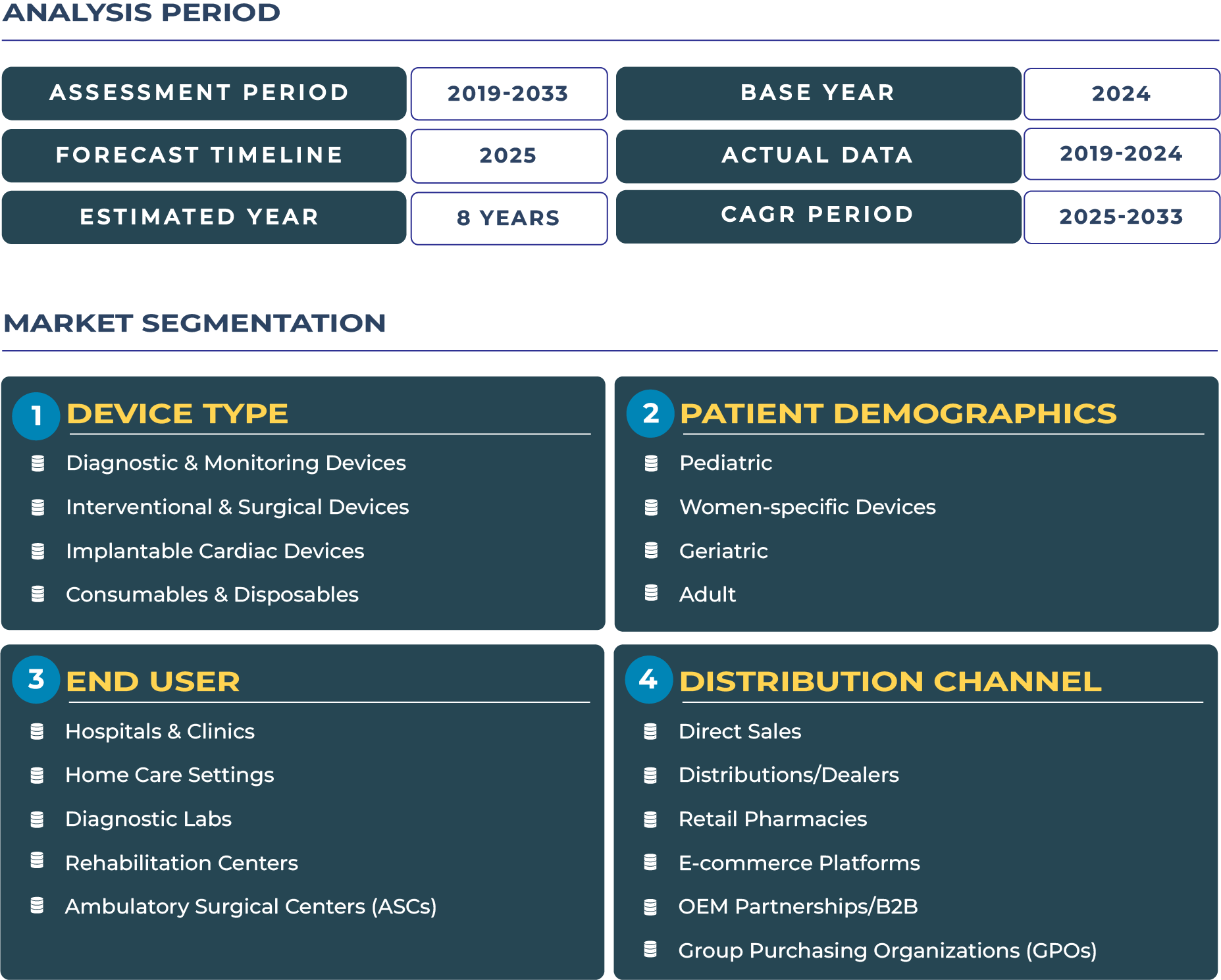
Frequently Asked Questions
Companies should prioritize urban hubs like Johannesburg and Cape Town, where private hospitals and medical tourism drive advanced device adoption.
Key constraints include economic inequality, procurement bottlenecks in public hospitals, and uneven affordability that restrict access to advanced devices for broader populations.
Partnerships with private hospital groups, local manufacturing of consumables, and expansion of medical tourism services are major growth channels in the country.
Related Reports

Japan AI Robotics Market Size | 2019-2033
- Report ID: IT283 | Coverage: Country |
- Category: Information Technology | Sub-Category: Artificial Intelligence |
- Published Date: Dec 2025 | US$495 |
Colombia Public Cloud Market Size | 2019-2033
- Report ID: IT1793 | Coverage: Country |
- Category: Information Technology | Sub-Category: IT Software & Services |
- Published Date: Jul 2025 | US$495 |
Chile Public Cloud Market Size | 2019-2033
- Report ID: IT1794 | Coverage: Country |
- Category: Information Technology | Sub-Category: IT Software & Services |
- Published Date: Jul 2025 | US$495 |
South Korea Drone Detection System Market Size | 2019-2033
- Report ID: A&D57 | Coverage: Country |
- Category: Aerospace & Defence | Sub-Category: Defence |
- Published Date: Jul 2025 | US$495 |
Nordics Insurance Brokerage Market Size | 2019-2033
- Report ID: IAS61 | Coverage: Country |
- Category: Insurance and Securities | Sub-Category: Insurance Brokerage |
- Published Date: Aug 2025 | US$495 |
Japan AI Robotics Market Size | 2019-2033
- Report ID: IT283 | Coverage:Country |
- Category:Information Technology | Sub-Category: Artificial Intelligence |
- Publishing Soon |US$495 |
Colombia Public Cloud Market Size | 2019-2033
- Report ID: IT1793 | Coverage:Country |
- Category:Information Technology | Sub-Category: IT Software & Services |
- Published Date: Jul 2025 |US$495 |
Chile Public Cloud Market Size | 2019-2033
- Report ID: IT1794 | Coverage:Country |
- Category:Information Technology | Sub-Category: IT Software & Services |
- Published Date: Jul 2025 |US$495 |
South Korea Drone Detection System Market Size | 2019-2033
- Report ID: A&D57 | Coverage:Country |
- Category:Aerospace & Defence | Sub-Category: Defence |
- Published Date: Jul 2025 |US$495 |
Nordics Insurance Brokerage Market Size | 2019-2033
- Report ID: IAS61 | Coverage:Country |
- Category:Insurance and Securities | Sub-Category: Insurance Brokerage |
- Published Date: Aug 2025 |US$495 |
Why Choose Us

24/5 Research Support
Get your queries resolved prior to and post purchasing research study

Customize As Per Specific Requirements
Get in-depth analysis based on your tailored research needs

Expertise in Tracking Niche Markets
Comprehensive view of latest technologies and opportunities across markets

360-Degree Analysis
Fact-based insights derived through supply & demand side analysis

Assured Quality
Deliver most accurate industry insights to maintain research quality

Information Security
Your confidential and personal data is secure and safe