
UK Fintech Market Size and Forecast by Fintech Services, Technology, Revenue Model, and End User: 2019-2033
Sep 2025
| Format:

 |
Pages: 110+
|
Type: Industry Report
|
Authors:
Jayson Gomes
(Manager – BFSI)
|
Pages: 110+
|
Type: Industry Report
|
Authors:
Jayson Gomes
(Manager – BFSI)
MARKET OUTLOOK
UK Fintech Market Outlook: Sandbox-Driven Productisation: From FCA Pilots to Commercial VRP Deployments
The United Kingdom has emerged as a regulatory-forward innovation hub where fintech products are increasingly shaped by sandbox-driven experimentation. Programs initiated by the Financial Conduct Authority (FCA) have allowed fintechs to test novel payment solutions, including Variable Recurring Payments (VRP), in live market environments before scaling them commercially. This dynamic has positioned the UK fintech market as a bridge between regulatory experimentation and enterprise-grade adoption, driving confidence among both merchants and consumers.
In 2025, the UK fintech market is projected to reach USD 25.8 billion, expanding to USD 50.2 billion by 2033 at a CAGR of 8.7%. The trajectory is powered by the successful migration of open banking pilots into real-world services such as VRP for subscription billing, cross-border payment innovation, and advanced wealth management platforms. This evolution has been reinforced by the UK’s role as a global financial hub, London’s concentration of fintech headquarters, and strong international investor appetite for scalable regulatory-compliant solutions. Collectively, these factors underscore how sandbox initiatives have become a bedrock for fintech market expansion, reducing barriers to productisation and accelerating monetisation pathways.
Reshaping Growth: Drivers and Restraints Influencing the UK Fintech Ecosystem
The UK fintech sector benefits from a unique confluence of market strengths. London’s position as a global financial hub continues to attract global capital, while the advanced payments ecosystem—driven by open banking APIs and faster payments infrastructure—supports new entrants in retail banking, wealthtech, and insurtech. High digital adoption across demographics has also expanded the total addressable market, enabling fintech services to scale across consumer and SME segments. Venture capital inflows remain steady, with UK-based fintechs raising strong rounds in banking-as-a-service and digital investment platforms. Together, these drivers highlight the UK’s ability to couple regulatory sophistication with commercial readiness.
However, structural restraints persist. Post-Brexit divergence in regulatory alignment introduces complexity for cross-border fintech operations, particularly in payments and lending tech. Firms operating across the EU-UK corridor face additional compliance overheads and increased operational costs. Moreover, established banks continue to exert lobbying pressure to maintain incumbency, often slowing the pace of fintech adoption in certain high-value segments such as capital markets. These challenges have created an uneven regulatory landscape where innovation thrives domestically but scales more cautiously internationally. The combined effect of Brexit-induced uncertainty and legacy bank influence underscores the need for fintechs to develop modular and compliance-first infrastructures to remain competitive.
Emerging Trends and Opportunities: From Open Banking APIs to Capital Market Expansion
One of the most defining trends in the UK fintech landscape is the maturation of open banking API innovation. With rising traffic volumes and merchant adoption, APIs have transformed from regulatory compliance tools into commercial enablers, powering embedded finance solutions for subscription billing, e-commerce, and lending marketplaces. In parallel, fintech-to-bank acquisitions are reshaping market dynamics, as traditional banks seek to acquire API-driven solutions to accelerate digital transformation. Cities like London and Manchester have emerged as fintech clusters, reinforcing regional strength in venture-backed innovation.
Opportunities are equally compelling. London continues to consolidate its position as the fintech headquarters for Europe, the Middle East, and Africa (EMEA), providing startups with a strategic base for cross-border expansion. In capital markets, fintechs are addressing inefficiencies in trading platforms, digital custody, and risk management tools, areas previously dominated by incumbents. Enterprise fintech SaaS solutions, particularly those offering compliance automation and modular infrastructure, are also gaining traction with mid-tier banks looking to digitise without overhauling legacy cores. These trends present fintech firms with a dual opportunity: leveraging regulatory openness for domestic scale while capitalising on London’s global influence for international reach.
Regulatory Leadership: FCA Initiatives Driving Commercial-Grade Fintech Innovation
The UK remains a global leader in regulatory innovation, largely due to the proactive stance of the Financial Conduct Authority. The FCA’s sandbox framework has allowed fintechs to test live products with real consumers under controlled conditions, significantly reducing go-to-market risks. Initiatives around VRP are particularly noteworthy, as they address long-standing inefficiencies in subscription-based payments and merchant reconciliation. Government-backed open banking mandates have further standardised API use, ensuring interoperability and fostering healthy competition.
These initiatives extend beyond regulatory facilitation. They set international benchmarks for fintech regulation, enabling UK firms to export best practices and compliant models abroad. By lowering entry barriers and aligning regulation with innovation, the FCA has positioned the UK as not just a market for fintech adoption, but as a model for global fintech governance.
Key Impacting Factors: Market Forces Shaping UK Fintech Performance
The performance of the UK fintech market is influenced by both macroeconomic and sector-specific forces. The number of FCA sandbox approvals has steadily increased, providing a clear pipeline of fintech innovations moving into commercialisation. Open Banking API traffic continues to climb, with rising integration by subscription merchants, insurers, and e-commerce platforms. At the same time, broader macroeconomic conditions—such as inflationary pressures and shifting interest rates—are impacting consumer borrowing patterns, thereby influencing demand for lending tech and digital credit solutions.
Additionally, the ongoing war in Ukraine and associated geopolitical tensions have impacted investor sentiment, leading to cautious capital deployment in risk-heavy fintech ventures. Nevertheless, strategic clarity from regulators and government initiatives has helped maintain resilience, keeping investor focus on high-compliance areas such as insurtech and wealth management. These factors demonstrate that while external shocks can disrupt funding cycles, the UK fintech ecosystem’s structural resilience continues to anchor long-term growth.
Competitive Landscape: VRP Expansion and Sandbox-Driven Strategies Redefining Market Competition
The UK fintech market is characterised by a mix of homegrown champions and international players. Notable firms such as Revolut are leading innovation in digital banking, while partnerships between global fintechs and UK banks are intensifying. In January 2025, it was announced that the UK would establish an independent firm dedicated to boosting Variable Recurring Payments (VRP), reinforcing the government’s intent to accelerate adoption in subscription-heavy sectors. This initiative reflects a broader strategy: deploying regulatory-backed products to gain merchant adoption at scale.
Product launches are focusing on building VRP infrastructure for subscription merchants, while regulatory engagement through FCA sandbox pilots shortens time-to-market for emerging insurtech and lending models. Expansion strategies increasingly involve positioning London as a base for EMEA operations, with fintech SaaS providers offering modular banking solutions to mid-tier institutions. Collectively, these competitive moves underscore how sandbox experimentation and VRP expansion are becoming defining differentiators in the UK fintech landscape.
Conclusion: Charting the Path from Pilots to Scaled Fintech Adoption in the UK
The UK fintech market is distinguished by its ability to transform pilot-stage innovation into commercially viable products. Unlike many markets that struggle to reconcile regulation with growth, the UK’s FCA-led approach has actively reduced friction, making sandbox-driven solutions credible at scale. As the subscription economy grows, the expansion of VRP, embedded finance, and open banking APIs will reshape consumer engagement, enabling seamless and recurring transactions. Meanwhile, capital markets and enterprise SaaS fintech solutions are positioning the UK as both a domestic innovator and an international exporter of regulatory-aligned fintech models.
However, the path forward will require careful navigation. Brexit-related divergence risks, geopolitical uncertainty, and legacy incumbency pressures remain critical hurdles. Yet, the UK’s combination of regulatory innovation, global financial hub status, and deep talent pools continues to provide a competitive edge. The fintech sector’s ability to pivot pilots into scaled offerings not only secures growth domestically but also strengthens the UK’s role in defining the future of global financial services. This convergence of sandbox-driven innovation and international positioning will remain the central USP for the UK fintech industry in the coming decade.
*Research Methodology: This report is based on DataCube’s proprietary 3-stage forecasting model, combining primary research, secondary data triangulation, and expert validation.
[Learn more]
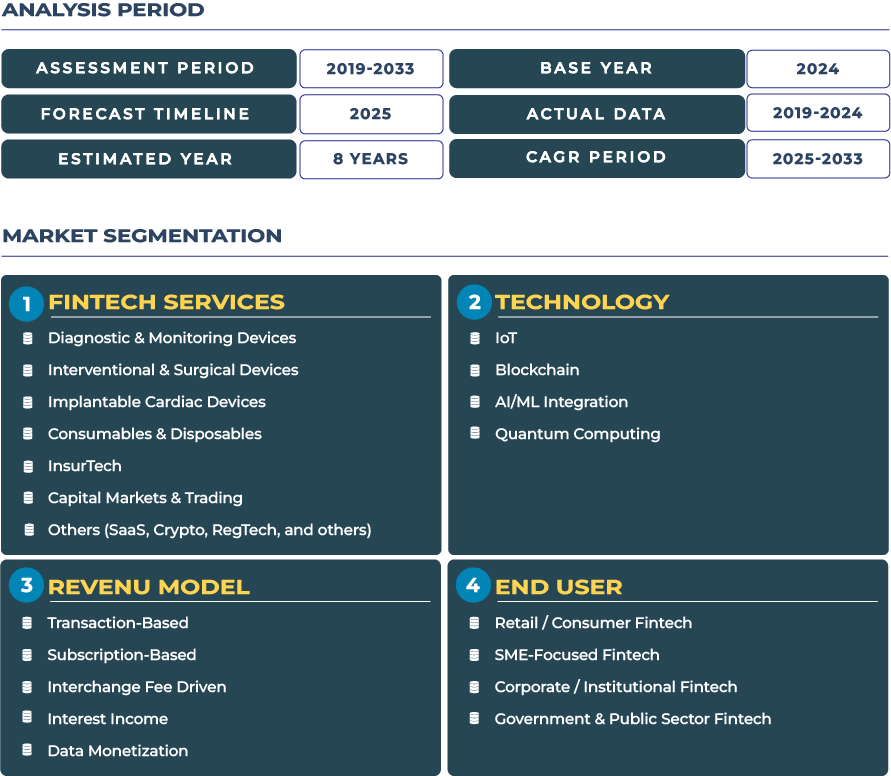
UK Fintech Market Segmentation
Frequently Asked Questions
Open Banking APIs are enabling insurers to deploy Variable Recurring Payments (VRP) for subscription-like premiums, reducing payment failures and improving customer retention rates.
Post-Brexit, insurers face greater compliance divergence between UK and EU frameworks, increasing operational costs for cross-border insurance fintech services.
FCA sandbox programs allow insurtech firms to test live models under regulatory supervision, reducing risk and accelerating adoption of compliant insurance fintech solutions.
Related Reports

Nigeria AI Memory Chip Market Size | 2019-2033
- Report ID: SEM228 | Coverage: Country |
- Category: Semiconductors | Sub-Category: Semiconductors |
- Published Date: Dec 2025 | US$495 |
UK Consumer Electronics Market Size | 2019-2033
- Report ID: CE67 | Coverage: Country |
- Category: Consumer Electronics | Sub-Category: Electronics |
- Published Date: Jul 2025 | US$495 |
Global Medical Device Market Size | 2019-2033
- Report ID: HEA54 | Coverage: Global |
- Category: Healthcare | Sub-Category: Medical Devices |
- Published Date: Feb 2026 | US$2,945 |
France Private Banking Market Size | 2019-2033
- Report ID: BAF892 | Coverage: Country |
- Category: Banking and Finance | Sub-Category: Banking Services |
- Published Date: Oct 2025 | US$495 |
Nigeria AI Memory Chip Market Size | 2019-2033
- Report ID: SEM228 | Coverage:Country |
- Category:Semiconductors | Sub-Category: Semiconductors |
- Publishing Soon |US$495 |
UK Consumer Electronics Market Size | 2019-2033
- Report ID: CE67 | Coverage:Country |
- Category:Consumer Electronics | Sub-Category: Electronics |
- Published Date: Jul 2025 |US$495 |
Global Medical Device Market Size | 2019-2033
- Report ID: HEA54 | Coverage:Global |
- Category:Healthcare | Sub-Category: Medical Devices |
- Published Date: Feb 2026 |US$2,945 |
France Private Banking Market Size | 2019-2033
- Report ID: BAF892 | Coverage:Country |
- Category:Banking and Finance | Sub-Category: Banking Services |
- Published Date: Oct 2025 |US$495 |
Why Choose Us

24/5 Research Support
Get your queries resolved prior to and post purchasing research study

Customize As Per Specific Requirements
Get in-depth analysis based on your tailored research needs

Expertise in Tracking Niche Markets
Comprehensive view of latest technologies and opportunities across markets

360-Degree Analysis
Fact-based insights derived through supply & demand side analysis

Assured Quality
Deliver most accurate industry insights to maintain research quality

Information Security
Your confidential and personal data is secure and safe