
US In-vitro Diagnostic Market Size and Forecast by Product Type, Technology, Application, Disease Type, End User, and Distribution Channel: 2019-2033
Oct 2025
| Format:

 |
Pages: 110+
|
Type: Sub-Industry Report
|
Authors:
Mahesh Y
(Assistant Research Manager)
|
Pages: 110+
|
Type: Sub-Industry Report
|
Authors:
Mahesh Y
(Assistant Research Manager)
MARKET OUTLOOK
Regulatory Excellence and Capital Investment Drive the US In-Vitro Diagnostic Market’s Global Dominance
The United States In-vitro Diagnostic (IVD) market stands as the world’s most influential hub for diagnostic innovation, anchored by a mature regulatory ecosystem, vast patient pool, and global investment attractiveness. Its position is fortified by the rigorous oversight of the U.S. Food and Drug Administration (FDA), whose comprehensive regulatory pathways set the benchmark for diagnostic validation worldwide. The U.S. also benefits from unmatched venture capital flows, strong reimbursement structures, and an unparalleled concentration of life science R&D institutions that continually push the boundaries of medical diagnostics.
As of 2025, the U.S. In-vitro Diagnostic market is estimated at USD 29.98 billion and is projected to reach USD 38.69 billion by 2033. This sustained growth reflects a maturing but highly profitable sector, supported by rising test volumes in oncology, infectious diseases, and genomics. Despite slower price expansion due to Medicare reimbursement constraints, the integration of molecular and digital diagnostics is enhancing test accuracy, accelerating result turnaround, and reinforcing the market’s growth trajectory. As investors and regulators emphasize value-based care, the U.S. IVD landscape continues to align innovation with measurable patient outcomes.
Growth Catalysts: Innovation, Private Investments, and Clinical Demand Power Market Progress
The U.S. IVD industry’s expansion is being driven by high clinical test volumes, strong private payer participation, and rapid adoption of next-generation technologies. The nation’s diverse healthcare infrastructure, ranging from large academic hospitals to private diagnostic laboratories, enables rapid deployment of advanced molecular testing and high-throughput screening systems. Additionally, favorable investment conditions and public-private collaborations have fueled an innovation pipeline encompassing personalized medicine, companion diagnostics, and AI-integrated software solutions.
The increasing prevalence of chronic diseases, including cancer and cardiovascular conditions, has accelerated demand for continuous diagnostic monitoring. The expansion of point-of-care testing devices in retail clinics and home settings reflects a shift toward consumer-centric diagnostics. Leading players are investing heavily in reagents, consumables, and instrument automation to streamline laboratory efficiency and support high-sensitivity assays. Furthermore, the pandemic’s legacy has established lasting demand for rapid molecular diagnostics, strengthening the market’s post-COVID diagnostic readiness.
Market Challenges: Reimbursement Constraints and Regulatory Complexity Shape Market Entry Dynamics
While the U.S. market remains highly lucrative, reimbursement pressures and complex procurement structures present persistent challenges. Medicare’s strict pricing frameworks limit margins for diagnostic manufacturers, particularly for routine testing categories. The dynamic shift toward value-based reimbursement models requires laboratories and device makers to demonstrate clinical efficacy and cost justification. This has intensified competition, compelling firms to invest in clinical trials and post-market studies to secure long-term reimbursement inclusion.
The lengthy procurement cycles in hospital systems further slow market penetration, especially for emerging diagnostic technologies. Smaller manufacturers face barriers to entry as healthcare providers prefer established vendors with proven outcomes. Moreover, heightened regulatory scrutiny under the FDA’s IVD regulation framework, particularly regarding Laboratory Developed Tests (LDTs), adds compliance complexity. Legal and litigation risks related to diagnostic misinterpretation also weigh heavily on corporate strategies. As a result, leading companies are increasingly shifting toward automation, software integration, and cloud connectivity to ensure consistency, compliance, and traceability in clinical workflows.
Emerging Trends and Future Opportunities Reshaping the US In-Vitro Diagnostic Landscape
The U.S. IVD market is entering a transformative era characterized by digital connectivity, decentralized diagnostics, and data-driven decision-making. The growth of personalized testing, particularly in oncology and genetic screening, is being accelerated by advancements in bioinformatics and next-generation sequencing (NGS) technologies. Cities such as Boston, San Diego, and San Francisco continue to serve as epicenters for medtech innovation, hosting R&D hubs that integrate diagnostics with therapeutic data for holistic care models.
The rise of subscription-based reagent delivery models and digital service contracts reflects an industry shift toward recurring revenue structures. Manufacturers are exploring “diagnostics-as-a-service” models, combining instrument installation with software analytics and consumables replenishment. This approach aligns with laboratories’ demand for operational predictability and performance consistency. Moreover, expanding access to clinical data analytics, facilitated by the Centers for Disease Control and Prevention (CDC) and private data registries, is creating new opportunities for predictive diagnostics and real-world evidence generation.
Future opportunities also lie in direct-to-laboratory partnerships and regional collaborations to enhance test accessibility. The emergence of mobile testing facilities and connected home testing kits is bridging healthcare gaps across suburban and rural regions. As hospitals adopt integrated digital health solutions, interoperability between laboratory systems and electronic health records (EHRs) will become a defining competitive advantage. Together, these trends underscore a market evolving beyond instruments, toward a holistic, data-centric diagnostic ecosystem.
Competitive Landscape: Strategic Collaborations and Innovation Define Market Leadership
The competitive dynamics of the U.S. In-vitro Diagnostic industry are shaped by technological leadership, strategic acquisitions, and collaborative commercialization. Major players such as Roche Diagnostics, Abbott Laboratories, Thermo Fisher Scientific, and Danaher Corporation dominate through diversified portfolios and continuous innovation cycles. In 2024, Abbott expanded its molecular diagnostics range with the launch of high-sensitivity infectious disease assays, strengthening its leadership in rapid testing. Meanwhile, Roche has accelerated cloud-based diagnostic integration, focusing on interoperable laboratory management systems to enhance workflow efficiency.
Leading companies are establishing dedicated commercialization teams to cater to ambulatory and private laboratory networks, enabling faster decision-making and tailored pricing strategies. Value-based contracting models are gaining momentum as healthcare systems demand cost justification and outcome accountability. Additionally, manufacturers are investing in regional training centers to enhance clinical adoption and reduce system downtime. This competitive environment underscores a shift from product-centric to service-centric strategies, where real-world evidence, analytics, and partnerships define sustainable growth.
*Research Methodology: This report is based on DataCube’s proprietary 3-stage forecasting model, combining primary research, secondary data triangulation, and expert validation.
[Learn more]
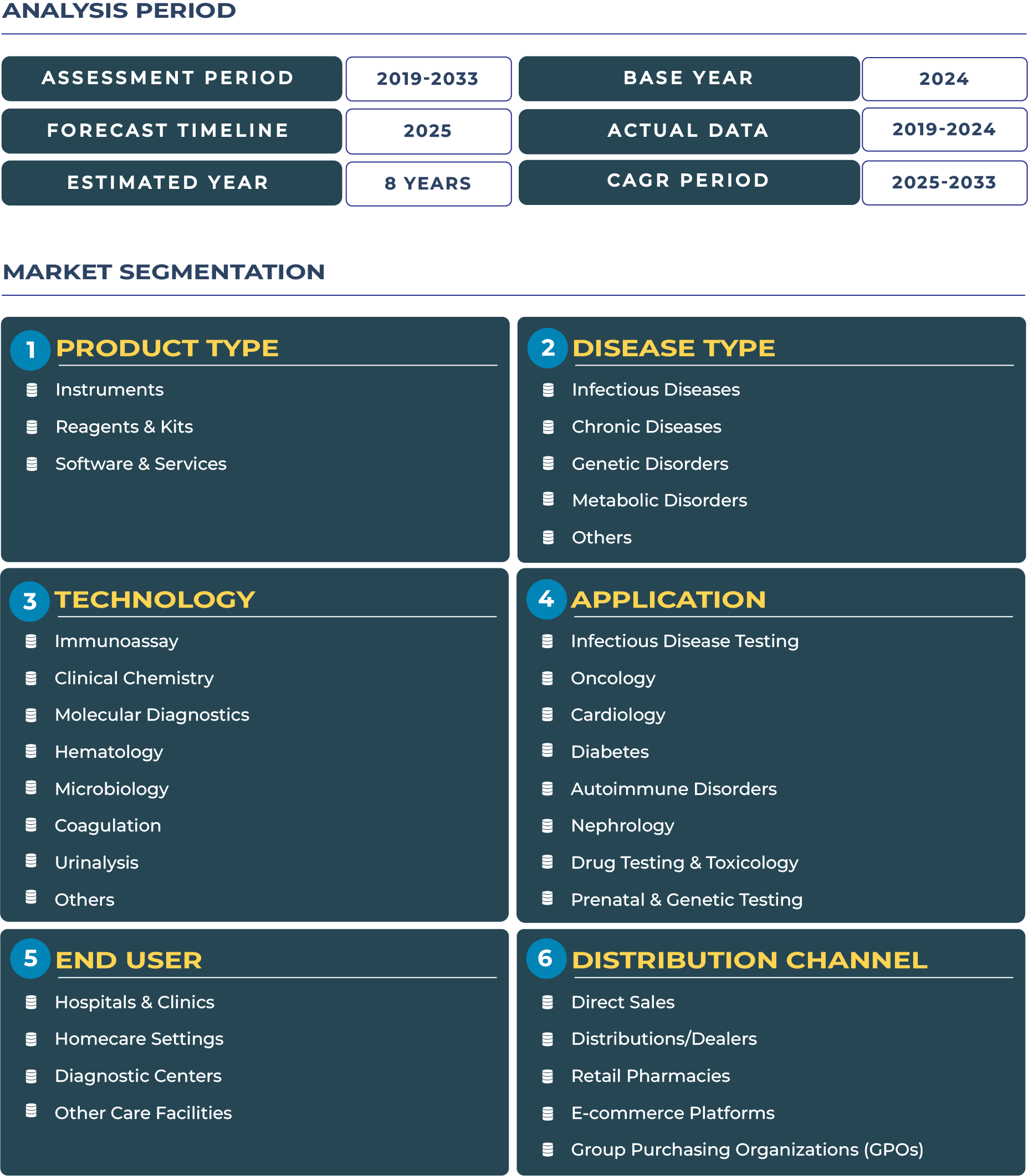
US In-vitro Diagnostic Market Segmentation
Frequently Asked Questions
The US IVD market is experiencing a surge in strategic mergers and VC-backed investments that accelerate innovation pipelines and expand access to high-margin testing technologies across hospitals and labs.
Hospitals face tight Medicare reimbursement thresholds, complex coding requirements, and lengthy evaluation processes, which can delay procurement and limit the rollout of high-cost diagnostic and implant systems.
Robotic-assisted surgery enhances diagnostic precision, reduces human error, and integrates real-time data into procedural workflows, marking a key intersection between diagnostics and surgical innovation.
Related Reports

Oman SaaS Market Size | 2019-2034
- Report ID: IT1865 | Coverage: Country |
- Category: Information Technology | Sub-Category: Cloud Computing Technology |
- Published Date: Dec 2025 | US$495 |
South Korea Investment Banking Market Size | 2019-2033
- Report ID: BAF854 | Coverage: Country |
- Category: Banking and Finance | Sub-Category: Banking Services |
- Published Date: Oct 2025 | US$495 |
Thailand Private Banking Market Size | 2019-2033
- Report ID: BAF954 | Coverage: Country |
- Category: Banking and Finance | Sub-Category: Banking Services |
- Published Date: Oct 2025 | US$495 |
Malaysia Diagnostic Imaging Devices Market Size | 2019-2033
- Report ID: HEA340 | Coverage: Country |
- Category: Healthcare | Sub-Category: Medical Devices |
- Published Date: Nov 2025 | US$495 |
Oman SaaS Market Size | 2019-2034
- Report ID: IT1865 | Coverage:Country |
- Category:Information Technology | Sub-Category: Cloud Computing Technology |
- Published Date: Dec 2025 |US$495 |
South Korea Investment Banking Market Size | 2019-2033
- Report ID: BAF854 | Coverage:Country |
- Category:Banking and Finance | Sub-Category: Banking Services |
- Published Date: Oct 2025 |US$495 |
Thailand Private Banking Market Size | 2019-2033
- Report ID: BAF954 | Coverage:Country |
- Category:Banking and Finance | Sub-Category: Banking Services |
- Published Date: Oct 2025 |US$495 |
Malaysia Diagnostic Imaging Devices Market Size | 2019-2033
- Report ID: HEA340 | Coverage:Country |
- Category:Healthcare | Sub-Category: Medical Devices |
- Published Date: Nov 2025 |US$495 |
Why Choose Us

24/5 Research Support
Get your queries resolved prior to and post purchasing research study

Customize As Per Specific Requirements
Get in-depth analysis based on your tailored research needs

Expertise in Tracking Niche Markets
Comprehensive view of latest technologies and opportunities across markets

360-Degree Analysis
Fact-based insights derived through supply & demand side analysis

Assured Quality
Deliver most accurate industry insights to maintain research quality

Information Security
Your confidential and personal data is secure and safe