
Europe In-vitro Diagnostic Market Size and Forecast by Product Type, Technology, Application, Disease Type, End User, and Distribution Channel: 2019-2033
Oct 2025
| Format:

 |
Pages: 160+
|
Type: Sub-Industry Report
|
Authors:
Mahesh Y
(Assistant Research Manager)
|
Pages: 160+
|
Type: Sub-Industry Report
|
Authors:
Mahesh Y
(Assistant Research Manager)
MARKET OUTLOOK
Europe’s Unified Diagnostic Frontier: How EU Frameworks Are Powering the In-vitro Diagnostic Market
The Europe In-vitro Diagnostic (IVD) market stands as a model of regulatory harmonization and innovation. The region’s commitment to a unified healthcare and device certification system, anchored in the EU In Vitro Diagnostic Regulation (IVDR), has created a streamlined environment for medtech advancement. CE marking under the IVDR ensures that diagnostic products meet the highest standards of safety, efficacy, and interoperability, fostering trust across hospitals, laboratories, and healthcare systems throughout Europe. This framework not only integrates cross-border healthcare delivery but also facilitates trade consistency among EU member states, making Europe a global benchmark for quality assurance in the diagnostic landscape.
In 2025, the Europe IVD market is estimated to reach USD 25.20 billion, with expectations to climb to USD 37.60 billion by 2033, growing at a CAGR of 5.1% from 2025 to 2033. This steady expansion is fueled by rising healthcare expenditure, a rapidly aging population, and the shift toward preventive and precision medicine. Despite macroeconomic volatility, post-pandemic recovery efforts and stable EU-wide reimbursement mechanisms are ensuring consistent investment flows in diagnostic innovation and laboratory automation. The IVD ecosystem is being strengthened through pan-European collaborations that drive standardized patient outcomes and sustainable medical procurement models.
Europe IVD Market Outlook: CE Marking, Integration, and the Future of Unified Diagnostics
The EU’s harmonized healthcare policy, coupled with strong regulatory oversight, has accelerated the pace of innovation in Europe’s diagnostic ecosystem. Standardized certification through CE marking allows companies to scale across borders without redundant approval processes, reducing costs and time to market. This uniformity has particularly benefited molecular diagnostics, clinical chemistry, and hematology testing devices, which are critical to managing chronic disease burdens such as diabetes, cardiovascular disorders, and cancer.
Furthermore, public and private laboratories are increasingly adopting digital IVD solutions, integrating cloud-based laboratory management software, and automating reagent workflows to improve accuracy and reduce turnaround time. The European Commission’s push for cross-border digital health data exchange has also encouraged interoperability between laboratories in Western and Eastern Europe. As sustainability gains importance, manufacturers are exploring eco-efficient reagents and recyclable testing kits to meet the EU’s environmental targets. Collectively, these initiatives underline the EU’s vision of fostering an integrated and responsible diagnostic future.
Key Drivers and Restraints Defining Europe In-vitro Diagnostic Industry
Aging Population and Strong Public Procurement Systems Accelerating Growth
Europe’s demographic shift toward an aging population is one of the most influential growth drivers for the In-vitro Diagnostic industry. With over 20% of the population aged 65 and above, chronic disease monitoring and preventive diagnostics have become national healthcare priorities. The availability of robust public procurement systems under the EU healthcare framework ensures that diagnostic products maintain quality consistency across hospitals. Programs under the EU4Health Programme are channeling funds toward improving testing capabilities for early detection of infectious and genetic conditions. Additionally, established reimbursement pathways across countries such as Germany, France, and the Netherlands have strengthened the commercial viability of advanced IVD systems.
Procurement Complexities and Regulatory Fragmentation Slowing Regional Market Uniformity
While Europe’s unified regulatory landscape enhances product safety, it also introduces compliance burdens for smaller manufacturers. The stringent conformity assessments mandated by the IVDR have increased certification costs, slowing the entry of small and mid-sized firms into the market. Moreover, country-specific Health Technology Assessment (HTA) requirements often extend procurement cycles, causing delays in tender approvals and reimbursement allocation. Price transparency policies and cost-containment measures implemented by public payers further limit profit margins. Despite these constraints, ongoing efforts by the European Commission’s Directorate-General for Health and Food Safety aim to simplify regulatory pathways and establish a central digital platform for conformity documentation, ensuring long-term efficiency gains.
Trends and Opportunities Shaping the Europe In-vitro Diagnostic Landscape
Value-based Procurement and Digitized Tendering Are Redefining Diagnostic Economics
Across Europe, procurement trends are shifting from volume-based purchasing toward value-based frameworks that reward outcome efficiency and long-term cost-effectiveness. Governments and hospital networks are piloting digital tendering systems to promote transparent competition and ensure timely product evaluation. This transformation is particularly visible in markets like France and the Nordic countries, where clinical evidence generation and real-world performance data now play pivotal roles in procurement scoring. Moreover, advanced reagent management and service contracts have become strategic differentiators for suppliers, allowing hospitals to minimize operational downtime while optimizing test throughput.
Cross-border Collaboration and Clinical Data Integration Creating Strategic Openings
The European diagnostic ecosystem is experiencing a wave of data-driven collaboration. Initiatives under the European Health Data Space are enabling the integration of diagnostic information across member states, supporting AI-assisted analytics and public health surveillance. Local partnerships are forming between laboratories and academic institutions to develop region-specific assays and bioinformatics solutions. Meanwhile, companies are leveraging outcome-based contracts and TCO (Total Cost of Ownership) optimization strategies to strengthen their market positioning. These dynamics present significant opportunities for innovators capable of aligning with EU policy objectives and clinical evidence standards.
Regional Analysis by Country
-
Western Europe
Western Europe dominates the regional In-vitro Diagnostic sector due to advanced healthcare infrastructure, high per-capita spending, and widespread adoption of digital diagnostic platforms. Germany, France, and the UK continue to lead in laboratory automation and high-throughput molecular testing adoption. Strategic hospital procurement frameworks and favorable reimbursement systems enhance commercial stability for leading suppliers.
-
Eastern Europe
Eastern Europe is emerging as a growth engine for cost-efficient diagnostics, driven by modernization initiatives and EU structural funding. Countries like Poland, Czech Republic, and Hungary are investing in reagent manufacturing and training programs to strengthen domestic laboratory networks. Cross-border collaborations with Western manufacturers are helping improve compliance and accelerate adoption of CE-marked diagnostic solutions.
Competitive Landscape: Strategic Compliance, Evidence Generation, and Market Integration
The European In-vitro Diagnostic ecosystem features a mix of global and regional leaders that emphasize innovation, compliance readiness, and evidence-based positioning. Industry giants like Roche Diagnostics, Siemens Healthineers, and bioMérieux continue to dominate, supported by strong HTA dossiers and collaborative R&D programs with European laboratories. Recent strategies include early development of conformity documentation to meet IVDR timelines, and the establishment of Key Opinion Leader (KOL) programs to strengthen clinical validation efforts.
Companies are also introducing tiered pricing models for different tenders, optimizing participation in public procurement across diverse economies. In 2024, Siemens Healthineers expanded its reagent manufacturing capacity in Germany to reduce import reliance and enhance European supply chain resilience. The sector is now increasingly driven by value-driven partnerships, transparent procurement policies, and pan-European health data integration, factors that are collectively redefining competitiveness and innovation speed in the diagnostic sector.
*Research Methodology: This report is based on DataCube’s proprietary 3-stage forecasting model, combining primary research, secondary data triangulation, and expert validation.
[Learn more]
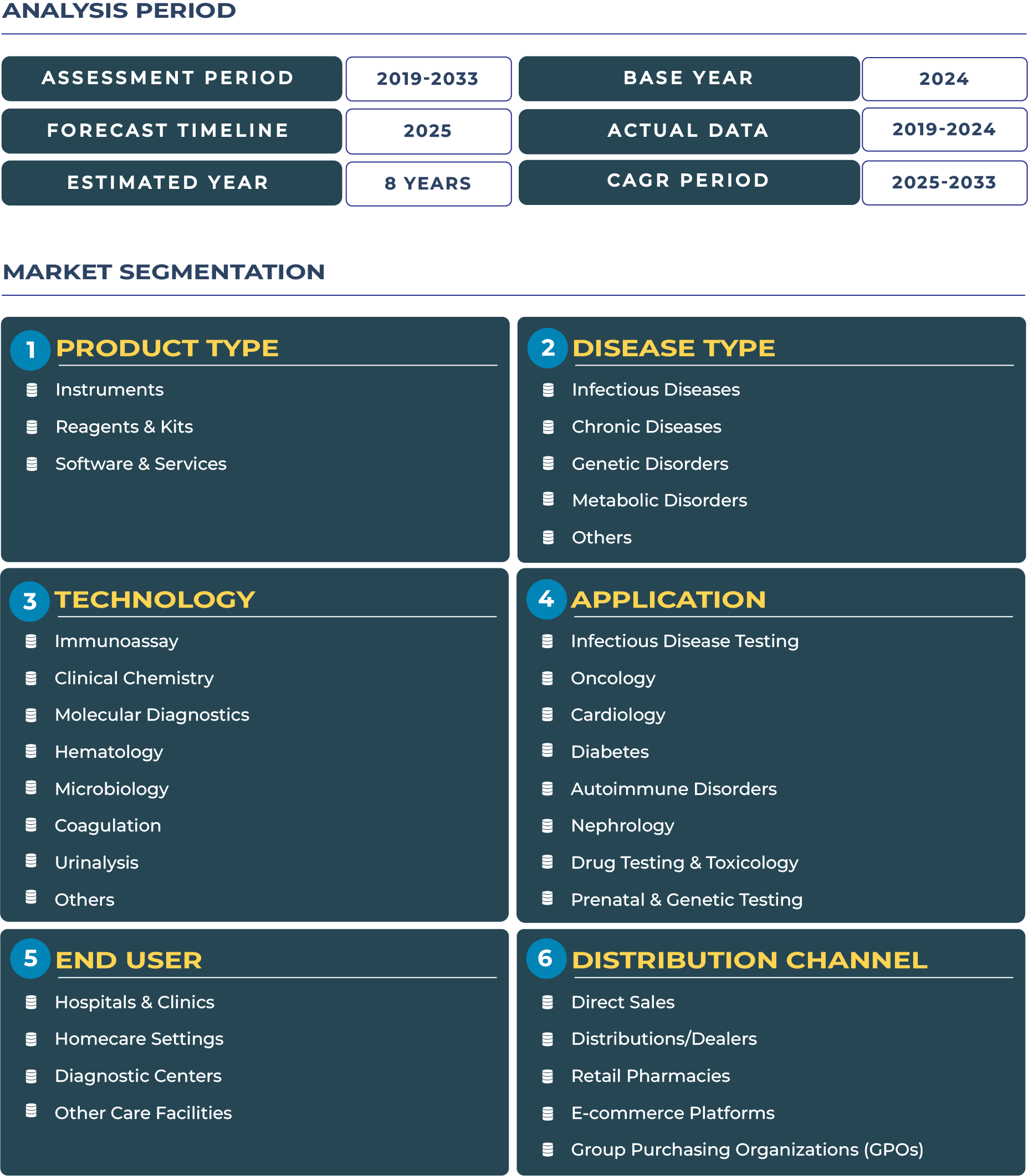
Europe In-vitro Diagnostic Market Segmentation
Europe In-vitro Diagnostic Market Countries Covered

Frequently Asked Questions
EU regulations, including the IVDR, ensure standardization, safety, and interoperability of diagnostic devices across member states. CE marking facilitates market access, enabling uniform quality and boosting patient trust in medical technologies.
Cost-control measures and price transparency frameworks often limit profit margins and slow procurement cycles, challenging suppliers to balance affordability with innovation while meeting evidence-based evaluation standards.
Digital health integration through the European Health Data Space is driving data interoperability, remote testing, and AI-enabled diagnostics. These trends are enhancing efficiency and advancing precision healthcare delivery.
Related Reports

Eastern Europe PaaS Market Size | 2019-2033
- Report ID: IT1886 | Coverage: Regional |
- Category: Information Technology | Sub-Category: Cloud Computing Technology |
- Published Date: Dec 2025 | US$1,345 |
Malaysia Investment Banking Market Size | 2019-2033
- Report ID: BAF857 | Coverage: Country |
- Category: Banking and Finance | Sub-Category: Banking Services |
- Published Date: Oct 2025 | US$495 |
Taiwan Private Banking Market Size | 2019-2033
- Report ID: BAF957 | Coverage: Country |
- Category: Banking and Finance | Sub-Category: Banking Services |
- Published Date: Oct 2025 | US$495 |
Singapore Diagnostic Imaging Devices Market Size | 2019-2033
- Report ID: HEA343 | Coverage: Country |
- Category: Healthcare | Sub-Category: Medical Devices |
- Published Date: Nov 2025 | US$495 |
Eastern Europe PaaS Market Size | 2019-2033
- Report ID: IT1886 | Coverage:Regional |
- Category:Information Technology | Sub-Category: Cloud Computing Technology |
- Published Date: Dec 2025 |US$1,345 |
Malaysia Investment Banking Market Size | 2019-2033
- Report ID: BAF857 | Coverage:Country |
- Category:Banking and Finance | Sub-Category: Banking Services |
- Published Date: Oct 2025 |US$495 |
Taiwan Private Banking Market Size | 2019-2033
- Report ID: BAF957 | Coverage:Country |
- Category:Banking and Finance | Sub-Category: Banking Services |
- Published Date: Oct 2025 |US$495 |
Singapore Diagnostic Imaging Devices Market Size | 2019-2033
- Report ID: HEA343 | Coverage:Country |
- Category:Healthcare | Sub-Category: Medical Devices |
- Published Date: Nov 2025 |US$495 |
Why Choose Us

24/5 Research Support
Get your queries resolved prior to and post purchasing research study

Customize As Per Specific Requirements
Get in-depth analysis based on your tailored research needs

Expertise in Tracking Niche Markets
Comprehensive view of latest technologies and opportunities across markets

360-Degree Analysis
Fact-based insights derived through supply & demand side analysis

Assured Quality
Deliver most accurate industry insights to maintain research quality

Information Security
Your confidential and personal data is secure and safe