
GCC In-vitro Diagnostic Market Size and Forecast by Product Type, Technology, Application, Disease Type, End User, and Distribution Channel: 2019-2033
Oct 2025
| Format:

 |
Pages: 160+
|
Type: Sub-Industry Report
|
Authors:
Mahesh Y
(Assistant Research Manager)
|
Pages: 160+
|
Type: Sub-Industry Report
|
Authors:
Mahesh Y
(Assistant Research Manager)
MARKET OUTLOOK
GCC In-vitro Diagnostic Market Outlook: Evolving as the Regional Medtech Investment Hub for Diagnostic Growth
The Gulf Cooperation Council (GCC) has emerged as a leading regional medtech investment hub, attracting significant attention for its growing In-vitro Diagnostic (IVD) market. Driven by government-backed healthcare megaprojects, diversification strategies, and the establishment of high-end medical ecosystems, GCC nations are redefining how diagnostics are integrated into healthcare delivery. According to DataCube Research, the GCC In-vitro Diagnostic Market is expected to grow from USD 1.58 billion in 2025 to USD 1.96 billion by 2033. This moderate yet steady growth is supported by the region’s focus on premium diagnostic instruments, rapid reagent availability, and digital laboratory service expansion across major cities like Riyadh, Dubai, and Doha.
GCC’s commitment to healthcare innovation is exemplified by national programs under Vision 2030 and Vision 2040, emphasizing digital health transformation, preventive screening, and molecular diagnostics. The Saudi Ministry of Health has prioritized the integration of advanced diagnostic platforms across public hospitals, while the UAE Ministry of Health and Prevention continues to foster innovation through private-public partnerships. The introduction of AI-based pathology systems, connected laboratory networks, and real-time analytics are transforming the IVD sector from a reactive testing approach to a proactive health management model. These developments underscore GCC’s ambition to become a global healthcare reference point for precision and quality.
Strategic Health Investments and Premiumization Strengthen GCC’s Diagnostic Vision
The GCC In-vitro Diagnostic industry is advancing in alignment with national healthcare expansion and medtech localization strategies. Regional governments are channeling billions of dollars into new hospitals, specialty centers, and diagnostic laboratories. Premiumization of healthcare services—driven by expatriate populations and rising patient expectations—has resulted in a shift toward high-performance analyzers and customized diagnostic kits. Moreover, as the region strengthens its reputation as a global medical tourism destination, the need for accuracy, speed, and quality in diagnostics has never been higher.
The region’s investment-friendly policies, stable macroeconomic outlook, and strategic collaborations with global IVD leaders have fortified the ecosystem. Key cities such as Dubai, Riyadh, and Doha are serving as central hubs for medical device trade and laboratory logistics. Despite a moderate CAGR, the consistent market growth reflects a move toward sustainability, quality assurance, and healthcare resilience. The adoption of software-driven diagnostic management systems further ensures data traceability and patient-centric diagnostics, placing GCC nations at the forefront of healthcare modernization in the broader Middle East.
Drivers & Restraints: Balancing Infrastructure Growth with Market Complexity
Government Megaprojects and High Per-Capita Spending Accelerating Diagnostic Demand
The GCC region benefits from some of the world’s highest per-capita healthcare expenditures, enabling swift adoption of next-generation diagnostic technologies. Large-scale healthcare infrastructure projects such as Saudi Arabia’s NEOM Health City, Qatar’s Sidra Medicine, and UAE’s Cleveland Clinic Abu Dhabi are embedding advanced diagnostic laboratories into their facilities. These projects emphasize early disease detection and precision diagnostics as essential components of future healthcare systems. The region’s ambition to strengthen its position in global medical tourism further enhances IVD market demand, particularly in molecular diagnostics, genetic testing, and immunoassays. Government incentives for local manufacturing and R&D collaborations are also encouraging multinational IVD firms to expand their regional footprint.
Scaling Challenges and Competitive Pressures Moderating Long-Term Expansion
Despite these opportunities, the GCC IVD market faces notable restraints. The relatively small population base across GCC nations limits large-scale market scalability. Price transparency initiatives, while improving healthcare affordability, also compress margins for diagnostic service providers. Competition for skilled medical technologists and laboratory specialists remains high, leading to increased recruitment costs and potential operational bottlenecks. Moreover, the region’s strong preference for imported diagnostic devices creates dependency risks in global supply chain disruptions. To address these challenges, countries are investing in vocational training programs and localizing reagent manufacturing, ensuring long-term operational independence and resilience.
Trends & Opportunities: From High-End Devices to Integrated Health Ecosystems
Private Healthcare Growth and High-End Device Integration Transforming Diagnostics
Private tertiary centers across the GCC are rapidly integrating high-end diagnostic equipment into their service lines, focusing on oncology, cardiology, and endocrinology testing. Dubai’s healthcare free zones and Saudi Arabia’s specialized medical clusters are driving laboratory automation and digital connectivity. The adoption of next-generation sequencing (NGS) and point-of-care testing (POCT) is gaining traction in Qatar and the UAE, reflecting a shift toward patient-centric diagnostics. This ongoing integration of technology and care delivery supports a broader transition toward value-based healthcare, where precision, turnaround time, and cost optimization play pivotal roles.
Regional Hub Distribution and Specialist Partnerships Unlocking Long-Term Opportunities
The GCC’s geographic and logistical advantage positions it as a hub for IVD manufacturing and distribution across the wider Middle East. The UAE, in particular, has become a nucleus for hub distribution models, supported by world-class logistics infrastructure and free trade zones. Partnerships between global IVD players and regional hospitals are enabling new service models—such as managed testing services and telepathology networks—that reduce total cost of ownership (TCO) while expanding access. Companies like Siemens Healthineers and Roche Diagnostics are collaborating with government entities to create specialist training programs and tele-consultation frameworks that strengthen local healthcare capabilities and ensure diagnostic continuity during public health emergencies.
Regional Analysis by Country
Saudi Arabia
Saudi Arabia dominates the GCC IVD market, propelled by Vision 2030’s healthcare transformation agenda. The government’s focus on smart hospital integration and localized reagent production drives diagnostic efficiency and independence.
United Arab Emirates (UAE)
The UAE is emerging as the logistics and innovation hub for IVD. Government-led initiatives under Vision 2031 promote medtech investments and regional partnerships through advanced laboratory networks and AI-enabled platforms.
Qatar
Qatar IVD landscape is expanding through high-end laboratory setups in Doha, supported by national health digitization and research funding in precision diagnostics and genomics.
Kuwait
Kuwait continues to modernize its diagnostic sector through new hospital projects and collaborations with international firms. Focus remains on improving lab turnaround times and quality assurance systems.
Oman
Oman’s healthcare modernization is driving demand for affordable yet efficient diagnostic testing. The Vision 2040 strategy prioritizes preventive healthcare and regional laboratory standardization.
Bahrain
Bahrain is focusing on cross-border healthcare collaborations, enabling efficient diagnostics through centralized lab facilities and integrated health information systems.
Competitive Landscape: Localization and Managed Services Redefining GCC’s Diagnostic Advantage
The GCC IVD sector is increasingly defined by localization, managed services, and digital transformation strategies. Global leaders like Roche Diagnostics, Siemens Healthineers, Abbott, and BioMérieux are deepening their regional operations through partnerships and investments. Key strategies include establishing regional headquarters in the UAE for faster market responsiveness, offering managed service bundles to healthcare networks, and sponsoring specialist training centers across Saudi Arabia and Qatar. These initiatives strengthen regional diagnostic resilience, enhance quality assurance, and align with GCC’s broader health transformation agendas. The region’s future competitiveness will hinge on how well it integrates global expertise with localized execution and innovation.
*Research Methodology: This report is based on DataCube’s proprietary 3-stage forecasting model, combining primary research, secondary data triangulation, and expert validation.
[Learn more]
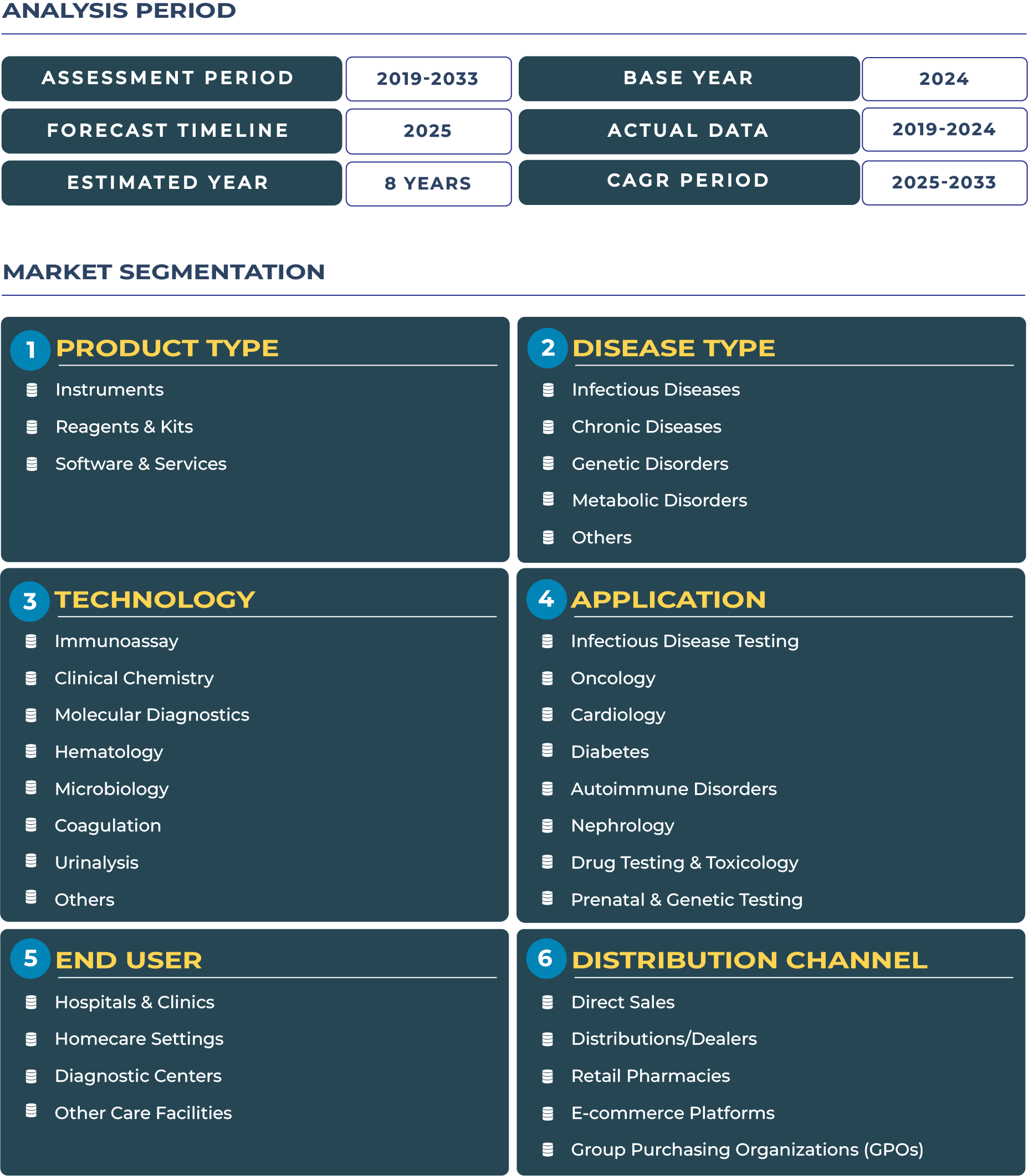
GCC In-vitro Diagnostic Market Segmentation
GCC In-vitro Diagnostic Market Countries Covered

Frequently Asked Questions
Government healthcare megaprojects in GCC nations are creating world-class diagnostic infrastructure, accelerating adoption of advanced IVD technologies and strengthening clinical precision across the region.
High GDP does not necessarily ensure affordability; healthcare cost controls, import dependencies, and premium pricing models often limit the accessibility of high-end medical devices in GCC.
The premium segment in GCC is characterized by demand for advanced diagnostic systems, high-throughput instruments, and managed service offerings that elevate the quality of patient care.
Related Reports

Benelux PaaS Market Size | 2019-2033
- Report ID: IT1884 | Coverage: Country |
- Category: Information Technology | Sub-Category: Cloud Computing Technology |
- Published Date: Dec 2025 | US$495 |
Poland Private Banking Market Size | 2019-2033
- Report ID: BAF919 | Coverage: Country |
- Category: Banking and Finance | Sub-Category: Banking Services |
- Published Date: Oct 2025 | US$495 |
Oman Private Banking Market Size | 2019-2033
- Report ID: BAF980 | Coverage: Country |
- Category: Banking and Finance | Sub-Category: Banking Services |
- Published Date: Nov 2025 | US$495 |
GCC AI Industrial Robotics Market Size | 2019-2033
- Report ID: IT1939 | Coverage: Regional |
- Category: Information Technology | Sub-Category: Artificial Intelligence |
- Published Date: Nov 2025 | US$1,345 |
Benelux PaaS Market Size | 2019-2033
- Report ID: IT1884 | Coverage:Country |
- Category:Information Technology | Sub-Category: Cloud Computing Technology |
- Published Date: Dec 2025 |US$495 |
Poland Private Banking Market Size | 2019-2033
- Report ID: BAF919 | Coverage:Country |
- Category:Banking and Finance | Sub-Category: Banking Services |
- Published Date: Oct 2025 |US$495 |
Oman Private Banking Market Size | 2019-2033
- Report ID: BAF980 | Coverage:Country |
- Category:Banking and Finance | Sub-Category: Banking Services |
- Published Date: Nov 2025 |US$495 |
GCC AI Industrial Robotics Market Size | 2019-2033
- Report ID: IT1939 | Coverage:Regional |
- Category:Information Technology | Sub-Category: Artificial Intelligence |
- Publishing Soon |US$1,345 |
Why Choose Us

24/5 Research Support
Get your queries resolved prior to and post purchasing research study

Customize As Per Specific Requirements
Get in-depth analysis based on your tailored research needs

Expertise in Tracking Niche Markets
Comprehensive view of latest technologies and opportunities across markets

360-Degree Analysis
Fact-based insights derived through supply & demand side analysis

Assured Quality
Deliver most accurate industry insights to maintain research quality

Information Security
Your confidential and personal data is secure and safe