
GCC Orthopedic Devices Market Size and Forecast by Product Type, End User, Distribution Channel, and Patient Demographics: 2019-2033
Oct 2025
| Format:

 |
Pages: 160+
|
Type: Sub-Industry Report
|
Authors:
Mahesh Y
(Assistant Research Manager)
|
Pages: 160+
|
Type: Sub-Industry Report
|
Authors:
Mahesh Y
(Assistant Research Manager)
MARKET OUTLOOK
GCC Orthopedic Devices Market Outlook: Regional Medtech Investment Hub Driving Orthopedic Growth
The Gulf Cooperation Council (GCC) has emerged as the regional medtech investment hub, positioning itself as a center for advanced orthopedic growth. Backed by government megaprojects in healthcare infrastructure, the region is prioritizing world-class orthopedic care facilities that attract patients both domestically and internationally. Premium orthopedic devices such as robotic-assisted joint implants, advanced spinal systems, and customized prosthetics are gaining traction in GCC hospitals. According to DataCube Research, the GCC orthopedic devices market is projected to grow from USD 749.3 million in 2025 to USD 1,302.1 million by 2033, expanding at a CAGR of 7.2%. This growth trajectory reflects both the strong policy commitment to healthcare diversification and the rising patient demand for specialized musculoskeletal treatments. The orthopedic devices sector is becoming central to GCC nations’ strategies of strengthening healthcare ecosystems while positioning themselves as global medical tourism leaders.
Government-Backed Healthcare Megaprojects Elevating Orthopedic Devices Industry Performance
The GCC orthopedic devices market outlook is reinforced by unprecedented government-backed healthcare investments and large-scale private collaborations. Saudi Arabia’s Vision 2030 program, the UAE’s medical free zones, and Qatar’s hospital expansions are all creating favorable conditions for advanced orthopedic solutions. Orthopedic prosthetics and joint reconstruction devices are witnessing higher adoption as regional hospitals shift toward minimally invasive procedures and robotic-assisted surgeries. The market is further boosted by an increasing emphasis on premium medical technologies as GCC nations position themselves as medtech innovation hubs. With medical tourism playing an integral role, orthopedic devices are at the forefront of strategic healthcare positioning. By combining state-led reforms with private sector efficiency, the orthopedic devices ecosystem in GCC is developing into a robust, innovation-driven marketplace for global investors and medical device manufacturers.
Drivers & Restraints: Understanding the Key Enablers and Structural Barriers in the GCC Orthopedic Devices Landscape
High Per-Capita Healthcare Spending and Mega Hospital Projects Driving Growth
The GCC orthopedic devices industry is underpinned by high per-capita healthcare spending levels that far exceed most emerging markets. This provides strong fiscal support for the adoption of premium devices such as spinal implants and orthopedic prosthetics. The ongoing development of mega hospital projects, including King Fahd Medical City in Riyadh and Sheikh Shakhbout Medical City in Abu Dhabi, highlights the region’s growing emphasis on specialized orthopedic care. Additionally, the ambition to establish medical tourism hubs in Dubai, Doha, and Riyadh is accelerating demand for high-end arthroscopy devices and joint reconstruction systems. These factors collectively make the GCC one of the most attractive regional clusters for orthopedic investment globally.
Restraints: Scaling Challenges, Talent Shortages, and Transparency Pressures
Despite rapid growth, the GCC orthopedic devices sector faces scaling challenges tied to relatively small population bases. The reliance on a limited pool of specialized orthopedic surgeons across markets like Kuwait and Oman constrains widespread adoption of advanced devices. At the same time, increasing price transparency and regulatory scrutiny are exerting downward pressure on margins, especially in premium product segments. Additionally, competition for skilled talent with Europe and the U.S. has created bottlenecks in deploying advanced orthopedic technologies. These factors, while manageable, highlight the need for innovative business models that address affordability and access challenges without compromising the premium care standards expected across GCC healthcare systems.
Trends & Opportunities: Premium Device Adoption and Hub-Based Distribution Models Redefining Market Strategies
Trends: Tertiary Center Growth, Medical Tourism, and High-End Device Integration
A defining trend in the GCC orthopedic devices market is the rapid expansion of private tertiary care centers, particularly in Saudi Arabia, UAE, and Qatar. These institutions are not only catering to domestic populations but also strategically positioning themselves to attract international patients. High-end device adoption, including robotic joint replacement systems and next-generation spinal implants, is increasingly common in flagship hospitals across Dubai and Riyadh. The demand for advanced imaging, arthroscopy devices, and orthobiologics is also growing, reflecting a transition toward cutting-edge musculoskeletal solutions that align with global healthcare standards.
Opportunities: Hub Distribution, TCO Models, and Specialist Partnerships
Future opportunities in the GCC orthopedic devices sector lie in the creation of centralized hub distribution networks, particularly from the UAE. By establishing regional headquarters and warehouses in Dubai, companies can streamline device availability and reduce logistics costs. Another opportunity exists in total cost of ownership (TCO)-focused service models, where manufacturers provide bundled offerings that include device supply, maintenance, and training. Specialist center partnerships—such as collaborations with orthopedic institutes in Doha and Abu Dhabi—are further enabling global companies to embed themselves into GCC healthcare ecosystems, while simultaneously improving patient outcomes through tailored, high-quality orthopedic interventions.
Regional Analysis by Country
Saudi Arabia
Saudi Arabia represents the largest orthopedic devices market in the GCC, supported by Vision 2030 healthcare reforms. Demand for joint reconstruction and spinal devices is expanding as the nation invests in orthopedic specialty hospitals.
United Arab Emirates (UAE)
The UAE is strengthening its position as a global medical tourism hub. Orthopedic prosthetics and robotic-assisted surgeries are increasingly performed in advanced hospitals across Dubai and Abu Dhabi.
Kuwait
Kuwait Orthopedic Devices industry is benefiting from state-funded hospital modernization programs. Rising demand for trauma fixation devices reflects growing investments in emergency and acute care services.
Qatar
Qatar Orthopedic Devices market is expanding through sports medicine specialization. Major hospitals are adopting arthroscopy devices and prosthetics to meet demand from athletes and medical tourists.
Oman
Oman is focusing on orthopedic ecosystem growth through public-private partnerships. Spinal devices and basic prosthetics are gaining adoption in Muscat’s expanding healthcare infrastructure.
Bahrain
Bahrain Orthopedic Devices sector is advancing through collaborations with regional hospitals. Growing emphasis on affordability and accessibility of orthopedic implants is driving adoption in public facilities.
Competitive Landscape: Regional Hubs and Managed Service Models Strengthening Orthopedic Devices Sector
The competitive dynamics of the GCC orthopedic devices industry are characterized by both international giants and regional players. Companies like Medtronic and Smith+Nephew are expanding their footprints through regional headquarters in the UAE, facilitating faster distribution and service delivery. Recent developments include partnerships with GCC hospitals to sponsor specialist centers and support advanced training in robotic orthopedic surgeries. Strategies such as managed service bundles are being adopted, where companies integrate device supply with aftercare training and technology upgrades. Local players are also entering collaborations with ministries of health, including the UAE Ministry of Health and Prevention, to provide affordable implants. This evolving landscape underscores a competitive yet collaborative orthopedic devices market ecosystem designed to meet the rising demand for premium musculoskeletal care across the GCC.
*Research Methodology: This report is based on DataCube’s proprietary 3-stage forecasting model, combining primary research, secondary data triangulation, and expert validation.
[Learn more]
GCC Orthopedic Devices Market Segmentation
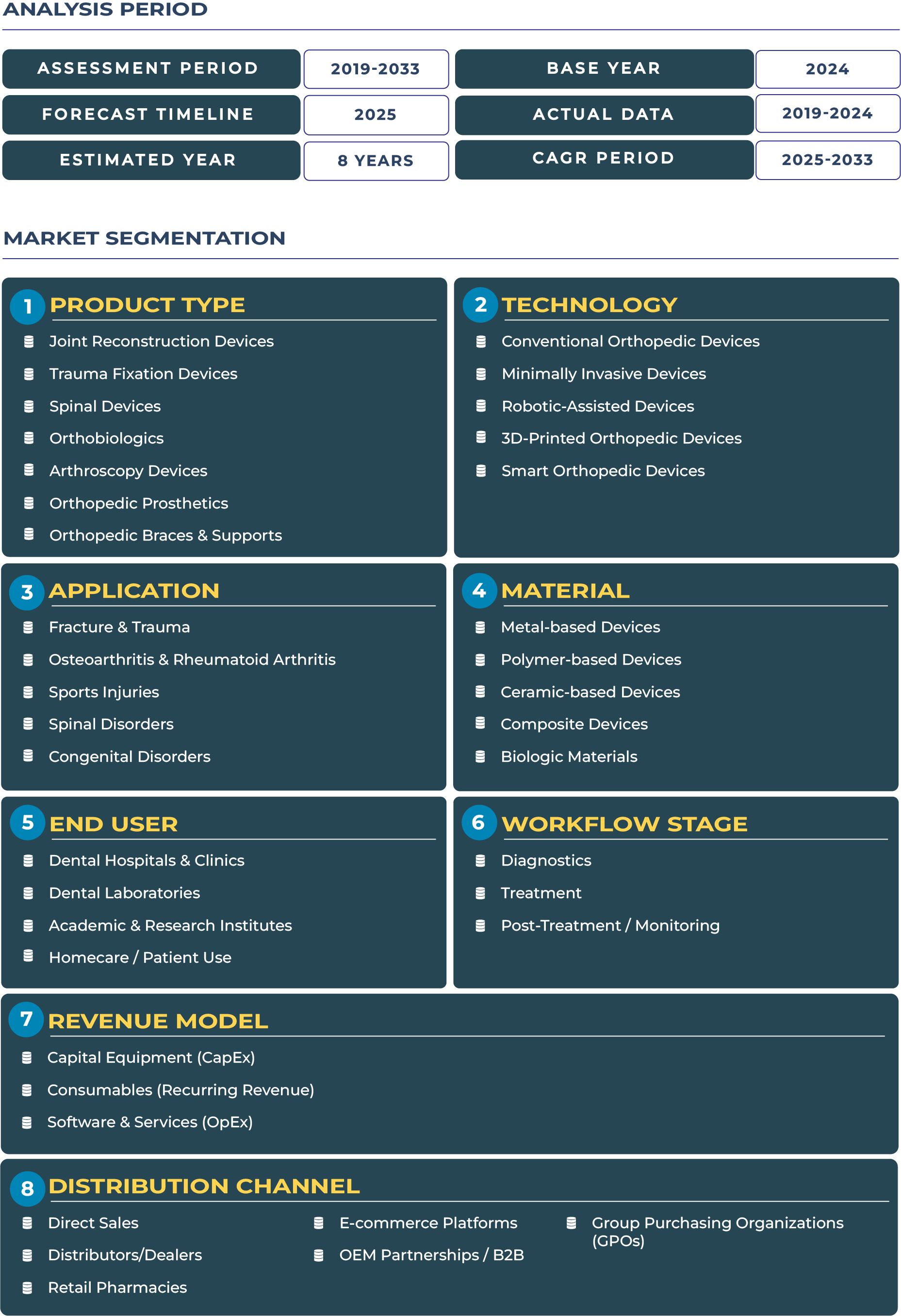
GCC Orthopedic Devices Market Countries Covered

Frequently Asked Questions
Megaprojects create demand for premium orthopedic technologies by funding advanced hospitals, research centers, and rehabilitation hubs, thus making GCC a high-value destination for orthopedic innovation.
Affordability challenges arise from premium device pricing, fragmented insurance coverage, and talent shortages that limit widespread accessibility of advanced orthopedic care in GCC.
Growing preference for robotic-assisted implants and customized prosthetics in flagship hospitals across Dubai, Riyadh, and Doha is reshaping the orthopedic implants landscape into a premium-driven sector.
Related Reports

Benelux PaaS Market Size | 2019-2033
- Report ID: IT1884 | Coverage: Country |
- Category: Information Technology | Sub-Category: Cloud Computing Technology |
- Published Date: Dec 2025 | US$495 |
Poland Private Banking Market Size | 2019-2033
- Report ID: BAF919 | Coverage: Country |
- Category: Banking and Finance | Sub-Category: Banking Services |
- Published Date: Oct 2025 | US$495 |
Oman Private Banking Market Size | 2019-2033
- Report ID: BAF980 | Coverage: Country |
- Category: Banking and Finance | Sub-Category: Banking Services |
- Published Date: Nov 2025 | US$495 |
GCC AI Industrial Robotics Market Size | 2019-2033
- Report ID: IT1939 | Coverage: Regional |
- Category: Information Technology | Sub-Category: Artificial Intelligence |
- Published Date: Nov 2025 | US$1,345 |
Benelux PaaS Market Size | 2019-2033
- Report ID: IT1884 | Coverage:Country |
- Category:Information Technology | Sub-Category: Cloud Computing Technology |
- Published Date: Dec 2025 |US$495 |
Poland Private Banking Market Size | 2019-2033
- Report ID: BAF919 | Coverage:Country |
- Category:Banking and Finance | Sub-Category: Banking Services |
- Published Date: Oct 2025 |US$495 |
Oman Private Banking Market Size | 2019-2033
- Report ID: BAF980 | Coverage:Country |
- Category:Banking and Finance | Sub-Category: Banking Services |
- Published Date: Nov 2025 |US$495 |
GCC AI Industrial Robotics Market Size | 2019-2033
- Report ID: IT1939 | Coverage:Regional |
- Category:Information Technology | Sub-Category: Artificial Intelligence |
- Publishing Soon |US$1,345 |
Why Choose Us

24/5 Research Support
Get your queries resolved prior to and post purchasing research study

Customize As Per Specific Requirements
Get in-depth analysis based on your tailored research needs

Expertise in Tracking Niche Markets
Comprehensive view of latest technologies and opportunities across markets

360-Degree Analysis
Fact-based insights derived through supply & demand side analysis

Assured Quality
Deliver most accurate industry insights to maintain research quality

Information Security
Your confidential and personal data is secure and safe