
Germany Diagnostic Imaging Devices Market Size and Forecast by Modality, Application, Technology, End User, and Portability: 2019-2033
Oct 2025
| Format:

 |
Pages: 110+
|
Type: Sub-Industry Report
|
Authors:
Mahesh Y
(Assistant Research Manager)
|
Pages: 110+
|
Type: Sub-Industry Report
|
Authors:
Mahesh Y
(Assistant Research Manager)
MARKET OUTLOOK
Germany Diagnostic Imaging Devices Market Outlook – Precision Engineering Meets Clinical Innovation
Germany stands as a technological frontrunner in the global diagnostic imaging devices landscape, blending precision engineering with clinical innovation. The nation’s strong industrial base, research depth, and healthcare system resilience underpin its reputation as Europe’s imaging technology powerhouse. With leading-edge developments across MRI, CT, PET, and hybrid imaging systems, Germany diagnostic imaging devices market continues to set benchmarks for efficiency and accuracy. According to market estimates, the industry is valued at approximately USD 2.4 billion in 2025 and is anticipated to reach nearly USD 3.0 billion by 2033, expanding at a steady CAGR of 2.8%. This trajectory is driven by increasing investments in hospital modernization, localized production capabilities, and the steady renewal of imaging fleets under national and regional healthcare improvement programs.
Germany’s High-End Imaging Technology Ecosystem Fuelling Diagnostic Precision
Germany diagnostic imaging devices sector represents a convergence of industrial leadership and medical innovation. Its global influence in modality design, particularly in magnetic resonance imaging (MRI) and computed tomography (CT), has cemented its role as a research and manufacturing nucleus. Supported by robust research and development funding through institutions such as the Federal Ministry of Education and Research (BMBF) and the Federal Ministry of Health (BMG), the country’s med-tech ecosystem continues to pioneer advanced technologies in radiology and nuclear medicine. The market outlook remains positive, propelled by ongoing hospital modernization programs, digital health strategies, and expansion in outpatient diagnostic centers. As Germany transitions toward data-driven healthcare, imaging devices integrated with smart diagnostics, low-dose imaging, and interoperability features are being prioritized across clinical networks. Despite moderate growth rates due to procurement complexities and pricing pressures, Germany’s reputation as a hub for advanced imaging innovation sustains its long-term competitiveness across Europe.
Drivers & Restraints – Structural Strengths and Administrative Frictions Defining Market Dynamics
Growth Drivers – Modernization Investments and Manufacturing Excellence
One of the primary growth catalysts for the German diagnostic imaging devices market is the alignment of healthcare modernization initiatives with industrial strengths. National programs, such as the “Zukunftsprogramm Krankenhäuser” (Hospital Future Program), have accelerated the adoption of advanced imaging systems across public hospitals. Simultaneously, private hospital groups are investing in state-of-the-art CT, MRI, and ultrasound systems to improve throughput and diagnostic accuracy. Germany’s strong OEM presence, featuring leading global manufacturers such as Siemens Healthineers, and a mature local supplier base support rapid servicing, localized assembly, and technical expertise, reducing downtime and improving cost efficiency. The nation’s manufacturing infrastructure, coupled with regulatory rigor, ensures that German-made imaging devices continue to be benchmarks of quality and precision.
Restraints – Complex Procurement and Pricing Sensitivities
Despite its technological leadership, Germany diagnostic imaging devices industry faces several systemic constraints. The federal-state governance structure creates fragmented procurement channels, leading to administrative delays in tenders and reimbursement processes. Moreover, price-sensitive negotiations under statutory health insurance frameworks often compress vendor margins and slow premium equipment adoption. Hospitals, particularly at regional and municipal levels, remain cautious with capital expenditures, prioritizing lifecycle cost efficiency over rapid adoption of high-end modalities. Additionally, economic headwinds from global inflation and the indirect impacts of geopolitical instability in Eastern Europe have tightened public spending cycles, affecting imaging infrastructure upgrades. Consequently, while modernization remains a strategic priority, fiscal conservatism continues to temper short-term market acceleration.
Trends & Opportunities – Technological Sophistication and Regional Expansion Defining the Next Decade
Trends – Academic Innovation and Private Diagnostic Expansion
Germany diagnostic imaging landscape is characterized by rapid technology diffusion within academic medical centres and large teaching hospitals. University hospitals in Munich, Heidelberg, and Berlin are among the first in Europe to adopt advanced MRI systems featuring ultra-high-field imaging for neurological and oncology applications. The increasing penetration of hybrid imaging systems, PET/CT and PET/MRI, reflects a shift toward precision diagnostics and integrated treatment planning. Concurrently, private diagnostic centres in metropolitan regions such as Hamburg and Frankfurt are expanding their service portfolios with digital radiography and portable ultrasound systems to meet growing outpatient demand. This dual-track development, public innovation and private expansion, is solidifying Germany’s status as the reference market for high-end imaging modalities in Europe.
Opportunities – Localization, Partnerships, and Service Differentiation
Amid growing price competition and regulatory complexity, strategic localization presents a vital opportunity for global and domestic imaging vendors. Establishing regional assembly lines or service hubs within Germany can significantly reduce landed costs and align offerings with federal-state tender requirements. Partnerships with experienced distributors who understand regional tender processes can also mitigate administrative hurdles. For instance, vendors leveraging distributor alliances for land-level tenders are better positioned to secure consistent contract wins across states. Furthermore, the evolution of value-based healthcare is generating opportunities for vendors to offer comprehensive “imaging-as-a-service” solutions, combining device supply, maintenance, and analytics into bundled packages tailored for both hospitals and outpatient centres.
Competitive Landscape – German Innovation Leadership and Strategic Collaborations Driving Market Maturity
The competitive landscape in the Germany diagnostic imaging devices market features a mix of established multinationals and agile new entrants that leverage localized production, strong aftersales service, and research and development excellence. Recent developments underline this ecosystem’s vibrancy. Between 2024 and 2025, United Imaging completed installations of its light-guide digital PET/CT systems across leading teaching hospitals such as Kliniken Essen-Mitte, enhancing oncology imaging capabilities. Similarly, Canon Medical announced the availability of its Radrex i5/Flex general radiography system in Germany in July 2025, offering an intelligent, space-efficient solution aligned with the growing demand for compact imaging systems. These initiatives illustrate how innovation and localization continue to strengthen Germany’s diagnostic imaging devices ecosystem. Siemens Healthineers remains a dominant player through continuous research and development investments in hybrid modalities and digital imaging integration, while other manufacturers are focusing on modular, mobile, and sustainable system designs to appeal to evolving procurement priorities.
*Research Methodology: This report is based on DataCube’s proprietary 3-stage forecasting model, combining primary research, secondary data triangulation, and expert validation.
[Learn more]
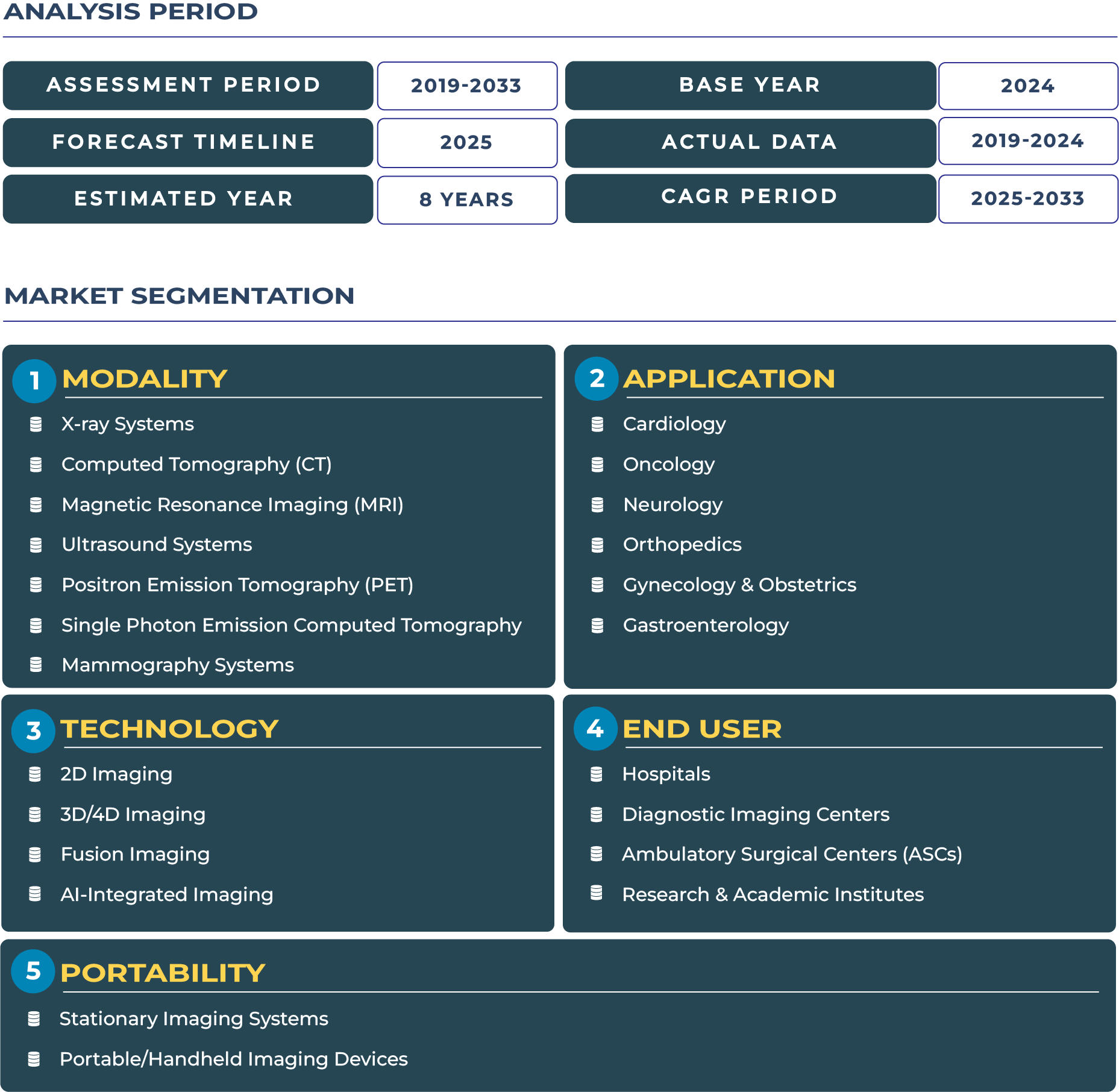
Germany Diagnostic Imaging Devices Market Segmentation
Frequently Asked Questions
Germany’s advanced manufacturing ecosystem, strong OEM presence, and sustained government investments in hospital modernization make it a leading hub for imaging technologies across Europe.
German research institutions and OEMs are advancing ultra-high-field MRI and low-dose CT technologies that enhance diagnostic precision and global adoption of next-generation imaging modalities.
Germany’s healthcare priorities emphasize early detection and integrated care, driving investments in hybrid imaging systems and AI-supported diagnostics to improve clinical outcomes and system efficiency.
Related Reports

South Africa SaaS Market Size | 2019-2034
- Report ID: IT1868 | Coverage: Country |
- Category: Information Technology | Sub-Category: Cloud Computing Technology |
- Published Date: Dec 2025 | US$495 |
Singapore Investment Banking Market Size | 2019-2033
- Report ID: BAF860 | Coverage: Country |
- Category: Banking and Finance | Sub-Category: Banking Services |
- Published Date: Oct 2025 | US$495 |
Saudi Arabia Rural Banking Market Size | 2019-2033
- Report ID: BAF960 | Coverage: Country |
- Category: Banking and Finance | Sub-Category: Banking Services |
- Published Date: Oct 2025 | US$495 |
Philippines Diagnostic Imaging Devices Market Size | 2019-2033
- Report ID: HEA346 | Coverage: Country |
- Category: Healthcare | Sub-Category: Medical Devices |
- Published Date: Nov 2025 | US$495 |
Bahrain AI Computer Vision Market Size | 2019-2033
- Report ID: IT1973 | Coverage: Country |
- Category: Information Technology | Sub-Category: Artificial Intelligence |
- Published Date: Nov 2025 | US$495 |
Saudi Arabia Diagnostic and Monitoring Devices Market Size | 2019-2033
- Report ID: HEA414 | Coverage: Country |
- Category: Healthcare | Sub-Category: Medical Devices |
- Published Date: Dec 2025 | US$495 |
South Africa SaaS Market Size | 2019-2034
- Report ID: IT1868 | Coverage:Country |
- Category:Information Technology | Sub-Category: Cloud Computing Technology |
- Published Date: Dec 2025 |US$495 |
Singapore Investment Banking Market Size | 2019-2033
- Report ID: BAF860 | Coverage:Country |
- Category:Banking and Finance | Sub-Category: Banking Services |
- Published Date: Oct 2025 |US$495 |
Saudi Arabia Rural Banking Market Size | 2019-2033
- Report ID: BAF960 | Coverage:Country |
- Category:Banking and Finance | Sub-Category: Banking Services |
- Published Date: Oct 2025 |US$495 |
Philippines Diagnostic Imaging Devices Market Size | 2019-2033
- Report ID: HEA346 | Coverage:Country |
- Category:Healthcare | Sub-Category: Medical Devices |
- Published Date: Nov 2025 |US$495 |
Bahrain AI Computer Vision Market Size | 2019-2033
- Report ID: IT1973 | Coverage:Country |
- Category:Information Technology | Sub-Category: Artificial Intelligence |
- Publishing Soon |US$495 |
Saudi Arabia Diagnostic and Monitoring Devices Market Size | 2019-2033
- Report ID: HEA414 | Coverage:Country |
- Category:Healthcare | Sub-Category: Medical Devices |
- Publishing Soon |US$495 |
Why Choose Us

24/5 Research Support
Get your queries resolved prior to and post purchasing research study

Customize As Per Specific Requirements
Get in-depth analysis based on your tailored research needs

Expertise in Tracking Niche Markets
Comprehensive view of latest technologies and opportunities across markets

360-Degree Analysis
Fact-based insights derived through supply & demand side analysis

Assured Quality
Deliver most accurate industry insights to maintain research quality

Information Security
Your confidential and personal data is secure and safe