
Italy Private Banking Market Size and Forecast by Service Type, Customer Type, Revenue Source, and Delivery Channel: 2019-2033
Oct 2025
| Format:

 |
Pages: 110+
|
Type: Sub-Industry Report
|
Authors:
Jayson Gomes
(Manager – BFSI)
|
Pages: 110+
|
Type: Sub-Industry Report
|
Authors:
Jayson Gomes
(Manager – BFSI)
MARKET OUTLOOK
Market Outlook: Uncovering Strategic Pathways in Italy Private Banking Ecosystem Through 2033
The market outlook for Italy private banking sector reflects measured growth but strategic substance. At USD 19.6 billion in 2025 rising to USD 22.6 billion by 2033, the implied CAGR of 1.8% indicates limited volumetric expansion but underscores the imperative for value-creation rather than scale alone. The modest forecast challenges firms to deepen service packaging, improve advisory outcomes, and capture incremental wallet share rather than rely on broader market expansion in a mature and saturated affluent segment.
Note:* The market size refers to the total revenue generated by banks through various services.
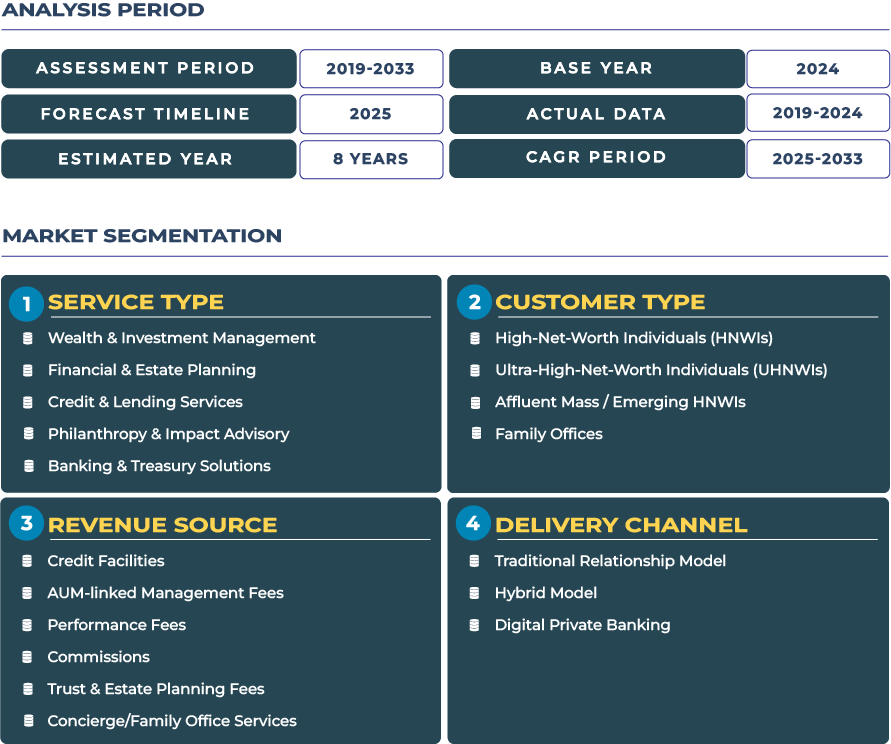
Several factors support this outlook. Italy net wealth of households reached €11,286 billion at end-2023-a 4.5% nominal increase from prior year. This significant asset base, coupled with the growing interest in real-estate and art-linked investment, underpins demand for private banking services beyond traditional investment advice. Yet the macro-environment remains challenging: slow economic growth, tight margins in banking, regulatory and tax complexity, and regional fragmentation temper growth potential. Hence, private banks in Italy must focus on boutique differentiation, integrated offerings (e.g., wealth & investment management, credit & lending services, philanthropy & impact advisory, banking & treasury solutions) and regional client-experience excellence to capture the available growth.
Drivers of Growth & Structural Constraints: Why Italy Private Banking Market Moves Slowly but Deliberately
Driving factors: Italy private banking sector benefits from several meaningful catalysts. First, the wealth accumulation among small- and medium-sized enterprise (SME) owners and family firms in regions such as Lombardy, Veneto and Emilia-Romagna provides a robust pool of HNWIs seeking tailored wealth-management platforms. Second, real-estate-driven affluence-residential, commercial and heritage sectors-fuels demand for advisory services linked to value preservation, cross-border exposure and estate planning. Recent data shows Italian private investors increased commercial-real-estate allocations significantly in 2024 (+68% YoY) and early 2025. Third, Italy tourist-linked investment flows (from luxury residency, lifestyle migration and second-home acquisitions) create wealth-management needs tied to portfolio diversification, credit structuring and legacy planning.
Restraining factors: On the flip side, Italy private banking industry faces structural impediments. Political instability and banking-sector concentration continue to weigh on market confidence. The banking system still carries elevated levels of non-performing loans (NPLs) and regulatory overheads greater than in some peer markets, raising cost-to-serve and limiting agility. In addition, the comparatively slow pace of digital-wealth transformation, alongside fragmented regional banking models and heavy reliance on traditional advisory frameworks, hampers scalability and margin improvement. Given the modest CAGR of 1.8%, Italian private banks must focus on efficiency, client-segmentation and high-value propositions to offset structural growth constraints.
Trend-vectors & Opportunity Windows: Real-Asset Diversification, Offshore Regularisation and Fintech Alliances in Italy Private Banking Landscape
Major trends: One critical trend in Italy private banking market is the surge of real-asset diversification among wealthy clients. The shift toward Italy commercial-real-estate market-especially from private investors-demonstrates a move beyond traditional portfolios. Another trend is offshore-wealth regularisation and mobility: Italy favourable tax regime for new residents and inbound wealth is attracting high-net-worth individuals from Northern Europe post-2025. Finally, digital transformation is gaining momentum as boutique private banks seek to deliver hybrid advisory, mobile dashboards, integrated treasury platforms and lifestyle-wealth services tailored to affluent clients.
Opportunity leverages: For Italian private banking firms, key opportunity zones emerge. First, real-estate wealth structuring advisory-helping clients navigate Italian property, legacy estates, cross-border holdings and tax-optimization-is a distinct value-book. Second, succession planning for family-business and multi-generational wealth is under-served; private banks that offer full-life-cycle multigenerational wealth planning-including family governance, philanthropy, art/heritage advisory-will differentiate. Third, fintech partnerships-joining boutique private banks with digital-wealth platforms, payments/treasury innovations and alternative-asset access-offer scalable growth paths without excessive infrastructure investment. Northern regions such as Milan and Lombardy remain growth hubs for these packaged advisory models.
Competitive Landscape: Strategic Manoeuvres Reshaping Italy Private Banking Industry
The competitive framework in Italy private banking market is dynamic, with firms repositioning toward ecosystem models. A leading institution, Banca Generali, a specialist private bank listed in Milan, remains a benchmark-focusing on advisory excellence, alternative-asset access and segment differentiation. Reports from April 2025 indicated a strategic bid from
*Research Methodology: This report is based on DataCube’s proprietary 3-stage forecasting model, combining primary research, secondary data triangulation, and expert validation.
[Learn more]
Italy Private Banking Market Segmentation
Frequently Asked Questions
Italian boutique private banks are evolving by embedding full family-office services-such as art & heritage advisory, estate planning across generations, philanthropy oversight and tailored credit/lending solutions-into traditionally advisory-only models. This holistic approach meets the complex needs of entrepreneurial families and aligns with Italy cultural-wealth dynamics.
Cultural and art-linked capital plays a significant role: wealthy Italian clients often view art, heritage property and luxury brand ownership as pivotal in their wealth portfolios. Private banking firms are responding with advisory services focused on art-finance, Italian property structuring, heritage tax planning and lifestyle-wealth integration-thus creating differentiated value beyond conventional investment portfolios.
Digital tools are advancing engagement by offering hybrid advisory platforms, mobile dashboards, real-time wealth tracking, integrated payments/treasury flows and access to alternative-asset vehicles. Italian private banks are partnering with fintechs to deliver seamless onboarding, personalized wealth journeys and high-touch digital experiences crafted for affluent and business-owner clients.
Related Reports

Germany Fintech-enabled Neobanking Market Size | 2019-2033
- Report ID: BAF515 | Coverage: Country |
- Category: Banking and Finance | Sub-Category: FinTech |
- Published Date: Jan 2026 | US$495 |
Latin America Diabetes Care Devices Market Size | 2019-2033
- Report ID: HEA192 | Coverage: Regional |
- Category: Healthcare | Sub-Category: Medical Devices |
- Published Date: Sep 2025 | US$1,345 |
Europe AI Speech Recognition Market Size | 2019-2033
- Report ID: IT1960 | Coverage: Regional |
- Category: Information Technology | Sub-Category: Artificial Intelligence |
- Published Date: Dec 2025 | US$1,345 |
UAE Fintech-enabled NFT Market Size | 2019-2033
- Report ID: BAF1023 | Coverage: Country |
- Category: Banking and Finance | Sub-Category: FinTech |
- Published Date: Jan 2026 | US$495 |
Germany Fintech-enabled Neobanking Market Size | 2019-2033
- Report ID: BAF515 | Coverage:Country |
- Category:Banking and Finance | Sub-Category: FinTech |
- Publishing Soon |US$495 |
Latin America Diabetes Care Devices Market Size | 2019-2033
- Report ID: HEA192 | Coverage:Regional |
- Category:Healthcare | Sub-Category: Medical Devices |
- Published Date: Sep 2025 |US$1,345 |
Europe AI Speech Recognition Market Size | 2019-2033
- Report ID: IT1960 | Coverage:Regional |
- Category:Information Technology | Sub-Category: Artificial Intelligence |
- Publishing Soon |US$1,345 |
UAE Fintech-enabled NFT Market Size | 2019-2033
- Report ID: BAF1023 | Coverage:Country |
- Category:Banking and Finance | Sub-Category: FinTech |
- Publishing Soon |US$495 |
Why Choose Us

24/5 Research Support
Get your queries resolved prior to and post purchasing research study

Customize As Per Specific Requirements
Get in-depth analysis based on your tailored research needs

Expertise in Tracking Niche Markets
Comprehensive view of latest technologies and opportunities across markets

360-Degree Analysis
Fact-based insights derived through supply & demand side analysis

Assured Quality
Deliver most accurate industry insights to maintain research quality

Information Security
Your confidential and personal data is secure and safe