
MEA Investment Banking Market Size and Forecast by Service Type, Client Type, Deal Size, Ownership Model, and Delivery Channel: 2019-2033
Oct 2025
| Format:

 |
Pages: 160+
|
Type: Sub-Industry Report
|
Authors:
Jayson Gomes
(Manager – BFSI)
|
Pages: 160+
|
Type: Sub-Industry Report
|
Authors:
Jayson Gomes
(Manager – BFSI)
MARKET OUTLOOK
MEA Investment Banking Market Outlook: Cross-Border Energy and Sovereign Advisory Transforming Regional Finance
The Middle East and Africa (MEA) investment banking market is undergoing a profound transformation, driven by cross-border energy financing and sovereign-backed infrastructure initiatives. With economies across the region accelerating their diversification away from hydrocarbons, the investment banking ecosystem is increasingly focusing on large-scale projects, public-private partnerships (PPPs), and strategic advisory mandates involving sovereign wealth funds. The region’s market size, valued at USD 4.5 billion in 2025, is projected to reach USD 6.6 billion by 2033, reflecting a steady 4.8% CAGR. This sustained growth underscores how strategic investment banking services, including mergers and acquisitions, debt capital markets (DCM), and restructuring advisory, are serving as vital enablers of regional financial modernization and cross-border collaboration.
Note:* The market size refers to the total revenue generated by banks through various services.
The Rise of Sovereign and Energy-Driven Advisory Across MEA
MEA investment banking market is entering a new era where sovereign-backed deals and cross-border energy projects define the competitive edge. Governments across the Gulf Cooperation Council (GCC) and Sub-Saharan Africa are seeking innovative financing models to fund energy transition, logistics infrastructure, and industrial diversification. Advisory services for sovereign debt issuance, project finance, and energy mergers have become critical to managing the capital flows driving this transformation. The market is benefiting from strong regional liquidity supported by sovereign funds such as the Public Investment Fund (PIF) in Saudi Arabia and the Abu Dhabi Investment Authority (ADIA). Moreover, the expansion of Islamic finance and cross-border investment vehicles has introduced new structuring opportunities for DCM and ECM products.
Despite the resilience of oil economies, the strategic shift towards renewable energy and infrastructure privatization is generating demand for complex advisory mandates. Nations like the UAE, Saudi Arabia, and Egypt are fostering PPP frameworks that require high-end investment banking expertise in debt syndication and restructuring. The energy transition, geopolitical alignment, and sovereign diversification agendas will continue to shape MEA investment banking landscape over the next decade, anchoring the region as a bridge between capital-rich GCC economies and fast-growing African markets.
Drivers & Restraints: Understanding the Forces Shaping the MEA Investment Banking Landscape
Energy and Sovereign-Backed Projects Catalyze Market Expansion
The primary growth driver for the MEA investment banking sector is the surge in cross-border energy projects and sovereign-backed capital programs. Mega energy transition projects such as Saudi Arabia’s NEOM and Egypt’s green hydrogen corridor have created a robust pipeline for merger and acquisition and infrastructure advisory. The ongoing push for carbon neutrality and diversification of national portfolios is stimulating demand for capital markets and project financing instruments. Additionally, the African Continental Free Trade Area (AfCFTA) initiative has improved cross-border investment flows, spurring advisory activity across sectors like logistics, telecom, and renewable energy.
Political and Economic Volatility Pose Structural Challenges
However, political instability, inconsistent regulatory regimes, and currency volatility continue to impede market expansion. In several Sub-Saharan nations, sovereign debt vulnerabilities and inflationary pressures have restrained deal momentum. Moreover, ongoing geopolitical tensions, including Red Sea trade disruptions and sanctions-related uncertainties, have led to cautious investor sentiment. Economic divergence between GCC states with high fiscal buffers and African markets with fragile debt dynamics adds another layer of complexity. These constraints emphasize the need for risk-adjusted financial advisory and structured solutions to mitigate exposure and sustain deal pipelines across diverse jurisdictions.
Trends & Opportunities: The Digital Pivot and Cross-Border Infrastructure Advisory
Digital Advisory Platforms Redefine Regional Deal Execution
One of the most prominent trends in the MEA investment banking industry is the integration of digital platforms for equity issuance, merger and acquisition data analytics, and capital raising. Financial hubs like Dubai and Johannesburg are deploying fintech-powered advisory ecosystems that improve transaction transparency and reduce due diligence time. Regional exchanges such as the Saudi Exchange (Tadawul) and the Nairobi Securities Exchange (NSE) are witnessing increased listings supported by digital investor engagement tools. The growing intersection between fintech and investment banking is reshaping the operational dynamics of ECM and restructuring advisory services.
Cross-Border Infrastructure and Energy Advisory as Growth Opportunity
The opportunity landscape in MEA investment banking is heavily tied to cross-border infrastructure financing, energy corridor development, and sovereign-led diversification agendas. As regional governments pursue connectivity projects linking ports, pipelines, and logistics corridors, investment banks are becoming central facilitators of capital structuring. The expansion of renewable energy zones across North Africa and the Red Sea region has also opened opportunities for DCM-linked financing and structured advisory products. With increasing collaboration between GCC and African nations, the scope for long-term project financing and cross-border syndication is unprecedented.
Regional Analysis by Country
Saudi Arabia
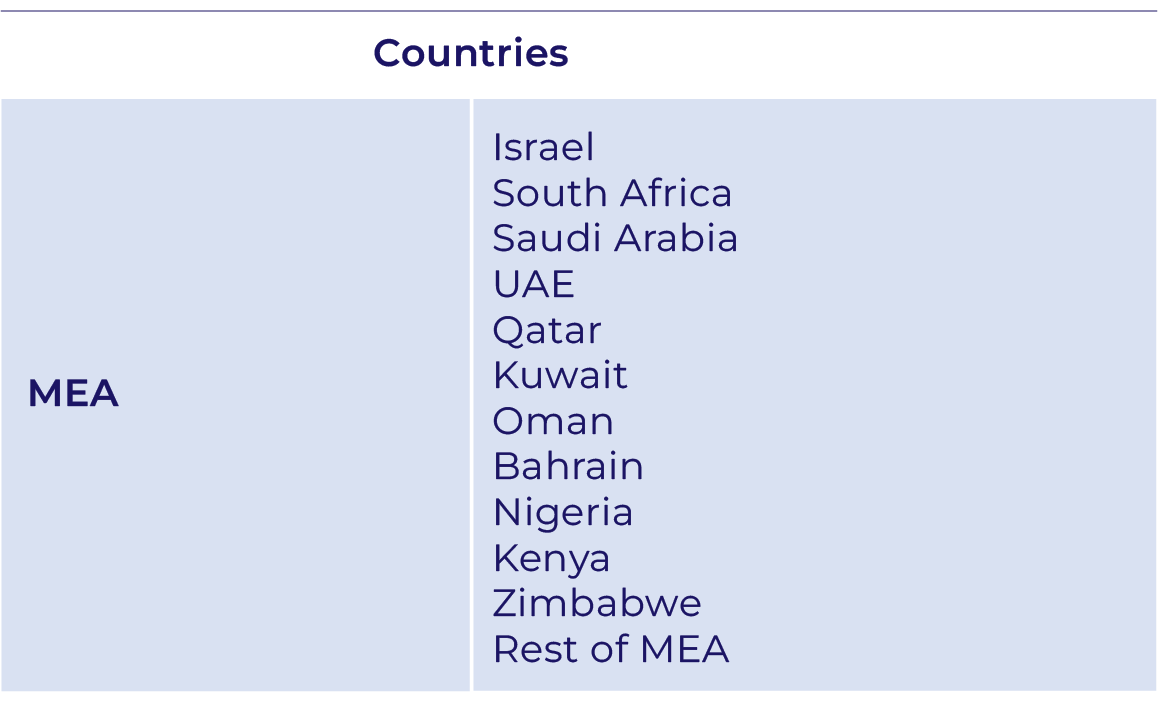
The Saudi market remains the anchor for MEA investment banking, propelled by Vision 2030 reforms. merger and acquisition activity is concentrated in energy diversification, giga-projects, and sovereign debt advisory.Kuwait
Kuwait’s banking system is expanding project finance advisory, especially for logistics and renewables. Government-linked entities are driving ECM and DCM issuance for fiscal diversification.UAE
The UAE continues to position itself as a regional financial hub. Dubai and Abu Dhabi attract both international and regional deals, particularly in green financing and cross-border merger and acquisition.Oman
Oman is leveraging PPPs and energy restructuring to attract advisory participation. Its diversification agenda is pushing new DCM opportunities for sovereign-backed projects.Bahrain
Bahrain focuses on fintech-driven capital market reforms and Islamic bond issuance, reinforcing its ECM and restructuring advisory footprint.Qatar
Qatar’s sovereign wealth-backed initiatives and cross-border energy financing continue to enhance its investment banking pipeline, particularly in green hydrogen and infrastructure advisory.South Africa
South Africa investment banking landscape is shaped by corporate restructuring and capital market innovation, supported by strong financial regulation.Israel
Israel investment bank market is dominated by technology IPOs and venture financing. Cross-border advisory services are expanding amid increased foreign investment flows.Nigeria
Nigeria’s energy reforms and privatization efforts are generating demand for merger and acquisition and DCM advisory, despite currency and policy volatility.Kenya
Kenya remains East Africa’s investment hub, with advisory mandates focusing on infrastructure, fintech, and sovereign debt restructuring.Zimbabwe
Zimbabwe’s investment banking activity is emerging in mining and agriculture finance, though macroeconomic instability limits cross-border transactions.
Competitive Landscape: Strategic Partnerships and Energy-Centric Advisory Dominate
Leading global and regional investment banks such as First Abu Dhabi Bank, Standard Bank Group, and Qatar National Bank are expanding their energy and sovereign advisory portfolios across MEA. Recent deals include Standard Bank’s participation in Africa’s renewable energy syndications (2024) and FAB’s structured financing for cross-border infrastructure in the GCC (2025). The strategic emphasis lies in building capacity for cross-border syndications, leveraging ESG-linked finance, and enabling sovereign transition bonds. Local players in South Africa and Nigeria are also collaborating with international institutions to scale energy transition advisory and capital markets access.
*Research Methodology: This report is based on DataCube’s proprietary 3-stage forecasting model, combining primary research, secondary data triangulation, and expert validation.
[Learn more]
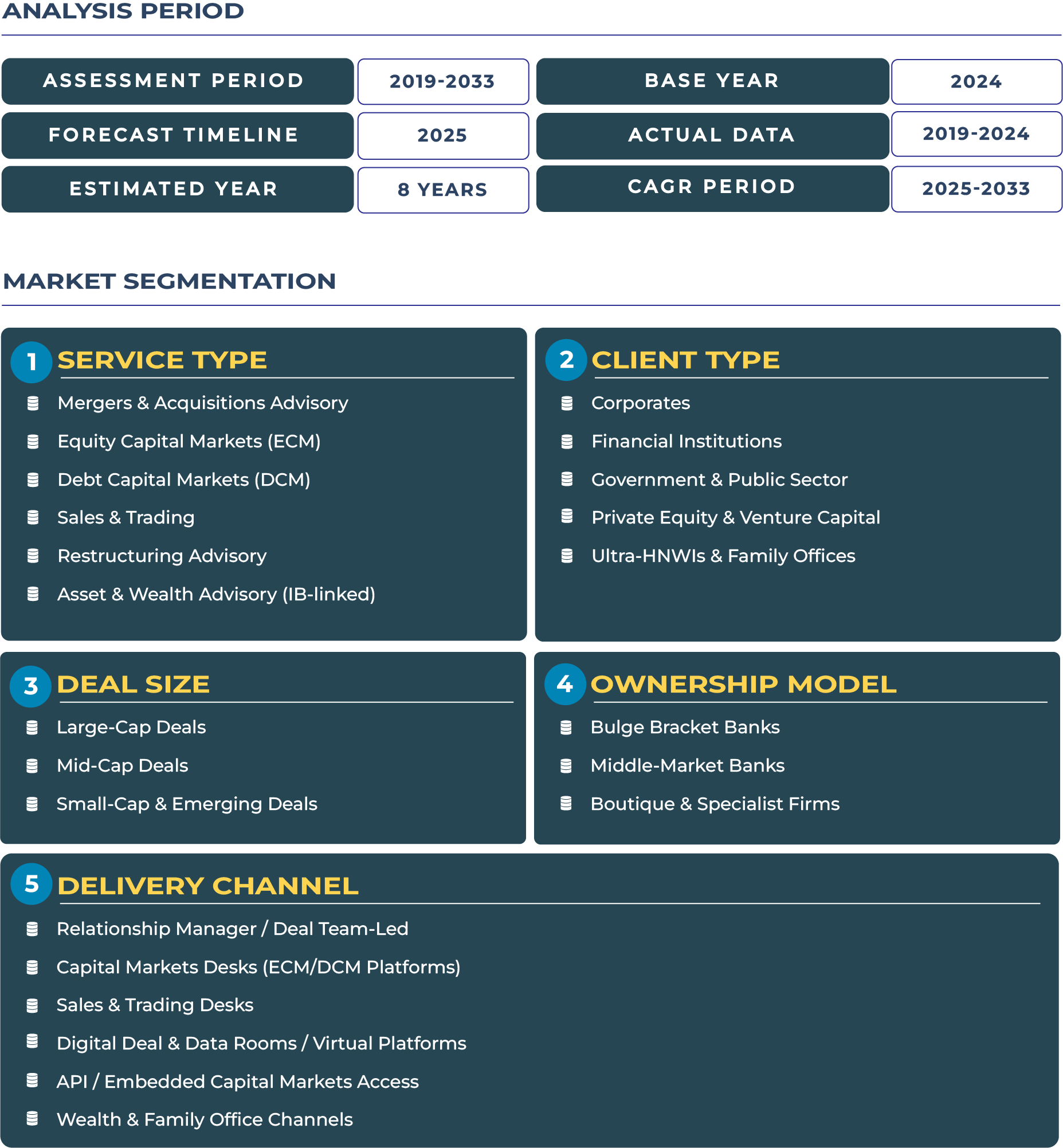
MEA Investment Banking Market Segmentation
MEA Investment Banking Market Countries Covered
Frequently Asked Questions
They are driving advisory demand in project finance, merger and acquisition, and DCM, linking GCC liquidity with African infrastructure projects and renewable energy corridors.
Geopolitical uncertainty, currency risks, and uneven fiscal management across Sub-Saharan Africa hinder consistent investment inflows and deal execution.
Emerging PPPs in renewable energy, logistics, and digital infrastructure are opening new project finance and restructuring advisory mandates across the region.
Related Reports

Turkey Fintech-enabled Robo-advisor Market Size | 2019-2033
- Report ID: BAF496 | Coverage: Country |
- Category: Banking and Finance | Sub-Category: FinTech |
- Published Date: Jan 2026 | US$495 |
Zimbabwe Banking Market Size | 2019-2033
- Report ID: BAF729 | Coverage: Country |
- Category: Banking and Finance | Sub-Category: Banking Services |
- Published Date: Oct 2025 | US$495 |
Kenya Diagnostic and Monitoring Devices Market Size | 2019-2033
- Report ID: HEA424 | Coverage: Country |
- Category: Healthcare | Sub-Category: Medical Devices |
- Published Date: Dec 2025 | US$495 |
Japan Ambulatory Care Market Size | 2019-2033
- Report ID: HEA469 | Coverage: Country |
- Category: Healthcare | Sub-Category: Healthcare Services |
- Published Date: Feb 2026 | US$495 |
Turkey Fintech-enabled Robo-advisor Market Size | 2019-2033
- Report ID: BAF496 | Coverage:Country |
- Category:Banking and Finance | Sub-Category: FinTech |
- Publishing Soon |US$495 |
Zimbabwe Banking Market Size | 2019-2033
- Report ID: BAF729 | Coverage:Country |
- Category:Banking and Finance | Sub-Category: Banking Services |
- Published Date: Oct 2025 |US$495 |
Kenya Diagnostic and Monitoring Devices Market Size | 2019-2033
- Report ID: HEA424 | Coverage:Country |
- Category:Healthcare | Sub-Category: Medical Devices |
- Publishing Soon |US$495 |
Japan Ambulatory Care Market Size | 2019-2033
- Report ID: HEA469 | Coverage:Country |
- Category:Healthcare | Sub-Category: Healthcare Services |
- Published Date: Feb 2026 |US$495 |
Why Choose Us

24/5 Research Support
Get your queries resolved prior to and post purchasing research study

Customize As Per Specific Requirements
Get in-depth analysis based on your tailored research needs

Expertise in Tracking Niche Markets
Comprehensive view of latest technologies and opportunities across markets

360-Degree Analysis
Fact-based insights derived through supply & demand side analysis

Assured Quality
Deliver most accurate industry insights to maintain research quality

Information Security
Your confidential and personal data is secure and safe