
Spain Diagnostic Imaging Devices Market Size and Forecast by Modality, Application, Technology, End User, and Portability: 2019-2033
Oct 2025
| Format:

 |
Pages: 110+
|
Type: Sub-Industry Report
|
Authors:
Mahesh Y
(Assistant Research Manager)
|
Pages: 110+
|
Type: Sub-Industry Report
|
Authors:
Mahesh Y
(Assistant Research Manager)
MARKET OUTLOOK
Spain’s Surge in AI-Enabled Imaging: Catalyzing the Diagnostic Imaging Devices Landscape
In recent years, Spain has witnessed a pronounced shift in the diagnostic imaging devices market driven by the convergence of artificial intelligence, cloud-based imaging platforms and cross-industry collaboration. The country’s burgeoning ecosystem of AI-driven health tech start-ups, led by companies such as Quibim in Valencia, has begun to reshape imaging workflows, enabling radiology departments and diagnostic centres to adopt more efficient and high-precision modalities such as advanced MRI and 3D ultrasound. Against this backdrop, the Spanish diagnostic imaging devices sector is estimated to progress from USD 0.9 billion in 2025 to USD 1.3 billion by 2033 at a CAGR of 4.1%. This forecast underscores how the digital transformation of radiology, through cloud-native image sharing and AI-augmented modality workflows, is reinforcing Spain’s reputation as a region ready to modernise its imaging infrastructure.
The digital momentum in Spain diagnostic imaging devices ecosystem is underpinned by a hospital network increasingly embracing cloud-connected PACS/RIS systems, and by private diagnostic clinics building capacity for advanced modalities like high-slice CT and 3.0 T MRI. The result: a more agile, distributed imaging model that complements the public health system’s modernization efforts. As the market transitions, we see modality-specific growth, particularly in CT and advanced ultrasound, accelerating faster than in legacy X-ray systems, though radiography continues to represent a foundational segment in nationwide imaging coverage.
Spain Diagnostic Imaging Devices Market Outlook: Charting Spain Diagnostic Imaging Devices Sector from Digitisation to Deployment
Looking ahead, the Spain diagnostic imaging devices market is positioned for steady growth driven by structural healthcare reforms, evolving reimbursement frameworks and escalating demand for advanced imaging workflows. The base-year estimate and the end-point projection reflect the market’s expected expansion across both public and private diagnostic platforms. Much of the growth will stem from deployment of next-generation modalities, such as multi-slice CT, high-field MRI and hybrid PET/CT systems, alongside a rising penetration of cloud-deployed software and AI-enabled image analysis solutions.
Macro-economic factors in Spain are interacting uniquely with the imaging devices sector. The legacy impact of the pandemic highlighted gaps in diagnostic capacity, while geopolitical and economic volatility in Europe has added pressure on hospital procurement cycles. However, Spain’s access to EU-level funding, through initiatives such as the Ministerio de Sanidad via its national Smart Health infrastructure programmes, offers a counter-balancing tailwind for investment in healthcare infrastructure and imaging equipment renewal.
Furthermore, regional decentralisation of the Spanish healthcare system means that autonomous communities are key decision-makers for device procurement, and this creates both fragmentation challenges and opportunities for targeted roll-outs. As private ambulatory surgical centres expand, the market for diagnostic imaging devices broadens beyond large tertiary hospitals to outpatient settings, which accelerates adoption of compact imaging platforms and mobile units. Drawing these factors together, the forecasted CAGR is realistic in light of the combined effect of digital enablement, structural healthcare trends and modality upgrades.
Key Growth Drivers & Market Restraints: Understanding the Forces Shaping Spain Diagnostic Imaging Devices Sector
Drivers: Infrastructure renewal and private sector expansion
Spain’s allocation of European recovery funds and national health modernisation budgets has created a compelling impetus for diagnostic imaging upgrades. Public hospital networks are increasingly replacing ageing X-ray and CT units with higher-end systems, and private diagnostic chains are expanding capacity in response to increased outpatient demand. The demographic shift toward an older population, rising incidence of chronic diseases such as oncology and cardiovascular illness, and the growing demand for precision diagnostic workflows further supports the adoption of modalities like MRI and 3D-capable ultrasound. The migration from traditional radiography to digital platforms and integration of cloud image-sharing solutions are also boosting the value proposition of new devices across the diagnostic imaging ecosystem.
Restraints: Budgetary uncertainty and fragmentation of rollout
Yet, growth is not without headwinds. Economic volatility in Spain and Europe is prompting tighter budgets across public hospitals, which operate under fiscal constraints and may defer procurement cycles for high-capex imaging devices such as PET or high-field MRI. The decentralised nature of the Spanish National Health System, where autonomous regional authorities manage budgets, creates a fragmented procurement landscape, complicating nationwide rollout of standardised imaging platforms. Additionally, high initial investment cost and extended return-on-investment cycles associated with advanced imaging modalities such as hybrid PET/CT or ultra-high field MRI inhibit some uptake in smaller diagnostic centres. Combined, these factors moderate the pace of adoption despite strong long-term fundamentals.
Trends & Opportunities: Mapping the Strategic Terrain for Spain Diagnostic Imaging Devices Market
Trend: Outpatient imaging growth and mobile deployment in underserved zones
One of the most salient trends is the growing adoption of outpatient and ambulatory imaging centres, particularly in Spain’s regional and rural provinces. Mobile imaging fleets, equipped with CT, ultrasound or X-ray systems mounted on vehicles, are gaining traction as cost-effective means to extend diagnostic capacity beyond urban hospitals. In major urban hubs such as Madrid and Barcelona, demand for advanced MRI and 3D ultrasound for cardiac and musculoskeletal applications is rising, driving upgrades and enabling more nuanced diagnostic workflows. The rapid incorporation of cloud-native image analysis tools and AI-enabled modalities is also enhancing productivity, providing a trend-based advantage across Spain diagnostic imaging devices landscape.
Opportunity: Leveraging EU funds and targeting regional imaging ecosystems
From an opportunity standpoint, imaging-device OEMs and service providers can align their strategies to exploit the inflow of EU recovery funds earmarked for healthcare capital expenditure and digital infrastructure. By positioning compact and cloud-connected imaging platforms as eligible for co-funding, they can capture procurement windows across regional health authorities. Furthermore, developing mobile imaging orchestration programmes in tandem with regional outpatient diagnostics offers differentiation and reach beyond urban markets. Additional opportunities lie in partnering with AI start-ups and imaging-software vendors in Spain’s active ecosystem, enabling imaging-device manufacturers to offer bundled hardware-software solutions and address workflow-efficiency demands in radiology departments.
Competitive Landscape: Strategic Moves Defining Spain Diagnostic Imaging Devices Sector
The competitive terrain of Spain diagnostic imaging devices market is anchored by international OEMs, while local niche players, especially in AI and software, are increasingly significant. For example, GE HealthCare has recently emphasised its imaging segment’s growth push in Europe and the development of AI-enabled diagnostic workflows. Meanwhile, companies such as Philips and Siemens Healthineers continue to rebuild procurement momentum across Spanish hospitals, aligning product launches with EU-funded upgrade programmes. These firms position their offerings to match tender cycles that leverage regional recovery budgets, mobile imaging fleets and cloud-based software integration. Further, strategic collaborations with Spanish AI-imaging start-ups enhance their ability to deliver differentiated value in the diagnostic imaging ecosystem.
In sum, the Spain diagnostic imaging devices sector presents an evolving landscape where modality upgrades, digital transformation, public-private funding confluence and regional healthcare dynamics converge. Device manufacturers, service providers and imaging-software developers that successfully navigate this environment, by offering modular, cloud-connected, AI-powered solutions tailored to Spain’s decentralised health system, are best placed to capture value over the forecast horizon to 2033.
*Research Methodology: This report is based on DataCube’s proprietary 3-stage forecasting model, combining primary research, secondary data triangulation, and expert validation.
[Learn more]
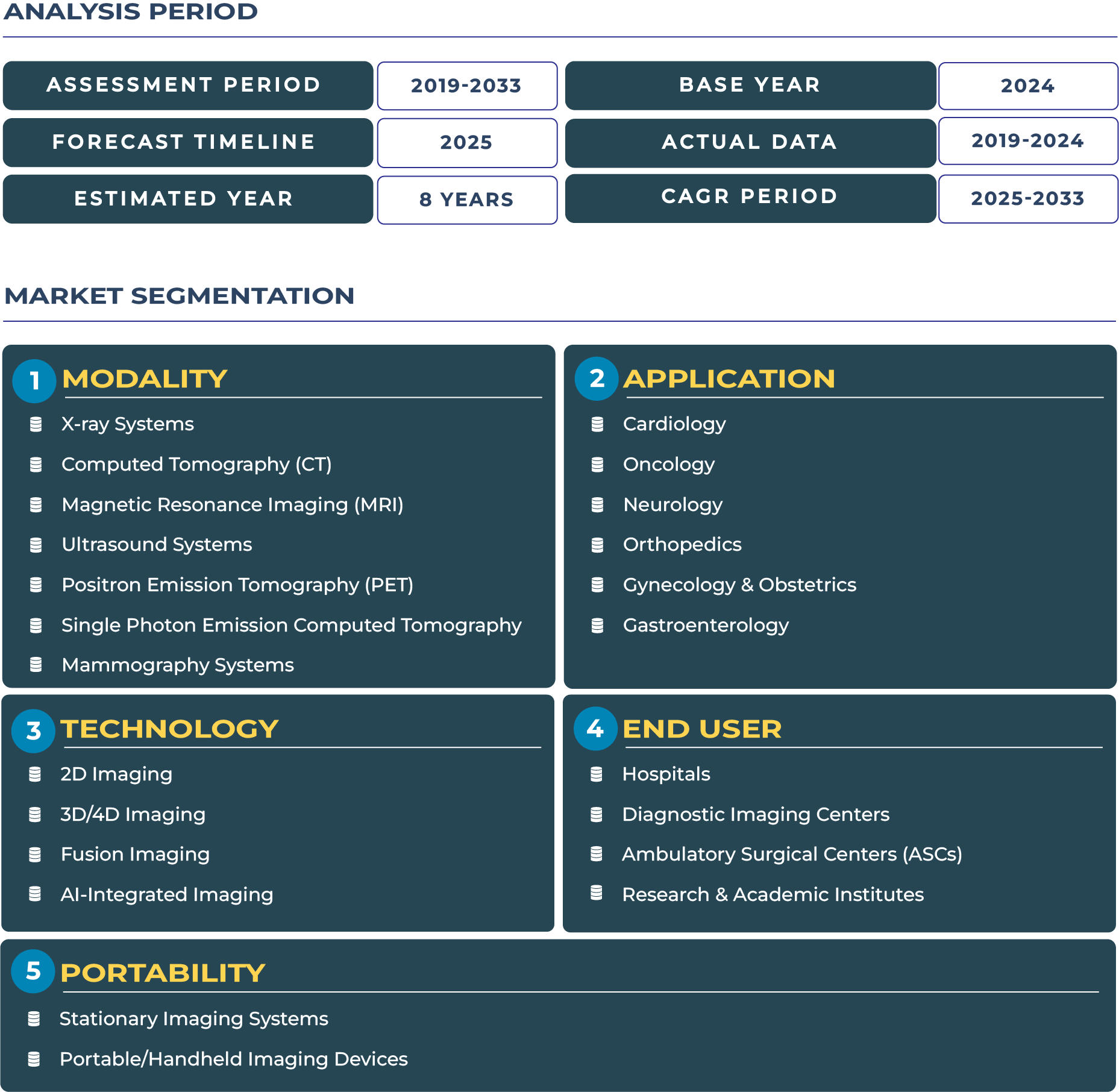
Spain Diagnostic Imaging Devices Market Segmentation
Frequently Asked Questions
Spain diagnostic imaging-device ecosystem is increasingly integrated with home-grown AI start-ups, which supply image-analysis algorithms and cloud-enabled workflow modules. Radiology departments are adopting these innovations to enhance modality output, and device manufacturers partner with these start-ups to bundle hardware with software solutions, accelerating device adoption across the sector.
Collaborations between device OEMs, healthcare IT vendors and regional diagnostic networks are foundational to Spain’s cloud imaging rollout. These partnerships enable radiology departments to link imaging hardware to centralized cloud platforms for image storage, sharing and AI-based interpretation, enhancing diagnostic efficiency and supporting remote care across autonomous regions.
Spanish hospitals and outpatient imaging centres are deploying cloud-native systems that integrate with modalities like CT, MRI and ultrasound to enable streamlined image acquisition, storage and AI-assisted interpretation. These deployments improve turnaround times, facilitate multi-centre collaboration and support the shift to outpatient and mobile imaging services, optimising the diagnostic imaging devices ecosystem across Spain.
Related Reports

Kenya SaaS Market Size | 2019-2034
- Report ID: IT1871 | Coverage: Country |
- Category: Information Technology | Sub-Category: Cloud Computing Technology |
- Published Date: Dec 2025 | US$495 |
Philippines Investment Banking Market Size | 2019-2033
- Report ID: BAF863 | Coverage: Country |
- Category: Banking and Finance | Sub-Category: Banking Services |
- Published Date: Oct 2025 | US$495 |
Oman Rural Banking Market Size | 2019-2033
- Report ID: BAF963 | Coverage: Country |
- Category: Banking and Finance | Sub-Category: Banking Services |
- Published Date: Oct 2025 | US$495 |
Brazil Diagnostic Imaging Devices Market Size | 2019-2033
- Report ID: HEA349 | Coverage: Country |
- Category: Healthcare | Sub-Category: Medical Devices |
- Published Date: Nov 2025 | US$495 |
BRICS AI Image Recognition Market Size | 2019-2033
- Report ID: IT1982 | Coverage: Regional |
- Category: Information Technology | Sub-Category: Artificial Intelligence |
- Published Date: Dec 2025 | US$1,345 |
Oman Diagnostic and Monitoring Devices Market Size | 2019-2033
- Report ID: HEA418 | Coverage: Country |
- Category: Healthcare | Sub-Category: Medical Devices |
- Published Date: Dec 2025 | US$495 |
Kenya SaaS Market Size | 2019-2034
- Report ID: IT1871 | Coverage:Country |
- Category:Information Technology | Sub-Category: Cloud Computing Technology |
- Published Date: Dec 2025 |US$495 |
Philippines Investment Banking Market Size | 2019-2033
- Report ID: BAF863 | Coverage:Country |
- Category:Banking and Finance | Sub-Category: Banking Services |
- Published Date: Oct 2025 |US$495 |
Oman Rural Banking Market Size | 2019-2033
- Report ID: BAF963 | Coverage:Country |
- Category:Banking and Finance | Sub-Category: Banking Services |
- Published Date: Oct 2025 |US$495 |
Brazil Diagnostic Imaging Devices Market Size | 2019-2033
- Report ID: HEA349 | Coverage:Country |
- Category:Healthcare | Sub-Category: Medical Devices |
- Published Date: Nov 2025 |US$495 |
BRICS AI Image Recognition Market Size | 2019-2033
- Report ID: IT1982 | Coverage:Regional |
- Category:Information Technology | Sub-Category: Artificial Intelligence |
- Publishing Soon |US$1,345 |
Oman Diagnostic and Monitoring Devices Market Size | 2019-2033
- Report ID: HEA418 | Coverage:Country |
- Category:Healthcare | Sub-Category: Medical Devices |
- Publishing Soon |US$495 |
Why Choose Us

24/5 Research Support
Get your queries resolved prior to and post purchasing research study

Customize As Per Specific Requirements
Get in-depth analysis based on your tailored research needs

Expertise in Tracking Niche Markets
Comprehensive view of latest technologies and opportunities across markets

360-Degree Analysis
Fact-based insights derived through supply & demand side analysis

Assured Quality
Deliver most accurate industry insights to maintain research quality

Information Security
Your confidential and personal data is secure and safe