
US Diagnostic Imaging Devices Market Size and Forecast by Modality, Application, Technology, End User, and Portability: 2019-2033
Oct 2025
| Format:

 |
Pages: 110+
|
Type: Sub-Industry Report
|
Authors:
Mahesh Y
(Assistant Research Manager)
|
Pages: 110+
|
Type: Sub-Industry Report
|
Authors:
Mahesh Y
(Assistant Research Manager)
MARKET OUTLOOK
AI and Precision Imaging Leadership: The Future Blueprint of the US Diagnostic Imaging Devices Market
The United States continues to lead the global diagnostic imaging devices market, backed by rapid integration of artificial intelligence, radiomics, and digital workflow automation. As the country sets benchmarks in precision imaging, the emphasis is shifting from hardware innovation to intelligent diagnostics that improve clinical outcomes and operational efficiency. In 2025, the US diagnostic imaging devices market is valued at USD 9.99 billion and is projected to reach USD 12.51 billion by 2033, expanding at a steady CAGR of 2.8%. This growth trajectory is anchored by technological leadership, strong healthcare infrastructure, and favorable reimbursement frameworks that support the adoption of advanced imaging modalities such as MRI, CT, PET, and ultrasound systems.
US Diagnostic Imaging Devices Market Outlook: A Transformation Rooted in Radiomics and Regulatory Evolution
The US diagnostic imaging devices market expansion is shaped by converging forces of digitization, clinical demand, and regulatory maturity. Hospitals and diagnostic centers are increasingly deploying AI-assisted MRI and CT systems for faster interpretation and predictive analytics. The US Food & Drug Administration (FDA) has accelerated approvals for software-based diagnostic support tools, ensuring safe commercialization of machine learning–enabled applications. Despite macroeconomic headwinds and inflationary pressures affecting hospital procurement cycles, the market remains resilient due to capital modernization projects and replacement of aging imaging fleets. Furthermore, initiatives such as the Centers for Medicare & Medicaid Services (CMS) reimbursement updates are creating consistent revenue visibility for device manufacturers and service providers. The combination of policy alignment, R&D leadership, and robust public-private collaboration defines the US as a central hub for imaging innovation.
Drivers & Restraints: Policy Support and Procurement Challenges Shaping Market Performance
Medicare Reforms and Hospital Network Consolidation Strengthening Equipment Uptake
One of the key drivers of the US diagnostic imaging devices industry is the reinforcement of reimbursement frameworks that promote faster adoption of AI-augmented diagnostics. The Medicare and private payer systems have evolved to reward precision imaging that reduces unnecessary procedures, incentivizing investments in advanced CT and MRI systems. Large private hospital networks are leveraging group purchasing organizations (GPOs) to streamline bulk procurements and drive economies of scale. These enterprise-level acquisitions enable consistent integration of cloud-based imaging software, improving cross-departmental interoperability and long-term cost efficiency.
Capital Procurement Delays and Regulatory Complexity Hindering Market Acceleration
Despite technological momentum, several structural barriers temper growth. Complex FDA 510(k) and De Novo approval processes often delay time-to-market for next-generation imaging tools, especially those incorporating deep learning components. Additionally, hospital procurement cycles are tightly bound to fiscal-year capital budgets, creating timing inconsistencies for OEMs. This challenge is compounded by price-sensitive mid-sized hospitals that prefer leasing or deferred purchasing models, particularly for high-cost modalities like PET/CT scanners. Nonetheless, service-based business models and vendor financing options are emerging as mitigators, helping to sustain steady unit sales even under constrained budgets.
Trends & Opportunities: From Subscription Models to Low-Dose Imaging Protocols
Shift Toward Enterprise Contracts and Outpatient Imaging Expansion
The US diagnostic imaging devices ecosystem is witnessing a decisive shift toward subscription-driven and service-based revenue models. Health systems are increasingly entering multi-year enterprise contracts for bundled hardware, software, and analytics support. This approach not only guarantees predictable costs but also ensures timely system upgrades aligned with radiology department needs. Additionally, the rise of outpatient imaging centers across metropolitan areas such as Los Angeles, Chicago, and Dallas is reshaping demand for compact and energy-efficient imaging systems. These facilities focus on rapid throughput and patient convenience, driving demand for portable ultrasound and low-dose CT scanners.
Emerging Opportunities in AI-Powered Triage and Emergency Imaging
Major opportunities lie in developing AI-enabled imaging triage solutions that assist clinicians in emergency departments and trauma units. Early adoption of these tools is already evident in US academic hospitals and tertiary centers. Vendors are exploring integrated platforms that combine imaging hardware with predictive analytics to identify stroke, cardiac, or oncology-related anomalies within seconds. These advancements not only optimize clinical workflows but also align with nationwide efforts to reduce patient wait times and enhance diagnostic accuracy. The ongoing expansion of precision imaging services within community and rural hospitals further opens a significant opportunity for market penetration.
Competitive Landscape: Strategic Partnerships and Value-Based Imaging Transformations
The competitive landscape in the US diagnostic imaging devices sector is characterized by active consolidation and technology-driven alliances. Key players such as GE HealthCare, Siemens Healthineers, and Philips are focusing on scalable service models that integrate hardware with analytics-driven platforms. In September 2025, Southlake Health partnered with Philips to deploy AI-enabled MRI systems designed to boost patient throughput and minimize scan times. Similarly, in early 2025, RadNet expanded its AI ecosystem through the acquisition of See-Mode, enhancing its ultrasound and breast imaging capabilities. These developments underscore a broader strategic pivot toward ecosystem-based competitiveness, where value creation stems from interoperability, predictive analytics, and cloud-driven service continuity. US-based companies are increasingly differentiating themselves through sustainability initiatives, focusing on energy-efficient imaging suites and recyclable component materials.
*Research Methodology: This report is based on DataCube’s proprietary 3-stage forecasting model, combining primary research, secondary data triangulation, and expert validation.
[Learn more]
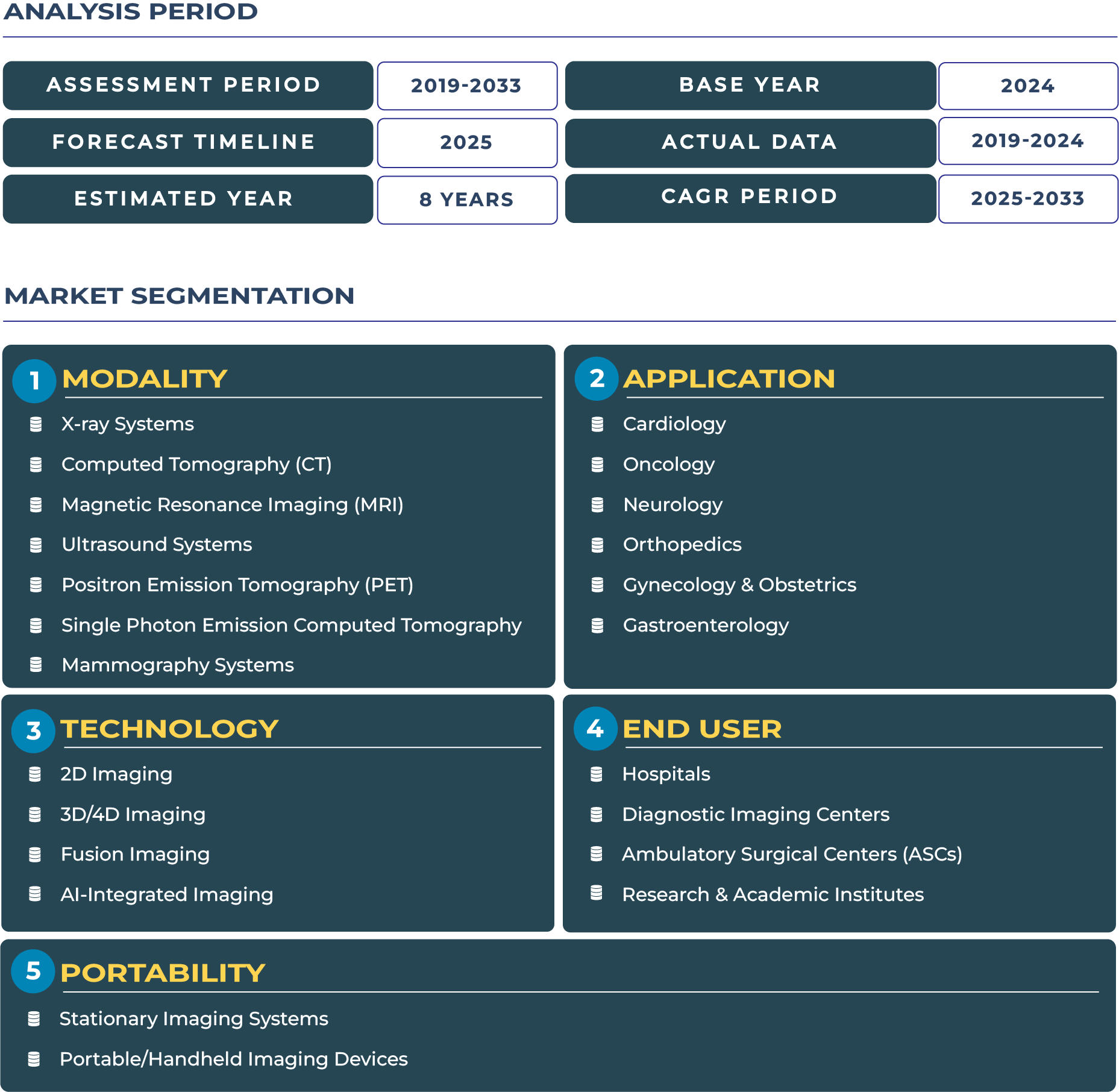
US Diagnostic Imaging Devices Market Segmentation
Frequently Asked Questions
The US leads through AI-integrated MRI, low-dose CT, and cloud-based imaging systems that deliver faster, more accurate diagnoses while enabling scalable interoperability across hospitals.
Accelerated 510(k) and De Novo clearances are supporting faster rollout of digital diagnostics and clinical software tools, encouraging OEMs to invest heavily in regulatory-aligned innovation pipelines.
AI-enabled imaging systems reduce reading times, enhance diagnostic precision, and improve resource utilization, addressing the chronic radiologist shortage across both urban and rural settings.
Related Reports

Oman SaaS Market Size | 2019-2034
- Report ID: IT1865 | Coverage: Country |
- Category: Information Technology | Sub-Category: Cloud Computing Technology |
- Published Date: Dec 2025 | US$495 |
South Korea Investment Banking Market Size | 2019-2033
- Report ID: BAF854 | Coverage: Country |
- Category: Banking and Finance | Sub-Category: Banking Services |
- Published Date: Oct 2025 | US$495 |
Thailand Private Banking Market Size | 2019-2033
- Report ID: BAF954 | Coverage: Country |
- Category: Banking and Finance | Sub-Category: Banking Services |
- Published Date: Oct 2025 | US$495 |
Malaysia Diagnostic Imaging Devices Market Size | 2019-2033
- Report ID: HEA340 | Coverage: Country |
- Category: Healthcare | Sub-Category: Medical Devices |
- Published Date: Nov 2025 | US$495 |
Zimbabwe AI Machine Learning Market Size | 2019-2033
- Report ID: IT1967 | Coverage: Country |
- Category: Information Technology | Sub-Category: Artificial Intelligence |
- Published Date: Dec 2025 | US$495 |
Argentina Diagnostic and Monitoring Devices Market Size | 2019-2033
- Report ID: HEA408 | Coverage: Country |
- Category: Healthcare | Sub-Category: Medical Devices |
- Published Date: Dec 2025 | US$495 |
Oman SaaS Market Size | 2019-2034
- Report ID: IT1865 | Coverage:Country |
- Category:Information Technology | Sub-Category: Cloud Computing Technology |
- Published Date: Dec 2025 |US$495 |
South Korea Investment Banking Market Size | 2019-2033
- Report ID: BAF854 | Coverage:Country |
- Category:Banking and Finance | Sub-Category: Banking Services |
- Published Date: Oct 2025 |US$495 |
Thailand Private Banking Market Size | 2019-2033
- Report ID: BAF954 | Coverage:Country |
- Category:Banking and Finance | Sub-Category: Banking Services |
- Published Date: Oct 2025 |US$495 |
Malaysia Diagnostic Imaging Devices Market Size | 2019-2033
- Report ID: HEA340 | Coverage:Country |
- Category:Healthcare | Sub-Category: Medical Devices |
- Published Date: Nov 2025 |US$495 |
Zimbabwe AI Machine Learning Market Size | 2019-2033
- Report ID: IT1967 | Coverage:Country |
- Category:Information Technology | Sub-Category: Artificial Intelligence |
- Publishing Soon |US$495 |
Argentina Diagnostic and Monitoring Devices Market Size | 2019-2033
- Report ID: HEA408 | Coverage:Country |
- Category:Healthcare | Sub-Category: Medical Devices |
- Publishing Soon |US$495 |
Why Choose Us

24/5 Research Support
Get your queries resolved prior to and post purchasing research study

Customize As Per Specific Requirements
Get in-depth analysis based on your tailored research needs

Expertise in Tracking Niche Markets
Comprehensive view of latest technologies and opportunities across markets

360-Degree Analysis
Fact-based insights derived through supply & demand side analysis

Assured Quality
Deliver most accurate industry insights to maintain research quality

Information Security
Your confidential and personal data is secure and safe