
Zimbabwe In-vitro Diagnostic Market Size and Forecast by Product Type, Technology, Application, Disease Type, End User, and Distribution Channel: 2019-2033
Oct 2025
| Format:

 |
Pages: 110+
|
Type: Sub-Industry Report
|
Authors:
Mahesh Y
(Assistant Research Manager)
|
Pages: 110+
|
Type: Sub-Industry Report
|
Authors:
Mahesh Y
(Assistant Research Manager)
MARKET OUTLOOK
Zimbabwe’s Resource Challenges Fuel a Reform-Focused In-vitro Diagnostic Transformation
Zimbabwe’s healthcare system, long constrained by economic volatility and limited medical resources, is undergoing gradual reform that is unlocking potential within the in-vitro diagnostic (IVD) market. Despite persistent macroeconomic pressures and constrained healthcare funding, the country’s commitment to health sector revitalization is gradually translating into tangible improvements in diagnostic capacity. While the healthcare infrastructure has traditionally lagged behind regional peers, growing partnerships with donor agencies, NGOs, and private medical investors are fostering access to critical diagnostic technologies and services. These collaborations are increasingly bridging the affordability gap in diagnostic testing across urban and semi-urban areas.
The Zimbabwe In-vitro Diagnostic Market is estimated at USD 18.9 million in 2025 and project
Market Drivers and Restraints Shaping Zimbabwe Diagnostic Evolution
Emerging Drivers: Private Investor Interest and Donor Interventions Catalyzing Market Growth
One of the key driving forces in the Zimbabwe in-vitro diagnostic landscape is the rising involvement of private investors and NGOs seeking to modernize healthcare delivery. The growth of private diagnostic laboratories in cities such as Harare and Bulawayo reflects increasing diaspora investment in healthcare ventures. Many of these facilities source reagents and software from global leaders such as Roche Diagnostics, ensuring access to reliable testing for conditions like HIV, tuberculosis, and malaria. Donor-funded initiatives supported by international organizations are also boosting testing capacities through equipment donations and staff training programs.
The influx of aid programs led by global health institutions and non-profit organizations has particularly strengthened the reagent and software sub-segments of the market. This momentum is further reinforced by the Zimbabwean government’s ongoing healthcare reform agenda under the Ministry of Health and Child Care, which aims to enhance access to affordable diagnostics through public-private collaboration. Collectively, these factors underscore the market’s gradual but steady expansion, emphasizing the role of external funding and private innovation in stabilizing the nation’s diagnostic ecosystem.
Prevailing Restraints: Economic Volatility and Limited Procurement Capacity Constraining Progress
Conversely, Zimbabwe in-vitro diagnostic sector continues to grapple with persistent structural challenges. Macroeconomic instability—characterized by currency depreciation, high inflation, and inconsistent procurement cycles—has hampered the sustainable acquisition of medical equipment and reagents. The public health system’s dependence on foreign currency for imports further exacerbates the affordability gap, creating disparities between urban and rural healthcare access. Additionally, domestic healthcare budgets remain under pressure, limiting the government’s ability to subsidize diagnostic innovations.
Infrastructure constraints, such as unreliable power supply and limited cold chain capacity, present additional barriers to consistent diagnostic testing, particularly in rural facilities. Workforce shortages, especially in biomedical engineering and laboratory sciences, compound these operational challenges. These factors collectively hinder long-term scalability, despite Zimbabwe’s efforts to attract international collaboration. Strengthening fiscal stability and regulatory transparency will therefore be pivotal in enabling broader adoption of diagnostic technologies across the country.
Emerging Trends and Strategic Opportunities in Zimbabwe In-vitro Diagnostic Industry
Key Trends: Diaspora-Driven Clinics and Donor-Led Laboratory Modernization
Recent years have witnessed a growing wave of diaspora-driven healthcare projects, with Zimbabwean professionals abroad channeling capital into private diagnostic and treatment facilities. This trend is particularly visible in Harare, where several newly established laboratories are utilizing cloud-based diagnostic management software and reagent automation systems. Donor-led programs—particularly those in collaboration with the World Health Organization (WHO)—are facilitating equipment standardization and laboratory quality assurance across public institutions.
Furthermore, the rise of digital diagnostic platforms has enabled remote analysis, reducing turnaround times for test results. This aligns with global healthcare digitization trends, allowing Zimbabwe diagnostic ecosystem to integrate with regional telehealth frameworks. Donor-funded modernization initiatives are not only expanding access but also improving laboratory accuracy, creating a foundation for sustainable diagnostic quality assurance programs.
Growth Opportunities: Donor-Funded Pilots and Diaspora Investment Partnerships
Amid economic headwinds, Zimbabwe in-vitro diagnostic market still presents several untapped opportunities. Donor-funded pilot programs focused on maternal health, HIV management, and tuberculosis screening have created consistent demand for reagents and rapid testing kits. These pilots serve as proving grounds for scalability and technology adoption across the public sector. Similarly, partnerships between diaspora investors and local healthcare entrepreneurs are creating hybrid business models that combine international technology access with localized service delivery.
The increasing push toward low-cost, high-efficiency diagnostic solutions opens the door for companies to introduce innovative reagent lines and point-of-care testing devices. Moreover, emerging opportunities lie in the localization of reagent packaging and software servicing—helping reduce import dependence and create skilled employment in laboratory support functions. Such localized initiatives are expected to transform Zimbabwe IVD ecosystem into a more resilient and self-sustaining healthcare segment.
Competitive Landscape: Global Expertise and Local Collaboration Reshaping Zimbabwe’s Diagnostic Path
The Zimbabwe in-vitro diagnostic industry features a mix of international players and local distributors operating under constrained but improving market conditions. Global companies like Roche, Abbott, and Siemens Healthineers continue to dominate through strategic partnerships with donor-funded laboratories and private hospitals. Their focus on reagent standardization and instrument reliability remains essential to diagnostic accuracy in local health centers.
On the domestic front, local distributors and private clinics are increasingly collaborating with government bodies under the Ministry of Health and Child Care to align testing protocols with global standards. These collaborations are improving reagent supply stability and fostering the development of diagnostic services tailored to Zimbabwe’s healthcare priorities. The strategic combination of donor engagement, diaspora funding, and private innovation is thus positioning Zimbabwe as a reform-driven, opportunity-rich market within Southern Africa’s diagnostic landscape.
*Research Methodology: This report is based on DataCube’s proprietary 3-stage forecasting model, combining primary research, secondary data triangulation, and expert validation.
[Learn more]
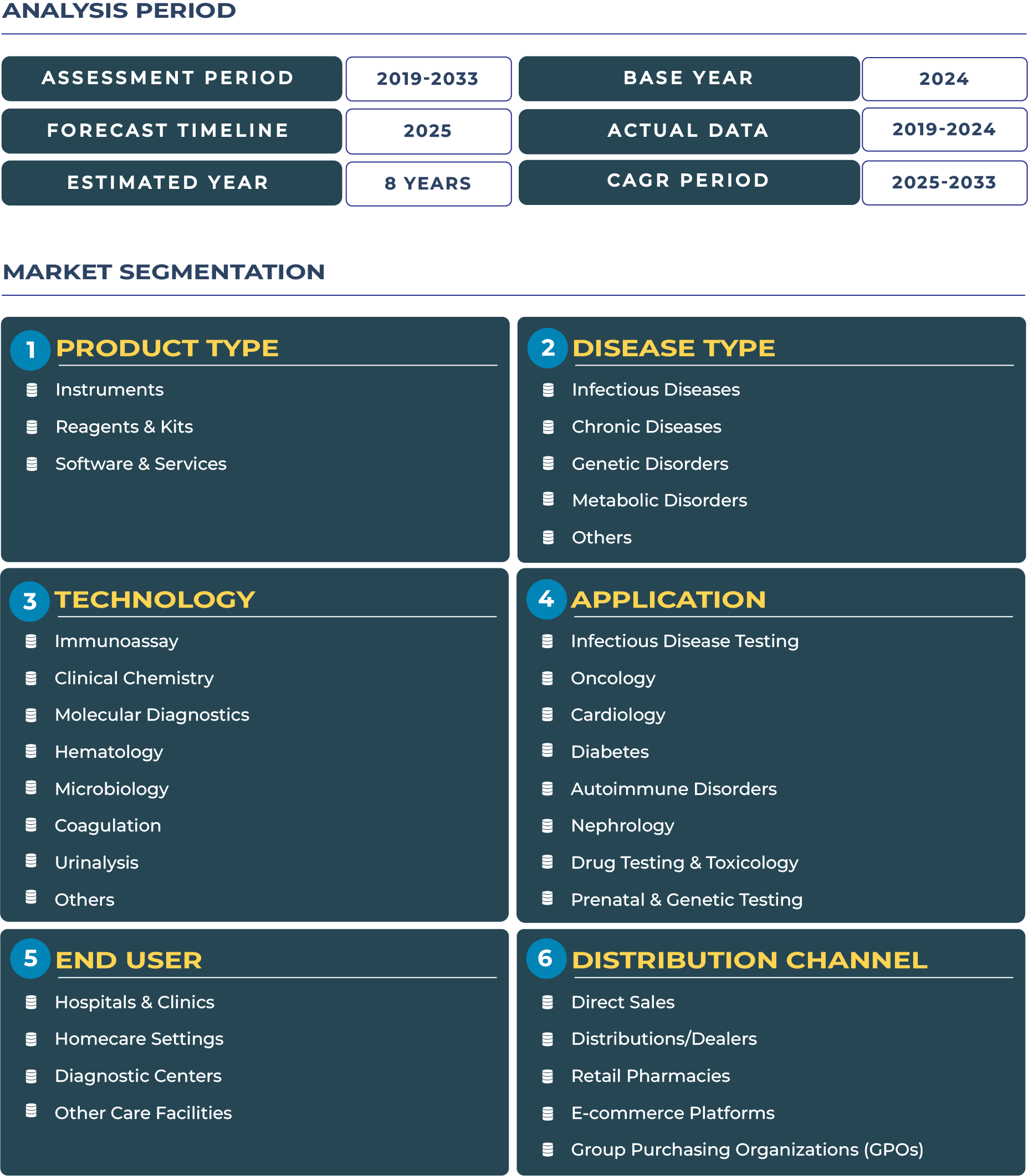
Zimbabwe In-vitro Diagnostic Market Segmentation
Frequently Asked Questions
Healthcare reforms are fostering regulatory clarity and donor collaboration, enabling diagnostic accessibility while promoting gradual modernization across public and private laboratories.
Supply chains face major hurdles from macroeconomic instability, foreign currency shortages, and limited cold chain logistics, which collectively slow down medical imports and distribution efficiency.
NGOs are deploying donor-funded pilot programs, training health workers, and financing diagnostic infrastructure, creating scalable models for affordable and accessible orthopedic and diagnostic care.
Related Reports

Hong Kong Private Banking Market Size | 2019-2033
- Report ID: BAF930 | Coverage: Country |
- Category: Banking and Finance | Sub-Category: Banking Services |
- Published Date: Oct 2025 | US$495 |
South Korea Diagnostic Imaging Devices Market Size | 2019-2033
- Report ID: HEA337 | Coverage: Country |
- Category: Healthcare | Sub-Category: Medical Devices |
- Published Date: Nov 2025 | US$495 |
Hong Kong Private Banking Market Size | 2019-2033
- Report ID: BAF930 | Coverage:Country |
- Category:Banking and Finance | Sub-Category: Banking Services |
- Published Date: Oct 2025 |US$495 |
South Korea Diagnostic Imaging Devices Market Size | 2019-2033
- Report ID: HEA337 | Coverage:Country |
- Category:Healthcare | Sub-Category: Medical Devices |
- Published Date: Nov 2025 |US$495 |
Why Choose Us

24/5 Research Support
Get your queries resolved prior to and post purchasing research study

Customize As Per Specific Requirements
Get in-depth analysis based on your tailored research needs

Expertise in Tracking Niche Markets
Comprehensive view of latest technologies and opportunities across markets

360-Degree Analysis
Fact-based insights derived through supply & demand side analysis

Assured Quality
Deliver most accurate industry insights to maintain research quality

Information Security
Your confidential and personal data is secure and safe