
Europe Diagnostic Imaging Devices Market Size and Forecast by Modality, Application, Technology, End User, and Portability: 2019-2033
Oct 2025
| Format:

 |
Pages: 160+
|
Type: Sub-Industry Report
|
Authors:
Mahesh Y
(Assistant Research Manager)
|
Pages: 160+
|
Type: Sub-Industry Report
|
Authors:
Mahesh Y
(Assistant Research Manager)
MARKET OUTLOOK
Europe Diagnostic Imaging Devices Market Outlook: Balancing Innovation and Regulatory Harmony
Europe diagnostic imaging devices landscape stands at the intersection of innovation and regulation, where technological advancement meets the region’s unwavering commitment to patient safety and ethical standards. The implementation of the EU Medical Device Regulation (MDR) and the forthcoming AI Act underscores a broader regional intent: to establish a framework that balances rapid innovation with clinical responsibility. As hospitals and imaging centers embrace digital transformation, Europe Diagnostic Imaging Devices Market is forecasted to grow from USD 11.7 billion in 2025 to USD 15.9 billion by 2033, registering a CAGR of 3.9%. This momentum is driven by rising healthcare digitalization, public-private collaborations, and the increasing integration of artificial intelligence (AI) in imaging diagnostics.
Harmonizing Innovation with Compliance in the European Diagnostic Imaging Landscape
The diagnostic imaging ecosystem across Europe is evolving into a digitally enabled, AI-assisted domain that prioritizes interoperability and clinical precision. The regional market expansion is underpinned by pan-European healthcare initiatives such as the European Health Data Space, which supports data sharing for research and imaging analytics. Meanwhile, AI-powered MRI and low-dose CT systems are redefining diagnostic accuracy and patient safety. Despite economic headwinds, including inflationary pressures on medical device procurement and geopolitical disruptions in Eastern Europe, the demand for connected imaging infrastructure remains resilient. Hospitals and diagnostic centers are modernizing equipment fleets to meet both MDR certification standards and sustainability goals. This transition toward AI-integrated and eco-efficient imaging solutions will reinforce Europe’s leadership in precision diagnostics over the next decade.
Drivers & Restraints: Balancing Digital Acceleration with Regulatory Complexity
EU-Wide Digital Health Funding Catalyzes Imaging Modernization
Europe’s commitment to healthcare digitization serves as a powerful market catalyst. The European Commission’s cross-border eHealth projects and digital infrastructure grants have accelerated the adoption of interoperable imaging platforms across hospitals and research institutions. Strong collaborations between academic research hubs and medical device companies have accelerated the commercialization of advanced modalities such as PET-CT and AI-driven ultrasound systems. The growing integration of cloud-based picture archiving and communication systems (PACS) also enhances accessibility and diagnostic efficiency, especially in underserved regions of Eastern Europe.
Fragmented Reimbursement and Rising Compliance Costs Challenge Market Cohesion
Despite technological progress, the market faces challenges arising from fragmented reimbursement systems across EU member states. Disparities in healthcare financing and procurement models complicate vendor strategies and slow product adoption in smaller economies. Moreover, compliance costs linked to the MDR framework have increased certification timelines and administrative burdens, especially for SMEs. These challenges create a dual-speed market dynamic, where Western Europe leads in digital maturity while parts of Eastern Europe struggle with regulatory and financial constraints. The resulting market heterogeneity underscores the need for harmonized policy frameworks that sustain innovation without stifling competition.
Trends & Opportunities: AI Integration and Sustainable Imaging Technologies Define the Next Wave
Interoperable Imaging Ecosystems and Cloud PACS Dominate Emerging Trends
Healthcare providers across Europe are investing in interoperable imaging IT infrastructures to facilitate real-time diagnostics and remote collaborations. Cloud-based PACS and vendor-neutral archives (VNAs) are enabling radiologists to access imaging data seamlessly across institutions. Furthermore, hybrid modalities like PET/MRI are gaining traction due to their superior clinical accuracy and reduced radiation exposure. These innovations, coupled with AI algorithms that assist in image segmentation and anomaly detection, are transforming the role of radiologists from image readers to clinical decision enablers.
Emerging Opportunities in CE-Compliant AI Imaging and Nationalized Go-To-Market Strategies
Vendors are increasingly developing CE-certified AI solutions that comply with MDR and upcoming AI Act guidelines. This regulatory clarity encourages investments in explainable AI and algorithmic transparency, both crucial for clinical trust. Another emerging opportunity lies in tailoring market entry strategies by country, reflecting reimbursement variances and procurement norms. Nations such as France and Germany are advancing value-based healthcare models that reward diagnostic accuracy and operational efficiency. Strategic partnerships with public hospitals and academic institutions provide device manufacturers with an edge in navigating Europe’s evolving diagnostic landscape.
Regional Analysis by Country
Western Europe
- Western Europe dominates the region’s diagnostic imaging landscape, supported by robust healthcare infrastructure and high per-capita imaging utilization. Countries like Germany, France, and the UK lead the adoption of advanced MRI and AI-integrated imaging systems. Government-backed digital health programs and collaborations between research consortia and medtech firms are propelling technological advancements. The region’s commitment to sustainability also encourages eco-friendly imaging device designs and circular economy initiatives.
Eastern Europe
- Eastern Europe presents an emerging growth frontier, with countries like Poland and the Czech Republic investing heavily in modernizing diagnostic imaging infrastructure. EU structural funds and cross-border healthcare projects are enhancing access to advanced modalities. However, challenges remain in reimbursement standardization and compliance alignment with MDR certification. This subregion’s evolution will rely on targeted policy reforms and technology partnerships with established Western European firms.
Competitive Landscape: Localized Market Strategies and Technological Collaborations Reshape Europe’s Imaging Industry
The competitive landscape in Europe’s diagnostic imaging devices industry is defined by technological innovation, localization, and compliance-led product differentiation. Companies such as Philips and Siemens Healthineers are at the forefront of AI-integrated imaging systems and digital workflow automation. In February 2025, Philips advanced its imaging solutions with remote scanning capabilities across Europe, allowing expert radiologists to assist and control scans remotely, expanding access to specialist diagnostics. Around the same period, DeepHealth unveiled its AI-based radiology informatics and population screening tools at ECR 2025, highlighting the increasing demand for workflow efficiency and data-driven screening.
These developments underscore a broader strategic pivot, vendors are customizing their product portfolios to match local compliance norms and hospital procurement cycles. By embedding AI-assisted reporting, low-dose imaging, and connected device ecosystems, companies aim to enhance clinical productivity while maintaining MDR compliance. The convergence of AI, interoperability, and sustainability is setting a new standard for Europe diagnostic imaging devices market, positioning it for steady and compliant growth through 2033.
*Research Methodology: This report is based on DataCube’s proprietary 3-stage forecasting model, combining primary research, secondary data triangulation, and expert validation.
[Learn more]
Europe Diagnostic Imaging Devices Market Segmentation
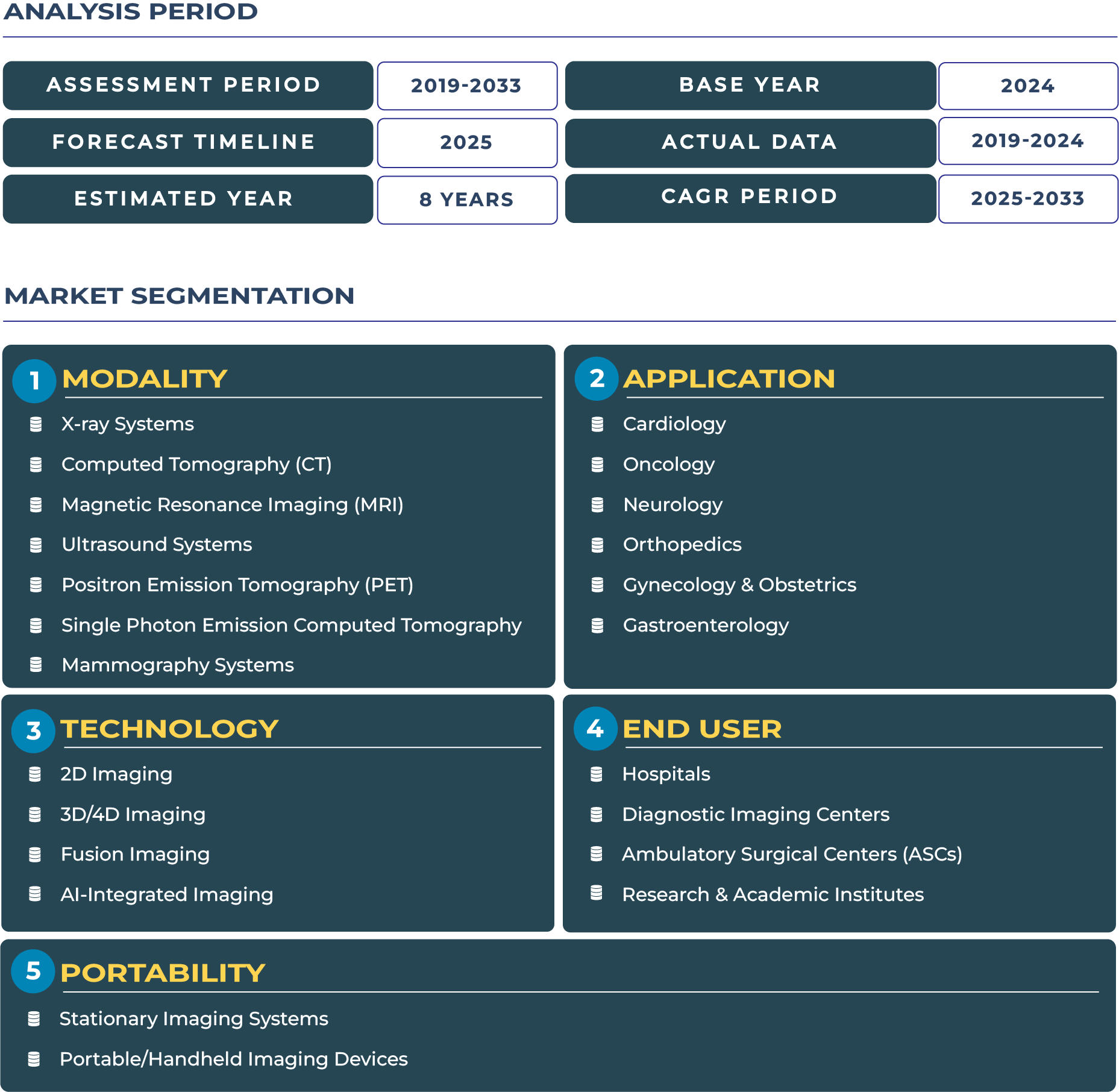
Europe Diagnostic Imaging Devices Market Countries Covered

Frequently Asked Questions
European imaging manufacturers are strengthening their compliance frameworks, focusing on transparency in AI algorithms and traceability in device certification, ensuring long-term regulatory alignment and patient safety.
AI-powered hybrid imaging, interoperable PACS platforms, and sustainable imaging technologies are driving modernization and improving diagnostic precision across healthcare networks.
Nations are investing in structured AI validation programs, harmonizing digital health standards, and incentivizing vendors to innovate within the guardrails of patient safety and ethical governance.
Related Reports

Eastern Europe PaaS Market Size | 2019-2033
- Report ID: IT1886 | Coverage: Regional |
- Category: Information Technology | Sub-Category: Cloud Computing Technology |
- Published Date: Dec 2025 | US$1,345 |
Malaysia Investment Banking Market Size | 2019-2033
- Report ID: BAF857 | Coverage: Country |
- Category: Banking and Finance | Sub-Category: Banking Services |
- Published Date: Oct 2025 | US$495 |
Taiwan Private Banking Market Size | 2019-2033
- Report ID: BAF957 | Coverage: Country |
- Category: Banking and Finance | Sub-Category: Banking Services |
- Published Date: Oct 2025 | US$495 |
Singapore Diagnostic Imaging Devices Market Size | 2019-2033
- Report ID: HEA343 | Coverage: Country |
- Category: Healthcare | Sub-Category: Medical Devices |
- Published Date: Nov 2025 | US$495 |
Bahrain AI Autonomous System Market Size | 2019-2033
- Report ID: IT1970 | Coverage: Country |
- Category: Information Technology | Sub-Category: Artificial Intelligence |
- Published Date: Dec 2025 | US$495 |
Peru Diagnostic and Monitoring Devices Market Size | 2019-2033
- Report ID: HEA411 | Coverage: Country |
- Category: Healthcare | Sub-Category: Medical Devices |
- Published Date: Dec 2025 | US$495 |
Eastern Europe PaaS Market Size | 2019-2033
- Report ID: IT1886 | Coverage:Regional |
- Category:Information Technology | Sub-Category: Cloud Computing Technology |
- Published Date: Dec 2025 |US$1,345 |
Malaysia Investment Banking Market Size | 2019-2033
- Report ID: BAF857 | Coverage:Country |
- Category:Banking and Finance | Sub-Category: Banking Services |
- Published Date: Oct 2025 |US$495 |
Taiwan Private Banking Market Size | 2019-2033
- Report ID: BAF957 | Coverage:Country |
- Category:Banking and Finance | Sub-Category: Banking Services |
- Published Date: Oct 2025 |US$495 |
Singapore Diagnostic Imaging Devices Market Size | 2019-2033
- Report ID: HEA343 | Coverage:Country |
- Category:Healthcare | Sub-Category: Medical Devices |
- Published Date: Nov 2025 |US$495 |
Bahrain AI Autonomous System Market Size | 2019-2033
- Report ID: IT1970 | Coverage:Country |
- Category:Information Technology | Sub-Category: Artificial Intelligence |
- Publishing Soon |US$495 |
Peru Diagnostic and Monitoring Devices Market Size | 2019-2033
- Report ID: HEA411 | Coverage:Country |
- Category:Healthcare | Sub-Category: Medical Devices |
- Publishing Soon |US$495 |
Why Choose Us

24/5 Research Support
Get your queries resolved prior to and post purchasing research study

Customize As Per Specific Requirements
Get in-depth analysis based on your tailored research needs

Expertise in Tracking Niche Markets
Comprehensive view of latest technologies and opportunities across markets

360-Degree Analysis
Fact-based insights derived through supply & demand side analysis

Assured Quality
Deliver most accurate industry insights to maintain research quality

Information Security
Your confidential and personal data is secure and safe