
Oman In-vitro Diagnostic Market Size and Forecast by Product Type, Technology, Application, Disease Type, End User, and Distribution Channel: 2019-2033
Oct 2025
| Format:

 |
Pages: 110+
|
Type: Sub-Industry Report
|
Authors:
Mahesh Y
(Assistant Research Manager)
|
Pages: 110+
|
Type: Sub-Industry Report
|
Authors:
Mahesh Y
(Assistant Research Manager)
MARKET OUTLOOK
Oman In-Vitro Diagnostic Market Outlook: Public Infrastructure Investment Lays the Groundwork for Diagnostic Growth
Oman’s government-led expansion of healthcare infrastructure is emerging as a key catalyst for its In-Vitro Diagnostic (IVD) market. With rising investments in hospital construction, regional medical centers, and diagnostic modernization, the demand for advanced lab systems, reagents, and diagnostic software is gaining momentum. The IVD market in Oman is estimated at approximately USD 53.4 million in 2025, and is expected to reach USD 79.0 million by 2033, implying a compound annual growth rate (CAGR) of about 5.0% over the forecast period. This growth reflects steady, foundational demand rather than rapid scale expansion.
The state’s allocation toward healthcare signifies clear strategic intent: to reduce import dependency, improve regional care access, and support diagnostic modernization. With the Ministry of Health Oman driving priorities around diagnostic capacity and public hospital upgrades across Muscat, Salalah, and interior provinces, the IVD ecosystem is being woven into Oman’s broader healthcare reforms. As chronic disease prevalence grows, demand for diagnostics in endocrinology, cardiology, and infectious disease will continue to underpin market expansion.
Drivers & Restraints: Sustained Public Funding Meets the Realities of a Small Market
Steady Public Investment and Provincial Upgrades Fuel Diagnostic Demand
A compelling driver for Oman IVD sector is the consistent public expenditure in regional hospital upgrades and diagnostic extension into under-served provinces. Projects in Dhofar, Al Batinah, and interior wilayat centers prioritize modern laboratory capabilities, transparency of lab operations, and pathogen surveillance. The small-sized national health system allows focused deployment of high-end instruments where capacity gaps exist. In parallel, the private sector remains nascent, but selective boutique clinics and medical tourism ambitions are beginning to attract advanced diagnostic partnerships.
Small Scale, Centralized Procurement, and Budget Constraints Limit Velocity
However, Oman’s diagnostic market faces structural challenges. The nation’s relatively small population restricts high test volume scale, reducing revenue potential for large instrument deployments. Procurement is tightly centralized via the Ministry of Health, which imposes long review cycles and standardization requirements that can deter niche product entrants. Private health investment remains limited compared to neighbors, restricting the breadth of diagnostic adoption. Additionally, competition for skilled clinical laboratory personnel presents ongoing challenges in sustaining advanced diagnostic units outside major urban centers.
Trends & Opportunities: Selective Modernization and Service-Driven Growth
Planned Hospital Upgrades and Selective Private Projects Steering Trend Lines
A clear trend in Oman’s IVD environment is the selective modernization of regional hospitals with targeted investments in molecular testing and rapid immunoassay systems. Instead of broad-scale lab proliferation, the Ministry is prioritizing centers of excellence in key governorates. Private sector projects, though limited, are emerging in Muscat and Salalah in diagnostic imaging and specialty surgery centers, often necessitating high-spec lab tie-ins. Telehealth expansion and remote sample collection models also present adjunct demand pathways, particularly for remote or rural catchment zones.
Opportunities in Pilot Programs, Leasing Models, and Regional Distribution Partnerships
Given capital constraints in smaller markets, one of the most viable opportunity paths is through pilot diagnostic programs in major hospitals, using leasing or reagent-rental models that reduce upfront investment burdens. International IVD firms may partner with local distributors to bundle service agreements, training, and maintenance. Oman also has geographic advantages as a potential distribution node connecting GCC and interior Yemen/Oman borders. Leveraging regional logistics and free zone frameworks can allow diagnostic firms to buffer inventory regionally and respond more quickly to demand.
Competitive Landscape: Partnering on Leasing and Local Capacity Building
The Oman IVD sector is currently dominated by international diagnostic vendors working through local medical device distributors. Key players in the region include Roche Diagnostics Diagnostics, Siemens Healthineers, Abbott, and Beckman Coulter, each supplying core instrumentation, reagent lines, and software solutions. These global firms often collaborate with Omani distributors to deploy leasing or managed service models for smaller hospitals. Training local diagnostic technologists via in-country academies helps align with Oman’s broader workforce localization goals. Competitive differentiation increasingly centers on after-sales support, reagent supply reliability, and modular software that can integrate into Oman’s nascent health information infrastructure.
*Research Methodology: This report is based on DataCube’s proprietary 3-stage forecasting model, combining primary research, secondary data triangulation, and expert validation.
[Learn more]
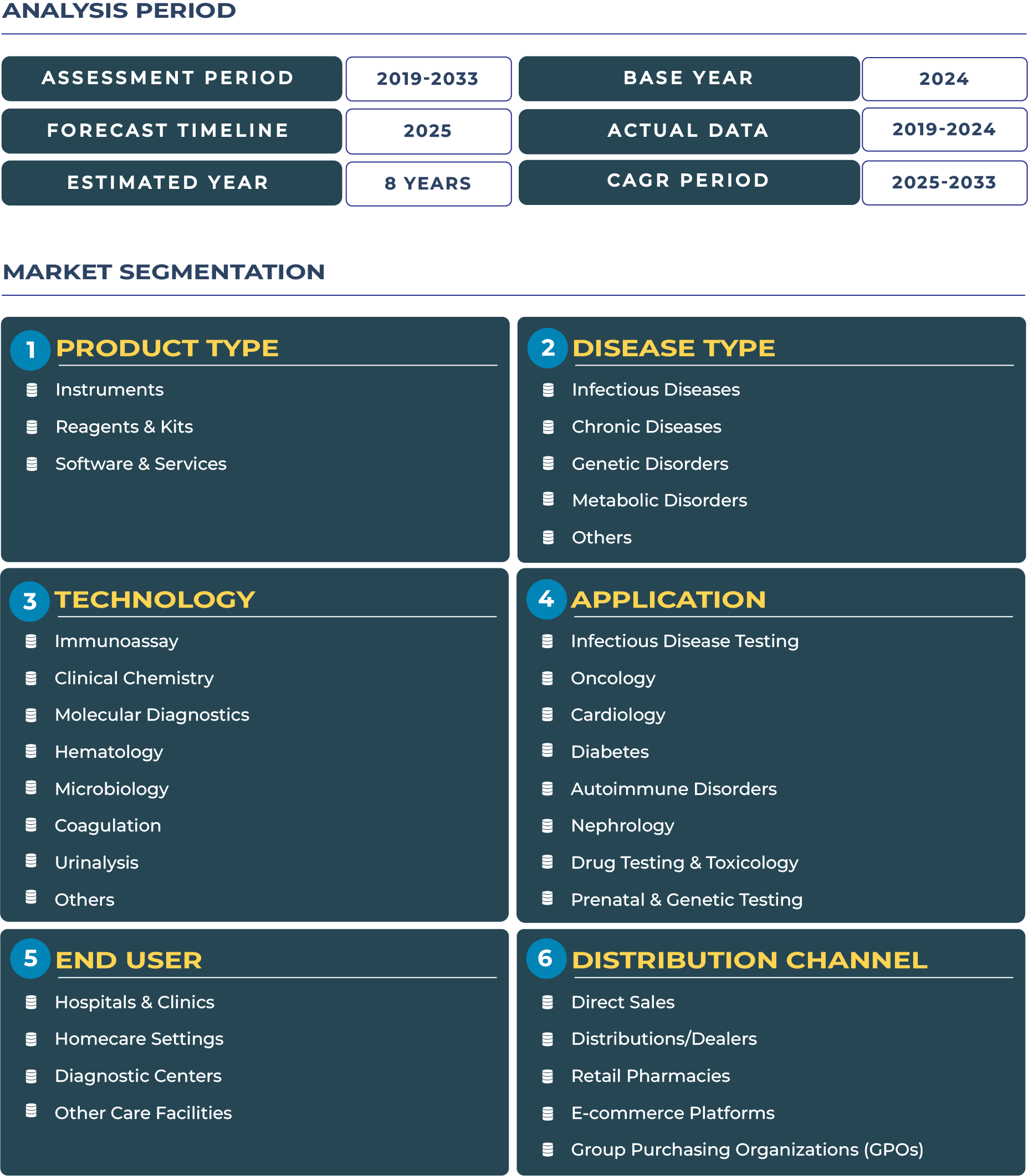
Oman In-vitro Diagnostic Market Segmentation
Frequently Asked Questions
Government investment in hospital and diagnostic infrastructure fosters demand for accurate preoperative diagnostics and implants. Strong labs and imaging services support orthopedic planning and outcomes.
In rural Oman, limited market size, sparse clinics, and centralized budgets constrain the spread of high-cost diagnostics and implants. Often, patients must travel to regional hubs for care.
Public hospitals act as anchor clients for IVD providers, driving instrument installations, reagent contracts, and lab network integration. They help define baseline technical standards and growth corridors.
Related Reports

Colombia SaaS Market Size | 2019-2034
- Report ID: IT1860 | Coverage: Country |
- Category: Information Technology | Sub-Category: Cloud Computing Technology |
- Published Date: Dec 2025 | US$495 |
India Private Banking Market Size | 2019-2033
- Report ID: BAF923 | Coverage: Country |
- Category: Banking and Finance | Sub-Category: Banking Services |
- Published Date: Oct 2025 | US$495 |
Israel Private Banking Market Size | 2019-2033
- Report ID: BAF984 | Coverage: Country |
- Category: Banking and Finance | Sub-Category: Banking Services |
- Published Date: Nov 2025 | US$495 |
ASEAN AI Service Robotics Market Size | 2019-2033
- Report ID: IT1943 | Coverage: Regional |
- Category: Information Technology | Sub-Category: Artificial Intelligence |
- Published Date: Dec 2025 | US$1,345 |
Colombia SaaS Market Size | 2019-2034
- Report ID: IT1860 | Coverage:Country |
- Category:Information Technology | Sub-Category: Cloud Computing Technology |
- Published Date: Dec 2025 |US$495 |
India Private Banking Market Size | 2019-2033
- Report ID: BAF923 | Coverage:Country |
- Category:Banking and Finance | Sub-Category: Banking Services |
- Published Date: Oct 2025 |US$495 |
Israel Private Banking Market Size | 2019-2033
- Report ID: BAF984 | Coverage:Country |
- Category:Banking and Finance | Sub-Category: Banking Services |
- Published Date: Nov 2025 |US$495 |
ASEAN AI Service Robotics Market Size | 2019-2033
- Report ID: IT1943 | Coverage:Regional |
- Category:Information Technology | Sub-Category: Artificial Intelligence |
- Publishing Soon |US$1,345 |
Why Choose Us

24/5 Research Support
Get your queries resolved prior to and post purchasing research study

Customize As Per Specific Requirements
Get in-depth analysis based on your tailored research needs

Expertise in Tracking Niche Markets
Comprehensive view of latest technologies and opportunities across markets

360-Degree Analysis
Fact-based insights derived through supply & demand side analysis

Assured Quality
Deliver most accurate industry insights to maintain research quality

Information Security
Your confidential and personal data is secure and safe